Rack density growth is outpacing the readiness of data center liquid cooling deployments. Getting ahead of it means evolving cooling infrastructure, aligning standards, and integrating power and cooling from the start.
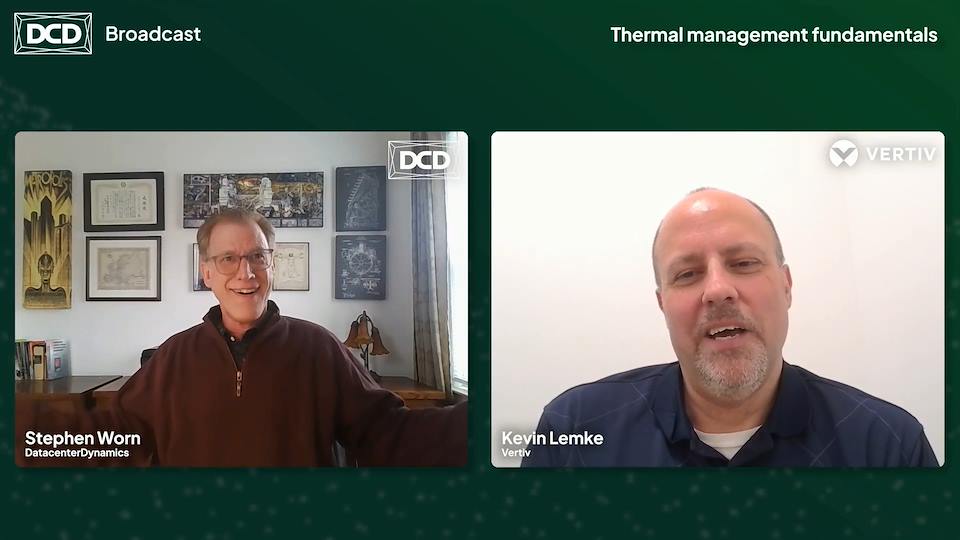
AI is driving rack density beyond 100 kilowatts (kW), demanding new thinking on how liquid cooling is built, powered, and serviced at every stage of deployment. In the second episode of Vertiv Cooling Innovation Day 2026, Kevin Lemke, Sr. Global Product Manager for Single Phase Liquid Cooling at Vertiv, joins Stephen Worn, CTO and Managing Director NAM at DatacenterDynamics (DCD), to discuss what that move demands in practice. From density growth to standards, power, risk, and lifecycle, they map out where liquid cooling stands and where it's headed.
Stephen Worn, CTO and Managing Director NAM at DatacenterDynamics (DCD): Rack density has jumped dramatically in a short time. Where are we now, and what does that demand from data center liquid cooling architectures?
Kevin Lemke, Sr. Global Product Manager for Single Phase Liquid Cooling at Vertiv:
Whenever we look at AI workloads and high-performance computing (HPC) environments, we’re always finding ourselves in either a proactive or reactive approach. In the air cooling world, we were previously looking at 3 kW up to 10 kW per rack. Right now we’re seeing the norm at 100-plus kW per rack, and we’re having discussions around 1 megawatts (MW) per rack in the future. To plan for all of those different scenarios, we’re going to have to move into larger building blocks to make these things happen from an efficiency standpoint. You have to size for a very dynamic load, and you need to be able to react within milliseconds to avoid overheating any of the chips from a server perspective.
Stephen: Liquid cooling has been without common testing standards for a long time. What’s changing, and why does it matter?
Kevin:
Air cooling has had standards for tests requiring certain points to be tested and certain points to be shown to customers, so you had a benchmark to compare against. Liquid cooling has not been that way. In the not-so-distant past, it’s been pretty much the wild west. Different coolant distribution units (CDUs) would have various rating points: one sized around a 4°C approach temperature difference, another around 8 or 10°C. So you could have what looks like the same box rated at 800 kW under one set of parameters and up to 2 MW under another. The standards coming into the industry are putting everybody on the same playing field so that customers can actually see they’re getting what they need for their deployments.
Stephen: How do you navigate the move from air cooling through hybrid architectures to full data center liquid cooling?
Kevin:
At Vertiv, we have a long-standing history from air cooling, and we don’t just stop with thermal solutions, we look at the power solutions as well. You cannot look at one single component and say it’s going to be good for the entire thermal chain or power train. Even in a liquid-cooled rack today, liquid cooling addresses about 70 to 80% of the cooling requirement, with 20 to 30% still handled by air-cooled solutions. But the trend we’re seeing is toward 100% liquid-cooled topology: not just liquid-cooled chips, but liquid-cooled power supplies and bus bars. We’re also seeing fluid velocity in stainless steel pipe going from 3 meters per second up to 6 meters per second as density grows, so the infrastructure has to be sized to provide that additional fluid capacity throughout the thermal chain.
Stephen: Power and cooling are increasingly linked at these densities. How do you approach that integration?
Kevin:
Liquid cooling is very critical, you cannot have it go down for liquid-cooled servers. As part of the overall solution, you have to look at how the cooling system is powered: is there a single power feed or two? Do you have a transfer switch? Do you put it on uninterruptible power supplies (UPSs)? Customers may not fully understand liquid cooling yet, so we raise things they should be thinking about, and that’s what makes us a trusted advisor. How does it work with the UPS, with rack power distribution, all the way through to the row manifolds and CDU? If there happens to be a failure, you also need to look at the blast radius, how many racks are affected.
Stephen: Concern about water in the data center has been a barrier to adoption for years. How do you manage that risk?
Kevin:
That barrier has been real in liquid cooling for 20 years — the industry has always been risk-averse about it, but there are concrete steps to mitigate. All our solutions include leak detection so you can catch issues before they escalate. Design is the other lever: the blast radius is how many racks or servers a piping failure could take out. Adding valves lets you isolate sections to one or two racks, cutting fluid exposure. You can also limit exposure by sizing your loops smaller — connecting 2 CDUs on a loop instead of 10 means less volume at risk. And from a pressure standpoint, if sensors show pressure dropping or going over, you have the data to act before a condition escalates.
Stephen: What does end-to-end support look like across the lifecycle of a liquid cooling deployment?
Kevin:
We look at the full lifecycle from initial design through manufacturing, deployment, commissioning, and service after the sale. Instead of calendar-based maintenance, we want to do condition-based maintenance: we understand what the solution is seeing from a sensor perspective and look at it predictively. We have data from solutions around the world, and we can see different trends in different units and be more proactive, we can tell a customer we think a certain event is coming up, so let’s get it scheduled before there’s an escalation or a down system.
Fluid management is also part of that: pH, conductivity, turbidity, monitored through the CDU, with our service teams doing fluid sampling to keep solutions running to standard. We also look at how customers can utiliz e their existing solutions in future deployments and how to maintain them over the full lifespan of the product.
Watch the full discussion: Liquid cooling platform changes from design to deployment