World Sustainability Day provides an opportunity to consider a practical challenge for the data center infrastructure industry. How can we support continued growth while managing increasing demands on energy, water, and other resources?
As AI, cloud computing, and digital services expand, organizations face growing infrastructure demands amid constraints on power, cooling, water, and site capacity. How the industry responds to those constraints will help shape the infrastructure supporting digital growth for decades to come.
Vertiv CEO Gio Albertazzi noted in his introduction to Vertiv's Responsible Business Report 2025 that, "operating responsibly and helping our customers do the same requires disciplined leadership in an industry that is undergoing rapid waves of reinvention." For the data center infrastructure industry, that challenge increasingly comes down to the decisions that shape how facilities are designed, powered, commissioned, and operated.
World Sustainability Day offers an opportunity to examine those decisions and how they collectively shape infrastructure growth. Through the One Vertiv, One World framework, we integrate responsible business considerations across product development, operations, supply chain engagement, employee experience, and customer support.
A framework for translating growth into responsible execution
One Vertiv, One World translates rapid growth, especially in the AI era, into resilient, responsible execution. Within that approach, product design and engineering represent one of the most direct points where resource implications enter the infrastructure lifecycle. Choices around refrigerant chemistry, power architecture, and commissioning practices can influence resource use as infrastructure evolves to support long-term digital growth.
Balancing cooling performance with emissions impact
Refrigerant selection directly influences the greenhouse gas (GHG) emissions profile of cooling systems. At Vertiv, we continued our transition to low global warming potential (GWP) refrigerants across its cooling portfolio. Each refrigerant choice considers energy efficiency, system design, and site-specific conditions.
The transition includes refrigerants such as R1234ze, R454B, R513A, and R32 in chillers, evaporative free cooling systems, and perimeter cooling solutions. These refrigerant selections are intended to reduce potential direct GHG emissions associated with refrigerant.
Grid-interactive power for constrained environments
At the system level, power architecture shapes how facilities source, store, and manage energy. These choices also influence grid-responsive integration and the use of alternative energy and backup power sources. Vertiv™ EnergyCore Grid, launched in 2025, supports microgrid-ready power architectures for large-scale data center infrastructure deployments, including environments with grid constraints or complex energy demands.
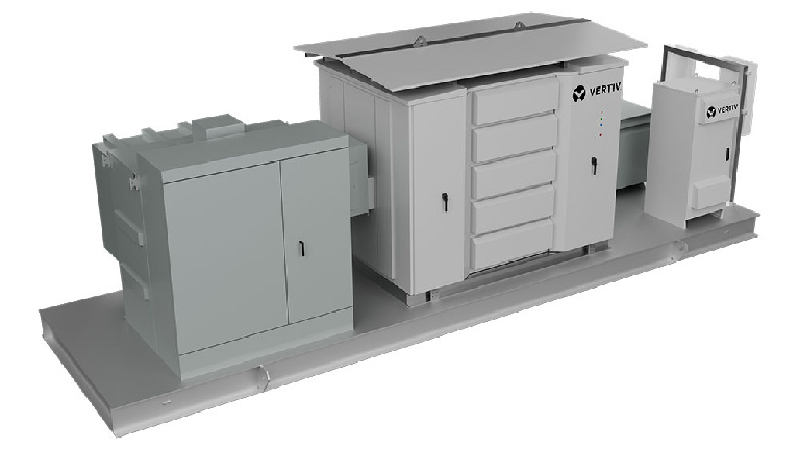
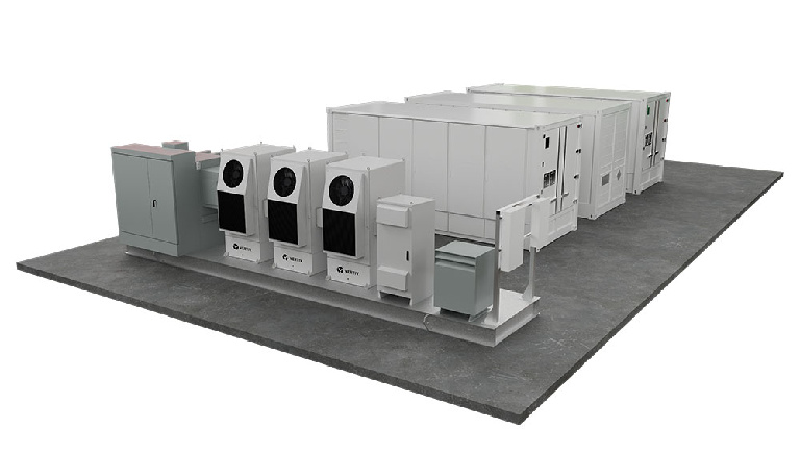
Figure 1. 3D rendering of the Vertiv EnergyCore. The utility-grade battery energy storage platform supports peak shaving, load shifting, and demand management in microgrid and grid-interactive systems.
Source: Vertiv.com
Within an integrated microgrid or grid-interactive power system, Vertiv EnergyCore Grid helps coordinate utility power, on-site generation, and distributed energy resources (DERs). This coordination can support operational flexibility and resilience, depending on system design and deployment conditions.
Material resource management through integrated design
Meeting growing digital infrastructure demand calls for more than expanding power and cooling capacity. It also involves careful management of the materials, equipment, and construction activities needed to bring new capacity online.
Many of those decisions begin during the design phase. Considerations such as serviceability, component longevity, modular capacity growth, and end-of-life planning can help limit material waste while supporting operational flexibility throughout the infrastructure lifecycle.
Integrated and prefabricated approaches can extend those benefits into deployment. By shifting construction and assembly into controlled factory environments, organizations can reduce construction complexity, limit on-site material waste, and support more predictable project execution.
Launched in 2025, Vertiv™ OneCore applies this approach through a factory-integrated architecture that brings together power, cooling, controls, and deployment execution. By integrating critical systems before they reach the site, it can help simplify construction and support phased capacity expansion as infrastructure needs change.
Closed-loop water recycling during commissioning
Resource management considerations extend beyond day-to-day facility operations. Opportunities also exist during construction, commissioning, and startup activities.
Before cooling systems enter service, piping networks typically undergo flushing processes to remove construction debris, mill scale, and residual oils. These activities can generate significant amounts of wastewater.
Vertiv™ PurgeRite™ NearZero™ captures, treats, and recirculates water onsite during the flushing process, instead of discharging and drawing additional water. Compared with traditional flushing, which can discharge six or more system volumes, Vertiv PurgeRite NearZero discharges about 1.2 times the system volume or less and can reduce total water use during the flushing process by up to 95%¹.
By reducing the volume of water that must be sourced, hauled, discharged, or disposed of, the service helps minimize resource demands while supporting cleanliness and passivation needs for closed-loop cooling systems.
Responding to evolving resource demands
The engineering choices behind data center infrastructure continue to evolve as technologies, resource constraints, and customer requirements change. Responsible business therefore encourages continued evaluation of those choices against performance, resilience, and resource considerations.
At Vertiv, engineering decisions around energy, water, waste, and emissions are part of how we design, build, and support data center infrastructure, not a separate effort from the business itself. As infrastructure requirements evolve, we continue working to improve efficiency, manage resources, and collaborate across the industry.
See how Vertiv is approaching responsible growth and the work ahead. Explore One Vertiv, One World.
¹ Compared with conventional non-recycled flushing methods for closed-loop hydronic systems for facility water and technology cooling systems. Actual results vary by system design, water quality, cleanliness requirements, and site conditions.