Data center power infrastructure must be designed for chip generations that don't exist yet. Here’s what that demands.
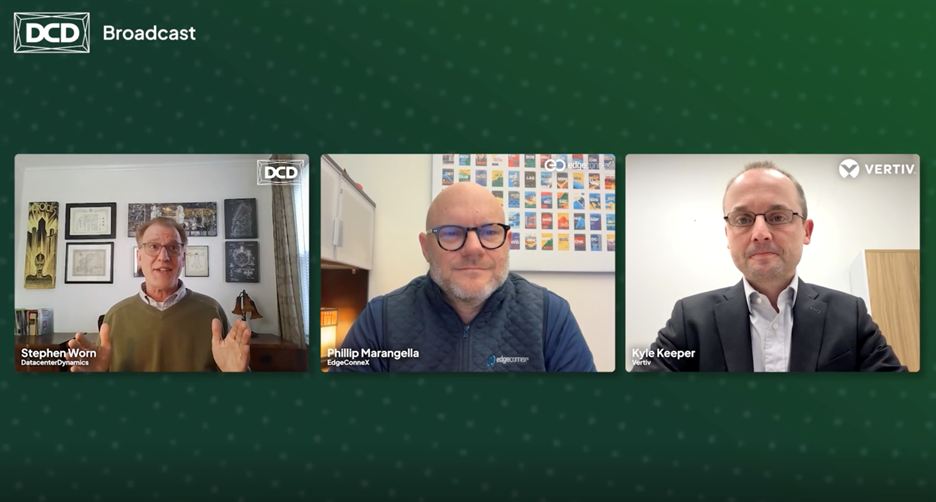
The first episode of Vertiv Power Innovation Day 2026 brings together Kyle Keeper, Senior Vice President of Power Management at Vertiv, and Phillip Marangella, Chief Marketing and Product Officer, EdgeConneX, in a conversation hosted by Stephen Worn, Chief Technology Officer and Managing Director, Datacenter Dynamics (DCD). They discuss the voltage and density changes reshaping rack-level power delivery, what infrastructure planning now demands, and how the industry is responding through partnership and collaboration.
Stephen Worn, Chief Technology Officer (CTO) and Managing Director, DatacenterDynamics (DCD):
The scale of secure power demand has radically changed. What macro forces are driving this?
Phillip Marangella, Chief Marketing & Product Officer, EdgeConneX:
When we started out, these "edge" data centers were one to two megawatts. Now, those are just racks. What’s driving the shift is no longer just about getting power to the data center, but also to the rack— at scale and at speed. Deployments used to take 24–36 months, but now customers want them in 12-18 months. This requires being flexible to customer requirements and scalable as you move to next-generation chipsets, so we can support new workloads without a major retrofit.
Kyle Keeper, Senior Vice President of Power Management, Vertiv:
The challenge goes beyond the sheer power demand from AI factories—it extends to the dynamic nature and type of loads that must be supported. That includes addressing rising power densities at the row and rack level and rethinking power strategies to handle power availability and grid dynamics. The question is how to plan for a deployment today while staying ready for what's still to come.
Stephen: You have visibility across utilities, hyperscalers, operators, and end users. How is Vertiv responding?
Kyle:
That's not how this industry always worked. The challenges are creating collaboration and early engagement—with regulatory bodies, governments, and municipalities—around grid regulations and even noise ordinances.
Our focus is on what is ready now: how do we deliver power from the site to the rack, safely, efficiently, and without designing ourselves into a corner? We see data centers evolving from passive loads to grid-enhancing assets. We’re also headed towards flexibility and hybrid architectures or higher-voltage AC and DC power, on-site generation, and grid-interactive control schemes.
Stephen: Rack density is pushing voltage requirements from 415V AC toward 800V DC. How is that changing how power gets to the rack?
Phillip:
The technology is evolving faster than operations can keep up. The shift to liquid cooling is one example; operational teams are being asked to handle something that used to be taboo in data centers, and it requires rewriting operational procedures.
Power is no different: with grid constraints and availability, you're always looking at alternative solutions to deliver the capacity when it's needed. Whether it's on-site natural gas, behind-the-meter, or battery energy storage systems (BESS), these are all in the quiver to augment supply.
Kyle:
The industry has come to terms with higher voltages. Hybrid architectures with AC and DC already exist today. DC already exists at the rack level. A long time ago, DC power moved out of the server into the rack, and that's not going away. We see existing platforms around 54-volt DC continuing to support upcoming generations of graphics processing unit (GPU) servers. We'll also see a transition to 100-volt systems with sidecar approaches. This approach helps support higher density in the rack and simplifies power distribution to the GPU pod.
Stephen: What you build today has to support chip generations not yet available. How does Vertiv plan for that from a roadmap perspective?
Kyle:
We've gone from an era where the power system just worked to one where it should be viewed as a strategic platform for data center designers and operators.
We're not designing for a single point in time but for a series of future design points. One of the biggest concerns is designing and deploying with greater certainty: certainty in timing, certainty in how solutions can be deployed, and certainty in how they will perform.
If you take two sites of the same size, there is an ability to differentiate based on system design: how it's architected, deployed, and operated over time. Thinking through phased energization, how systems perform under these workloads, and how they interconnect with the grid — these factors create real differences.
In spite of the complexity, it's manageable. We're already in a phase of real-world deployments.
Stephen: The scale demands power and cooling solutions that work together. How do you deliver that on time, on budget?
Kyle:
We've designed against this idea of repeatable building blocks. The question is whether we can do it at scale: pre-engineered, prefabricated, validated, in a more factory environment.
The more we can do as an industry in that fashion versus bespoke on-site work using generalist resources that might be seeing this equipment for the first time — that is a risky way of going about this. Efficiency and optimization haven't gone away, but more predictable deployments, being able to do it at speed, at scale — those are the models that are going to be most successful.
Stephen: Predictable deployment at speed and scale. How can we succeed with you?
Phillip:
We are succeeding. You reduce risk with communication, collaboration, and partnership. We see power as an impediment. We're going to solve for it, and it's going to improve the overall grid architecture as a result. That has been underappreciated over the years. It's going to be good for the entire power ecosystem.
Buckle up. Because as fast as we've been going, it's only going to get faster. You've got to be brave, you've got to be patient. But it's fun. We're on this rocket ship.
Kyle:
The ones that are most successful are going to be those that have the strongest partnerships. We value partnerships like those with EdgeConneX — you make us smarter. We're going to have to continue to get smarter. We're proud of our heritage, but we have to continue to evolve. We're well positioned for what's needed today and what's yet to come.