
Most enterprise operators don't ask about CDU backup power until it's too late. Discover why enterprise data centers need dedicated UPS protection for liquid cooling CDUs.
Data center operators building AI infrastructure ask detailed questions about coolant distribution unit (CDU) sizing, flow rates, and thermal efficiency. Few ask the question that matters most when something goes wrong: What happens to my GPU cluster if the liquid cooling system loses power?
When CDU pumps lose power, the coolant stops circulating and junction temperatures begin climbing immediately. A high-power chip can reach its thermal limit in under a second, forcing a shutdown that takes the workload down with it to protect itself. That protection saves the silicon, but surrounding components—memory, power regulators, and storage—may lack equivalent thermal protection and may be more prone to prolonged exposure as heat accumulates. Once the flow stops, the gap between normal operation and shutdown is measured in seconds. Most liquid cooling deployments don’t include dedicated backup power for the cooling system itself. That gap is the problem.
Why sharing a UPS between IT and mechanical loads creates risks
Many operators assume CDU pumps can share the capacity of an uninterruptible power supply (UPS) with IT equipment, or rely solely on generator backup. Both assumptions carry real risk.
Mechanical cooling loads powered by variable frequency drives (VFDs) behave fundamentally differently from servers and storage systems: IT equipment draws steady, predictable current. VFD-driven pumps do not. This creates four problems:
- High inrush currents: Pump motors can draw 1.2 to 1.5 times their normal operating current during startup. A UPS designed for IT loads is not built to withstand this type of draw and can trip during a surge.
- Harmonic distortion:: Standard 6-pulse VFDs can generate 30 to 50% total harmonic distortion (THDi), which may overheat transformers, strain switchgear, and cause nuisance trips on generators and utility feeds.
- Poor power factor: Inductive motors typically operate at a lagging power factor between 0.7 and 0.9, increasing reactive power demand, straining upstream infrastructure, and potentially triggering utility penalties.
- Undervoltage sensitivity: A 10 to 15% voltage sag can trigger a VFD fault and drop motor contactors instantly, cutting coolant flow before any thermal protection logic can respond.
Connecting mechanical loads to a UPS not designed for them also introduces power quality noise that affects sensitive IT electronics on the same circuit and can create warranty exposure if the UPS is operated outside its intended design parameters.
What a UPS designed for mechanical loads actually does
The Vertiv™ Liebert® APM2 (20 to 600 kW, 400/480V) is built specifically for these conditions. Its three-level topology with silicon carbide (SiC) converters address each of the challenges above directly.
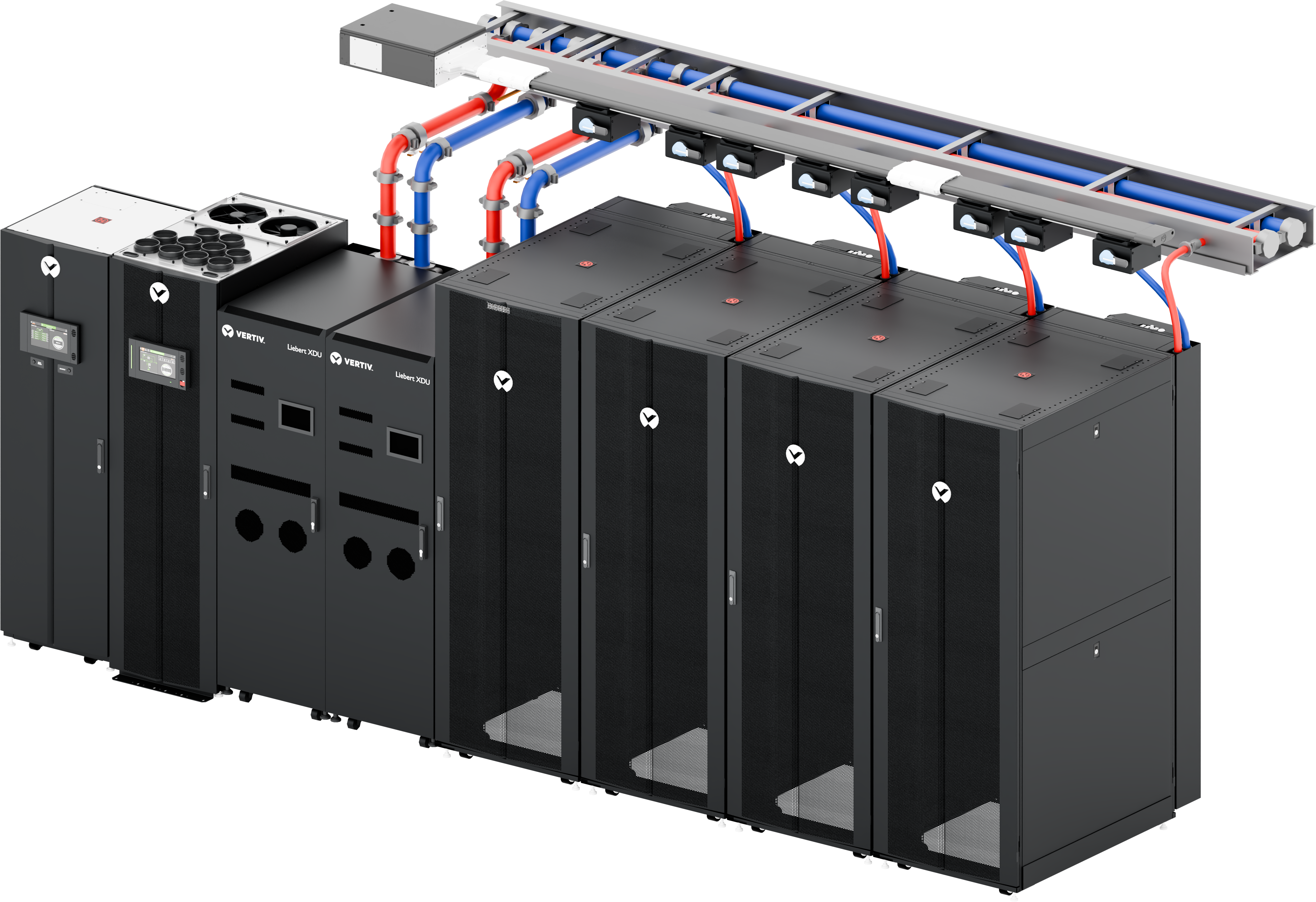
Figure 1. Vertiv™ Liebert® APM2 UPS integrates seamlessly with the following Vertiv suite of solutions: (from left) Vertiv™ Liebert® EnergyCore, Vertiv™ Liebert® APM2, Vertiv™ CoolChip CDU, maintenance bypass cabinet (MBC), and Vertiv™ VR Racks. Source: Vertiv.
The active front-end rectifier shapes the input current into a clean sinusoidal waveform, reducing THDi to less than 3-5% and delivering a near-unity input power factor of approximately 0.99. This eliminates upstream harmonic interference without the need for external filters or capacitor banks, helping facilities meet IEEE 519 limits at the point of common coupling.
Voltage regulation holds the output within ±1%, and frequency regulation holds within ±0.05 Hz. When input power falls out of tolerance, battery backup engages with zero transfer time, keeping VFDs and motor contactors operating through sags, swells, and generator transitions. Response time is within four to five milliseconds.
For motor starts, the inverter handles crest factor loads up to 3:1 and supports up to 125% load for up to 10 minutes, short-duration overloads up to 150%, and continuous operation up to 105%. Sequential pump starts after an outage can be managed without simultaneous inrush spikes.
The modular design supports N+1 redundancy with hot-swappable power, control, and bypass modules replaceable in under 30 minutes. This keeps the cooling UPS serviceable without shutting down cooling, eliminating a critical vulnerability window during routine maintenance.
Validated with Vertiv™ CoolChip CDUs
Vertiv tested the Vertiv™ Liebert® APM2 with the Vertiv™ CoolChip CDU 1350 across start/stop cycles, inverter-to-bypass transfers, and full battery operation as detailed in the "Powering the Thermal Chain" application brief. No CDU alarms or faults were triggered.
- A 90 to 120 kVA Vertiv™ Liebert® APM2 supports a 4 MW cooling block with three Vertiv™ CoolChip CDU 1350 units in a 35-inch footprint
- A 180 to 240 kVA APM2 supports up to 8 MW with five to six CDUs in a 59-inch footprint
Cooling power is compute power
As rack densities climb past 100 kW and liquid cooling becomes standard in AI deployments, the risk profile of an unprotected cooling system becomes harder to justify. Thirty seconds is not enough time for a generator to respond. It is, however, enough time for permanent chip damage. Treating cooling power as mission-critical infrastructure, on its own dedicated UPS designed for the load, is the most direct way to close that gap.
Authors

Benny Bray
As a product manager, Benny is responsible for liquid cooling products throughout their lifecycle, including the definition, development, launch, maintenance, and end-of-life. In this role, he is also responsible for market trend analysis, data analysis, creating and managing the company’s offering-related materials and information required to support various go-to-market initiatives, and acting as a liaison across Vertiv teams.

Rohini Sajanpawar
Rohini Sajanpawar is the Global Product Marketing Manager for Medium UPS Power Management at Vertiv. With a strong background in engineering, sales, and research, she specializes in creating impactful product messaging and driving innovation. Rohini has led product marketing for major Vertiv launches, including the Vertiv™ Liebert® ITA2, Vertiv™ EXS, Vertiv™ Liebert® PPC, and Vertiv™ Liebert® APM2 in North America. Her previous experience as a Technical Sales Engineer for channel UPS systems honed her technical expertise and provided a strong foundation for her role in product marketing for AC power management products. A Certified Product Marketing Manager, Rohini holds a Bachelor of Engineering from India and a Master’s in Material Science and Engineering from the Rochester Institute of Technology, NY. She combines her academic expertise and industry experience to support Vertiv’s mission of delivering critical infrastructure solutions.

Sharan Kumar
Sharan Kumar is the Global Product Manager for Medium UPS Power Management at Vertiv. He is responsible for the strategy and lifecycle management of the company's medium power UPS portfolio, helping bring innovative power solutions to market data centers and critical infrastructure applications. Drawing experience across engineering, product development, and product management, Sharan combines technical expertise with market insight to support product innovation and portfolio growth. He holds a master's degree in mechanical engineering from Politecnico di Milano, Italy.
*In compliance with the EU AI Act’s transparency requirements, this article included the use of AI during brainstorming and content organization. Writers and technical subject matter experts (SMEs) further reviewed, refined, and finalized the published version.