
Cooling demand in data centers is rising, and data center operators are playing a balancing act. As rack and workloads increase with increased artificial intelligence (AI) functions and services, business goals expand, and data centers transition to scalable technologies, facility operators are finding techniques and methods to maximize water utilization.
What is water usage effectiveness (WUE)?
As operators find efficient cooling designs and innovations, one tested metric and approach involves tracking water usage effectiveness (WUE). WUE measures how efficiently a data center uses water for cooling. Introduced by The Green Grid, it has become a key metric as AI drives rack densities up to 130 kW. While liquid cooling offers superior energy efficiency, it introduces new water demands that must be carefully managed for cost control and operational resilience.
Berkeley Lab’s 2024 US Data Center Energy Usage Report states that in projected scenarios beyond 2023, average WUE is expected to rise slightly, reaching between 0.45 and 0.48 L/kWh. This predicted increase is driven by the expansion of hyperscale and colocation data centers, along with the growing adoption of liquid-cooled systems.
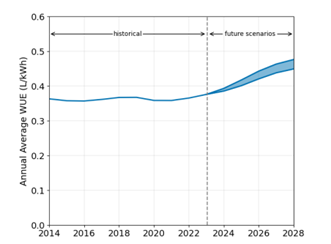
Figure 1. Annual average site WUE across U.S. data centers projection beyond 2023 (Source: Berkeley Lab 2024 US Data Center Energy Usage Report)
Tracking WUE helps teams identify opportunities to improve water utilization, optimize cooling strategies, and make informed decisions about infrastructure upgrades. For organizations, monitoring usage and controlling it can translate to the infrastructure’s lower utility spend, fewer regulatory headaches, and stronger long-term resilience.
The equation below computes how much water a data center uses to support each kilowatt-hour of IT energy. A lower result indicates a more efficient water utilization.
Tracking WUE sets the baseline. Improving it often starts with how cooling systems manage water reuse, especially through the cycle of concentration.
Cycle of concentration: A lever for better WUE
Balancing the cycle of concentration (CoC)—the ratio of solid impurities in reused and recirculated water in comparison with makeup water discharged and concentrated via evaporation—can reduce makeup water needs by up to 20%, contributing to cost savings. Achieving a balanced CoC requires chemical treatment to control scaling and biofouling, which also protects downstream heat exchangers. Variable frequency drives (VFDs) on tower fans and pumps can reduce energy use by matching output to demand, indirectly lowering water use by reducing evaporation rates. These measures can improve WUE without requiring wholesale changes to the cooling loop.
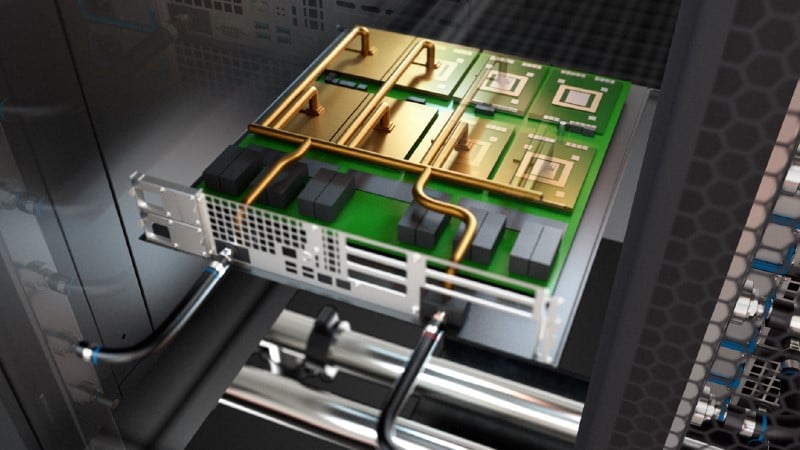
Key strategies to optimize data center water usage
While liquid cooling remains effective, its role must be weighed against emerging alternatives.
- Closed-loop liquid cooling systems: According to EESI, a medium-sized data center using open-loop cooling systems can consume approximately 110 million gallons of water annually (~416 million liters), while large hyperscale facilities may use up to 5 million gallons per day (~18.9 million liters/day). Closed-loop systems can help data centers reduce water usage.
- Hybrid cooling systems: Hybrid systems combine air and liquid cooling to improve thermal performance while reducing water use. These systems often operate in dry mode for most of the year, using ambient air to reject heat and keeping WUE near zero. They work well in moderate climates but may struggle to maintain efficiency in extreme conditions or during peak loads.
- Low GWP refrigerants as a practical alternative: For facilities facing water constraints, low global warming potential (GWP) refrigerants deliver optimized performance and protected uptime while meeting new regulations.
Monitoring and real-time optimization
Cooling efficiency depends on more than hardware—it requires tight monitoring control and real-time visibility. Sensors tracking temperature changes, humidity, and flow feed data into platforms that adjust setpoints automatically based on load and climate conditions. Systems like Vertiv™ Liebert® iCOM™-S analyze hundreds of data points to fine-tune water temperatures, fan speeds, and cooling output. This can reduce swings in WUE, flags anomalies early, and supports predictive maintenance. For operators, this also means fewer surprises, better resource use, and more stable performance across changing workloads.
Scaling cooling without scaling water demand
Applying WUE-focused strategies, like closed-loop systems, hybrid cooling, and automated controls, can support high-density workloads while keeping water consumption stable. This approach helps operators manage resource use more precisely, reduce operating costs, and stay aligned with environmental standards.
Learn how Vertiv applies these strategies in real-world data centers. Explore Vertiv’s 2024 Responsible Business Report for more insights on water efficiency.