AI loads behave as a single computer, unlocking a different thought process for how the entire facility needs to be designed. The answer now revolves around tokens, liquid cooling, and 800 VDC.
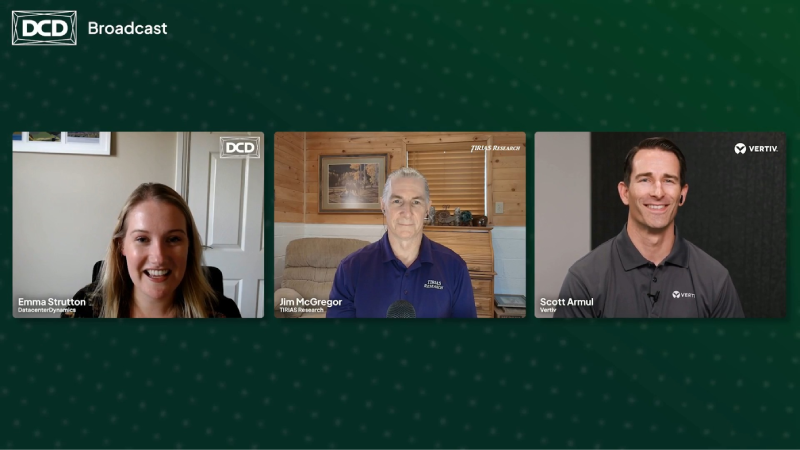
In the fifth and final episode of DataCenterDynamics (DCD) AI Week 2026, Scott Armul, Chief Product and Technology Officer at Vertiv, and Jim McGregor, Founder and Principal Analyst at Tirias Research, speak with Emma Strutton, Head of Channels at DCD about what that evolution looks like in practice. They cover performance metrics, modular infrastructure, and the skills gap reshaping operations.
Emma Strutton, Head of Channels, DCD: How have AI workloads fundamentally changed the design and operation of data centers compared with traditional enterprise and cloud facilities?
Scott Armul, Chief Product and Technology Officer, Vertiv:
AI brings a fundamental change in performance, which hits much greater densities than we've seen in the past. The biggest difference from previous loads is that AI loads in a cluster environment tend to operate as a single computer at a rack level or at a site level.
You see behavior that is incredibly dynamic in terms of the load profile and incredibly synchronous in terms of how it all works together. That has fundamentally different impacts on how a data center needs to behave, operate, perform, and enable resiliency. It's unlocking a different thought process for how the entirety of the data center facility needs to be designed.
Jim McGregor, Founder and Principal Analyst, Tirias Research:
We call them factories for a reason because you must think of them as a factory. These things are very expensive, power hungry, and meant to do a very specific function just like a factory. You want it to run 24/7 as efficiently as possible. Everything must work together and simultaneously.
Emma: How should operators be thinking about performance beyond traditional efficiency metrics?
Scott:
The difference between a traditional cloud environment and what AI is trying to accomplish is a different compute output. We think about AI compute output in terms of tokens, the currency of AI. This is now a question of tokens per second, how I convert megawatts into token output, tokens per dollar, and time to first token.
From a Vertiv perspective, we're thinking about all four of those things as levers that need to be optimized together. Looking at the power train or thermal chain, how do I get the maximum number of megawatts producing tokens as opposed to having waste on the peripherals.
Emma: How are changing metrics and workload characteristics influencing infrastructure decisions across the facility?
Jim:
You have to optimize around one or multiple workloads simultaneously. If you're doing inference, you may be doing it on one server or a couple in a single rack. If you're trying to do training, you're using thousands of GPUs across multiple racks and multiple clusters. Everything that we're doing now is based on one key factor: the densification of compute.
You're going to expect latencies in the milliseconds or even microseconds. That creates a whole new challenge of how do you architect solutions across multiple servers, multiple racks, multiple data centers. Your power and thermal requirements may double, triple, or quadruple, so you have to think of a factory in a modular fashion.
Emma: How are changing technology refresh cycles affecting lifecycle planning strategies?
Jim:
It's extreme when you're spending billions of dollars on a data center. Nobody wants to think they can only use it for one generation. A lot of traditional enterprise data centers have raised floors with cabling running underneath. The racks we're using now for densification are so heavy they can't sit on those raised floors. You have to have them on concrete because they weigh as much as an SUV. You have to architect the data center completely differently, knowing that liquid cooling is coming, and you're going to be doubling or quadrupling the power within a couple of years.
Scott:
Moving from 140 kilowatts (kW) in a rack to 230 and, 400, and beyond, is a forcing function to unlock performance. We're moving to liquid cooling, evolving to different voltage architectures. Liquid cooling has seconds of performance out of band that can be tolerated before you're throttling workloads or taking the workload down. It calls for a different thought process and architecture in terms of how we design the infrastructure. Modularity is probably the biggest thing that we're going towards.
Emma: Why is managing the entire power and thermal chain becoming more important than optimizing individual components?
Scott:
From a Vertiv perspective, the future readiness discussion lends itself to overall system design. How do you look multiple generations ahead and work backwards to say what does the overall system design need to look like to unlock those maximum megawatts.
When you look at the entirety of the power train or thermal chain, you can arrive at different answers because you have each lever to look at the entirety and do true systems design. We found value in designing the entire system, then working backwards to our individual product portfolios, as opposed to optimizing individual products and hopefully coming up with something better than its individual parts.
Emma: How are technologies like liquid cooling and 800 VDC changing the skills needed within operations teams?
Scott:
The operator doing server change outs in a liquid cooled environment is effectively a plumber that has certifications and understands the implication of introducing air into a high value technical cooling loop.
800 VDC fundamentally takes IT level power and puts it above the safety low voltage threshold that the normal industry is used to operating at. The industry needs a massive amount of additional skilled trades and personnel to implement these technology changes. We're driving a proactive investment into academies and training facilities that allow folks to get hands on with liquid cooling and 800 VDC in a data center application.
Emma: How can operators avoid building facilities optimized only for today's AI hardware?
Scott:
The one real fixed constraint is typically going to be bringing power into the site. Working downstream from that, it's a discussion on block sizes and how you're matching up what is utilized for heat rejection, the size of your liquid cooling loop, and the pod size you're designing around. If I'm set up in a two MW UPS block, I can think about deploying a second Vertiv™ SmartRun off of that same block. If I need to go to 800 VDC for my next chip generation, I can leverage all of that traditional infrastructure and simply deploy an 800 VDC sidecar with the IT. It may not be the most optimal from day one, but it unlocks a tremendous amount of optionality.
Emma: How can operators balance speed to market with long-term operational flexibility?
Scott:
Speed to market and time to token are inherent to any developer's business model. As an industry, we orient ourselves around more standardized designs. We can move beyond simple reference designs to an approach that is a controlled product, a data center managed and released with a bill of materials for that 250 MW data center. Pair that with prefabricated infrastructure built in a factory-controlled environment that can cut time to a traditional stick build data center by 50%.
Jim:
If it takes two to three years to build a data center and it only takes six to nine months to get the IT hardware, that's a mismatch that just doesn't work. With demand skyrocketing, agentic AI workloads driving 10 to 100X more compute capacity, and multimodal solutions driving exponential increases, we need to match the deployment cycles. The more we make this standardized, factory automated, and modular, the easier it is to do that.
Emma: What characteristics will define the most successful AI data centers?
Scott:
There wouldn't be a singular path towards a defined solution for AI. It's about looking ahead and developing more of an ecosystem and partnership approach to where we think the solutions and architecture will be years in the future. The definition of a complete portfolio is changing rapidly, moving outbound much closer to the utility, looking at power generation and implementation of process level liquid cooling. We're doing this all while we need to go faster and at a scale the industry has never seen before.
Jim:
There really isn't a lull in AI demand. We're seeing it wave after wave. We're still in this innovation cycle where things are changing rapidly. It's hard to standardize solutions when you have such a high level of innovation. We're still at the very beginning of AI. When we start thinking about multimodal, multimedia, and even physical AI, the demands are just increasing significantly.
Watch the full discussion: The AI data center operating model - Performance, flexibility, and future readiness