
Despite elevated cooling temperatures, learn which cooling technologies and innovations work best based on geography, climate, external ambient conditions, water availability, and thermal differentials before making million-dollar infrastructure decisions.
As chip temperatures at the technology coolant supply (TCS) potentially reach 40-45°C/104°-113°F, many assume the industry is entering an era of universal "compressor-less" cooling—eliminating mechanical refrigeration compressors in favor of passive heat rejection, which can help reduce facility energy consumption. But the latest white paper, “Rising Chip Temperatures and the Transformation of Data Center Cooling: A Scenario-Driven Assessment of Heat Rejection Technologies”, reveals a more nuanced reality: location determines cooling technology as much as chip specifications do.
The five-zone framework
Vertiv researchers created the chilled water heat rejection map for liquid cooling, dividing the operational landscape into five distinct zones, defined by the intersection of server temperature and external ambient conditions:
- Zone 1 (Compressor-less ideal): High server temperatures (≥30°C/86°F) combined with medium-low ambient temperatures create the sweet spot for dry coolers and adiabatic dry coolers. These systems can help reduce power consumption by eliminating compressor loads entirely. However, this zone represents a narrow slice of real-world deployments—typically limited to cold climates or facilities with elevated return water temperatures.
- Zone 2 (Water-enabled compressor-less): Cooling towers extend the compressor-less operational field for medium-high server temperatures (≥25°C/77°F) in medium-low ambient conditions. However, this can increase water consumption and dependency on local water availability—factors increasingly constrained by environmental regulations and resource scarcity.
- Zone 3 (Hybrid solutions): When both server temperatures and ambient temperatures run high, trim cooler technology bridges the gap. This innovative hybrid operates as a dry cooler during favorable conditions and seamlessly engages compressors as ambient temperatures climb, potentially reaching 55°C/131°F and higher. It represents operational flexibility for facilities operating in variable climate conditions.
- Zone 4 (Mixed mechanical + free cooling): For medium-low server temperatures (≤35°C/95°F) paired with moderate ambient conditions, free-cooling chillers and water-cooled chiller + dry cooler combinations optimize efficiency by leveraging free cooling when available while maintaining mechanical backup capability.
- Zone 5 (Full mechanical): Extreme climates with sustained temperatures above 50°C/122°F combined with medium-low server temperature requirements necessitate traditional chillers or adiabatic chillers. No amount of chip temperature elevation eliminates this need when ambient conditions exceed thermal differentials required for passive heat transfer.
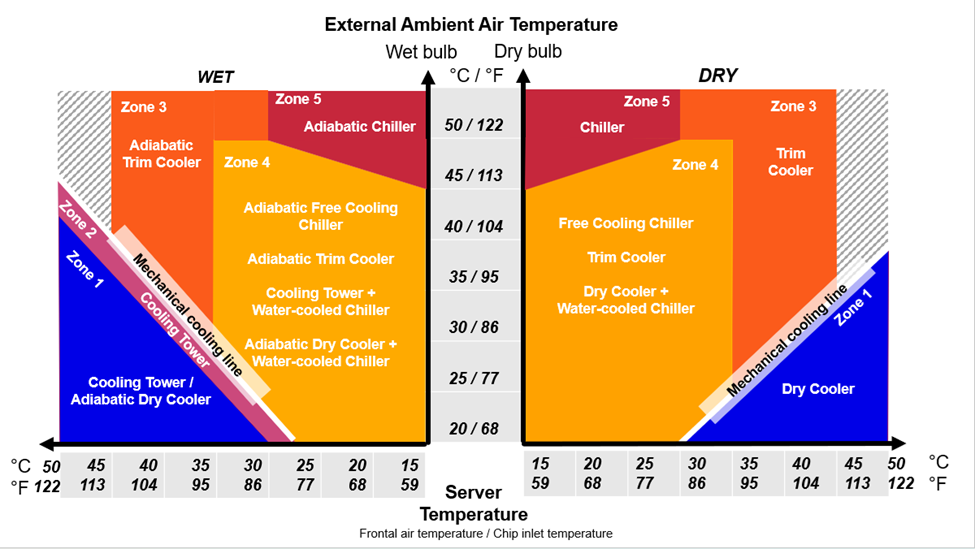
Figure 1. The Chilled Water Heat Rejection Map identifies the possible technologies data center operators can use to manage their cooling needs in the facility based on crucial factors for optimized resource use and availability. Source: Vertiv.
In parallel, this research provides an overview of air-based cooling architectures and defines the operational conditions that necessitate compressor-driven mechanical cooling for room-level thermal management. This provides additional, broader context to position these requirements and to complement the liquid-cooling analysis and considerations discussed.
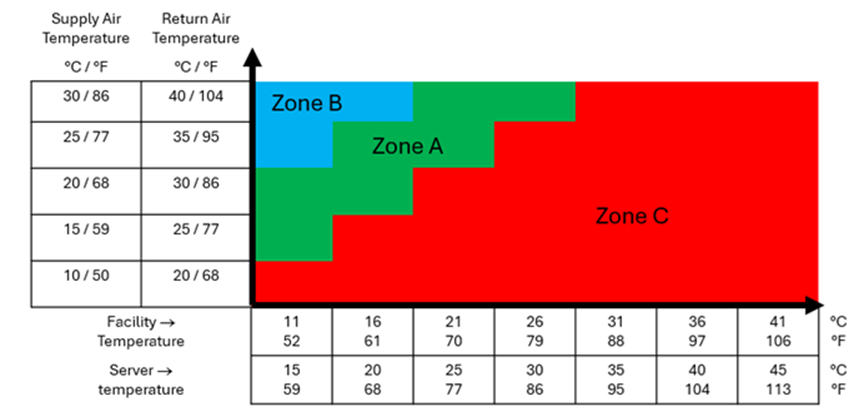
Figure 2. The Air Cooling Heat Rejection Map identifies three distinct operating zones for indoor chilled water units, depending on the facility water temperature and the target return air temperature, among other considerations. Source: Vertiv.
To find the complete list of factors included for consideration of thermal technologies, the definitions, and breakdown and basis of the zones, download the paper here.
Higher temperatures = Compressor-less cooling?
Given the analysis, the assumption that higher chip temperatures automatically warrant the use of compressor-less cooling solutions for efficient thermal management is a misconception that overlooks critical environmental and operational variables.
While elevated chip inlet temperatures, potentially reaching 40°C to 45°C (104 to 113°F), create greater thermal headroom for passive heat rejection, the feasibility of compressor-less technologies depends on three converging factors:
- The working temperature on the chip or server side
- The external ambient conditions (temperature and humidity) of the data center location, and
- The availability of water for evaporative or adiabatic processes.
The relationship is governed by a fundamental thermal differential (Δ in/out), representing the temperature difference between server-side conditions and outdoor air. For example, if a data center operates with server temperatures at 20°C/68°F while outdoor temperatures reach 35°C/95°F, compressor-based systems remain necessary because the external air is too warm for passive cooling. Conversely, a facility operating at 40°C/104°F chip temperature in the same climate could theoretically use compressor-less dry coolers. However, in extreme climates where outdoor design temperatures consistently reach 50°C/122°F to 55°C/131°F, even 40°C/104°F chip temperatures would be insufficient to eliminate compressors as outdoor air remains hotter than the system's return temperature.
Therefore, compressor-less viability is not universally enabled by high chip temperatures alone but is fundamentally constrained by local climate and water resource availability.
The 90% reality check
Perhaps the most striking finding in our research: over 90 percent of North America's top data center markets experience design temperatures ≥40°C/104°F. While there are differences in numbers, similar patterns emerged across Europe and the Asia Pacific.
This means the vast majority of existing and planned facilities operate in climate zones (i.e., IECC Hot through Mixed classifications) where compressor-less technology faces significant limitations, even with elevated chip temperatures. A data center in Phoenix, Dubai, or Perth with 40°C/104°F chip temperatures still requires mechanical cooling, because ambient temperatures of 50°-55°C/122-131°F exceed the viable thermal differential. Conversely, facilities in Anchorage, Scandinavia, or northern regions of Japan can leverage compressor-less designs effectively.
Design for reality, not theory
The transformation of data center cooling isn't a simple equation of rising chip temperatures enabling universal compressor-less operation. It's a complex interplay of business growth objectives, thermal requirements, geographic constraints, water availability, and long-term operational resilience. The white paper provides the framework, technical specifications, and climate mapping essential for making informed infrastructure decisions worth millions in capital and operational expenditures.
Download the full research to access detailed zone analysis, regional climate maps, and technology selection matrices to find the specific deployment scenarios.