
Data center demand is accelerating, driven by AI workloads, edge computing, and digital transformation. Traditional construction methods, which rely on extensive on-site building, often take years to deliver new capacity. A modular data center offers an alternative that can shorten deployment timelines by shifting substantial integration and testing work to a factory environment.
A modular data center is a pre-engineered facility. The factory assembles, integrates, and tests its components — including power systems, cooling, racks, and management software — before shipment to the deployment site. This approach combines prefabrication, the off-site manufacturing of components, with modularity, the construction of discrete units, to create a complete data center environment.
A modular data center is a pre-engineered facility built in a factory and shipped to its operating site largely complete. Prefabricated modular (PFM) data centers encompass facilities that engineers pre-design with systems assembled, integrated, and tested in a factory environment. This process can shorten deployment time and help improve project schedule predictability.
These facilities can include subsystems such as thermal management, power protection and distribution, controls and management software, and services. They also include ancillary systems such as lighting, fire protection, physical security, and water treatment.
PFM is not limited to containerized data centers. A wide variety of customizable form factors exist to meet capacity requirements ranging from whitespace to power to cooling. Some form factors, particularly container-like designs and micro-data centers, are portable. Trucks can deliver and relocate them if needed.
Why modular data centers matter as capacity demands grow
Modular data centers address several pressures facing infrastructure operators. Demand from colocation providers seeking the agility to add capacity as needed drives market growth. Growing demand for edge micro-data centers related to 5G adds to this momentum. Interest in PFM data centers is growing as operators look for more agile and repeatable approaches to infrastructure deployment.
Growing adoption of generative AI is creating additional demand for rapidly deployable infrastructure. Modular data centers can be configured to support advanced AI workloads when equipped with the required power and thermal management infrastructure.
How factory-built modular data centers come together
The modular approach shifts construction from the deployment site to a controlled factory environment. Modules are self-contained units housing IT racks, cooling equipment, power systems, and supporting infrastructure that undergo building, integration, and testing off-site. Factories then ship them to the location for assembly.
Several form factors scale to different requirements:
- Single-module units: Vertiv™ SmartMod™ is a single module with up to 14 racks and up to 100 kilowatts (kW). It as a ‘data center in a box’ designed for deployment across a range of suitable sites.
- Expanded modular units: The Vertiv™ SmartMod™ Max features two modules that crews assemble on-site to form a single space. It supports up to 26 racks and up to 200 kW of total IT load, with direct expansion or chilled water cooling options.
- Multi-module platforms: The Vertiv™ MegaMod™ is a scalable, multi-module data center designed for up to 256 racks in a 1 MW IT space. Factories ship multiple modules as single units, and crews assemble them on-site. The Vertiv™ MegaMod™ Plus version offers up to 25% more racks and cooling capacity through separate IT hall and cooling modules.
- Custom solutions: Custom prefabricated modular data centers scale up to 2 MW IT blocks with 200–300 racks. Lead times range from 6–12 months.
- Hybrid modular approach: This method incorporates off-site prefabrication of complex building blocks into or next to traditionally constructed buildings. These blocks include power modules, cooling and hydro modules, and whitespace superstructure. Scalable designs reach up to 50 MW IT and 450–1,500 racks.
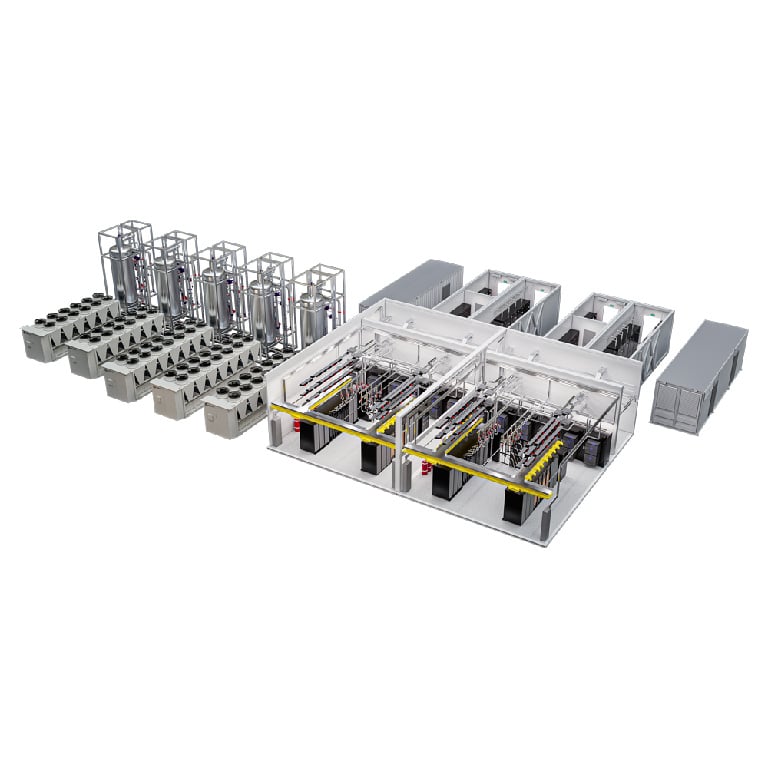
Figure 1. Vertiv™ MegaMod™ HDX, showing an integrated data center infrastructure configuration with IT equipment areas and supporting power and cooling systems.
Key benefits of a modular data center approach
Modular data centers offer several advantages over traditional stick-built construction:
- Faster deployment: PFM data centers enable faster deployment. They leverage economies of scale and streamlined processes made possible by off-site assembly. Certain prefabricated modular solutions may reduce deployment time by up to 50% compared with conventional on-site construction, depending on project scope and conditions.
- Improved schedule predictability: Factory assembly helps improve the predictability of both schedule and performance. PFM can give operators another option when comparing expansion of an existing facility with construction of new capacity.
- Quality control and consistency: Factory-based processes can help improve quality control, installation consistency, and coordination before systems arrive on-site.
- Scalability: Modular data centers offer modular scalability, enabling operators to expand capacity incrementally as needs grow. Configurations stack vertically or sequence side-by-side. The Vertiv™ MegaMod™ features a flexible pay-as-you-grow model.
- Evaluating the embodied carbon implications of modular construction: A life cycle assessment (LCA) comparing a 1.5 MW steel-framed Vertiv™ MegaMod™ PMDC with an on-site-built concrete facility of comparable IT capacity found lower embodied carbon for the modular design. The findings apply to the construction types, assumptions, system boundaries, and configurations evaluated in the assessment.
- Supporting compliance requirements in federal deployments: Modular solutions designed for federal environments may incorporate infrastructure and security features that support applicable Federal Information Security Management Act (FISMA) and the Federal Risk and Authorization Management Program (FedRAMP) requirements. Certification or authorization depends on the complete system, implementation, and review process.
What to consider before choosing modular construction
Modular data centers also present considerations that operators must weigh. Transport emissions for PMDCs ran approximately 25% higher than concrete construction in an LCA comparison. An assumed 1,000-kilometer factory-to-site transport distance drove this gap. The transport-related difference may vary with factory location, deployment region, transportation method, and distance to the site.
Custom prefabricated solutions have lead times of 6–12 months, depending on deployment schedules and complexity. Hybrid modular deployments typically take 9–14 months. While faster than traditional construction, these timelines still call for advance planning.
Where modular data centers fit
For colocation providers, PFM offers the agility to add capacity as needed. For edge deployments, trucks can deliver and relocate portable form factors if needed. For expansions and retrofits of existing facilities, building block solutions can support staged growth while helping reduce disruption to existing operations.
Federal data center projects may need to address applicable security, efficiency, procurement, and infrastructure requirements, making compliance considerations an important part of planning and deployment.
Rethinking how data center capacity is planned and delivered
Modular data centers reshape how operators approach power systems, cooling, rack density, and capacity planning. The factory-based model shifts portions of integration and testing off-site, which can reduce certain on-site construction activities and coordination requirements.
Power and cooling subsystems — including thermal management, power protection and distribution, and controls — undergo pre-configuration in the factory. When combined with the required site infrastructure and commissioning activities, these systems can form an integrated operating environment. Cooling options range from direct expansion to chilled water systems, as seen in the Vertiv™ SmartMod™ Max DX and CW variants.
The pay-as-you-grow model allows operators to align capacity with demand rather than committing to full build-out upfront. A modular approach can make it easier to add or replace selected infrastructure blocks as technology and capacity requirements evolve.
How AI is influencing modular data center demand
AI adoption drives modular data center demand. Growing adoption of generative AI creates a need for rapidly deployable infrastructure, and PMDCs support advanced AI workloads. Faster deployment and incremental expansion can make modular approaches suitable for organizations managing changing AI infrastructure requirements.
The PFM market, while still a relatively small portion of overall data center construction, is gaining acceptance. Operators expect more efficient, agile, and globally consistent infrastructure. Demand from colocation providers and edge micro-data centers related to 5G continues to expand the addressable market.
Building data center capacity with greater speed and flexibility
A modular data center is a prefabricated facility. The factory assembles, integrates, and tests its components before shipment to the deployment site. For the configurations evaluated in one Vertiv life cycle assessment, a steel-framed modular design showed lower embodied carbon than the concrete-shell reference design.
As AI workloads and edge deployments continue to grow, modular data centers provide a scalable, flexible path to adding capacity. They can shorten certain project timelines compared with conventional on-site construction. The infrastructure decision is no longer simply about how much capacity to build. It is about how quickly and predictably operators can deliver that capacity.
Figure 2. Vertiv™ SmartMod™ Max, a prefabricated modular data center solution designed to support efficient deployment of critical IT infrastructure.
Frequently Asked Questions
What is a modular data center?
A modular data center is a prefabricated facility. The factory assembles, integrates, and tests its components — including power, cooling, racks, and management software — before shipment to the deployment site. Prefabricated modular data centers combine off-site manufacturing with discrete modular construction to shorten deployment time and help improve schedule predictability.
How long does it take to deploy a modular data center?
Modular construction can shorten deployment timelines by moving substantial assembly, integration, and testing work off-site. Actual schedules vary by design, location, permitting, supply availability, and project complexity. Certain prefabricated modular data centers may reduce deployment time by up to 50% compared with conventional on-site construction, depending on project scope and conditions. Custom prefabricated solutions have lead times of 6–12 months, while hybrid modular deployments typically take 9–14 months, depending on complexity.
What is the difference between a modular data center and a traditional data center?
Traditional data centers are site-specific and involve extensive on-site construction. Factories build modular data centers, ship them largely complete, and crews assemble them on-site. They offer modular scalability, faster deployment, and a pay-as-you-grow model that aligns capacity with demand.
Can modular data centers support AI workloads?
Yes, when configured with the required power, cooling, rack, and control infrastructure. Modular construction alone does not determine whether a facility can support high-density AI workloads. Growing adoption of generative AI creates demand for rapidly deployable infrastructure that modular data centers can meet.
What form factors are available for modular data centers?
Form factors range from single-module units like the Vertiv™ SmartMod™, with up to 14 racks and 100 kW, to multi-module platforms like the Vertiv™ MegaMod™. The Vertiv™ MegaMod™ offers up to 256 racks in a 1 MW IT space. Hybrid modular approaches scale up to 50 MW IT with 450–1,500 racks, and custom solutions reach 2 MW IT blocks with 200–300 racks.
Are modular data centers portable?
Some PFM form factors are portable, particularly container-like designs and micro-data centers. Trucks can deliver these units and, if needed, move them to another location. The Vertiv™ SmartMod™, described as a "data center in a box," crews can deploy securely virtually anywhere.
What compliance standards do modular data centers meet?
PMDCs can earn pre-certification for critical standards such as the Federal Information Security Management Act (FISMA) and the Federal Risk and Authorization Management Program (FedRAMP). Solutions designed for federal environments may support applicable security and compliance requirements. Authorization remains dependent on the complete system, implementation, documentation, and review process.