AI workloads are making power and cooling demand more dynamic and unpredictable, raising the stakes for data center uptime. What does it take to anticipate issues when power, cooling, and IT infrastructure must respond as one interconnected system?
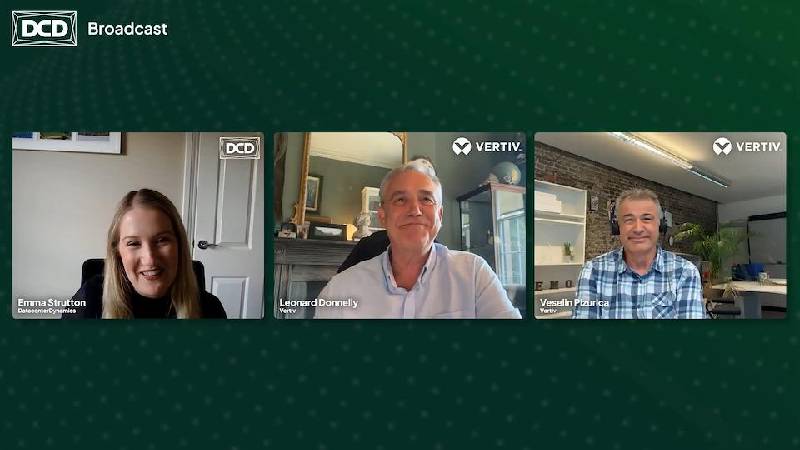
The shift to AI workloads is accelerating faster than most operational models can handle. In the second episode of the Vertiv DCD Management and Operations Innovation Day 2026, Vertiv’s Veselin Pizurica, Senior Director and Chief Architect of AI/ML, and Leonard Donnelly, Vice President, Digital Services and Platform Strategy, join Emma Strutton, Head of Channels, DCD, to discuss moving from reactive to predictive operations. They cover why AI factories demand new operational software, how predictive analytics extends asset life, and what system-wide monitoring means for uptime and financial outcomes.
Emma Strutton, Head of Channels, DCD: What has changed most dramatically in AI data center operations?
Leonard Donnelly, Vice President, Digital Services and Platform Strategy, Vertiv:
The main driver is a rapid transition from predictable enterprise centric workloads to AI workloads. But within the AI domain, you’ve got high velocity changes in the workloads moving from training to inference workloads. And when you get into the inference domain, it means much more unpredictability. You’ve very high bursts of demand and the power and cooling infrastructure needs to meet that challenge.
Emma: What new operational challenges are emerging with these workloads?
Leonard:
The systems needed have become incredibly sophisticated. It’s a real time world. The theme is we’re moving from reactive traditional approach to a predictive analytics approach. The scale of the problem or the scale of the sophistication, and the way we need to maintain the uptime of the AI data center or factory, calls for a new generation of software to meet that demand.
Veselin Pizurica, Senior Director & Chief Architect of AI/ML, Vertiv:
You cannot anymore look at one problem or one asset in isolation. It’s almost as you look as a conductor with an orchestra where things need to be holistically approached. The second problem is that often the problem exposed in one place, the root cause has another one. There are cascading problems that have a ripple effect through stability. All of these things have been amplified by extreme demand for power and cooling and have to work together rather in isolation.
Emma: How is the relationship between operators and technology partners changing?
Leonard:
The way of putting it is we’re all in this together. The root causes of problems here are invariably not just in the systems we may provide; they have a direct relationship with the physical infrastructure. The conversation we have to have with the customer is not just about looking after our stuff, it’s also having a dialogue about their infrastructure and how we can improve things together.
Veselin:
There are two opposing conversations. On one hand, everybody understands that scheduled maintenance is good because it’s predictable. On the other hand, when we start talking about something that’s evolving over time, you need to react upon that, but it has to be, in the sense, predictable. The real time monitoring and understanding of the problem, knowing the priorities and risk associated with that, must be scheduled upfront, as well. You must be able to elaborate and convey that message to the end customers because let us not forget IT laws are not separate from the OT problems.
So having said that, if you have a proper understanding of the problems, you can actually elaborate that and bring the right problem statement around, right field service engineers at the spot at the right time with the proper information what needs to happen.
Leonard:
The most fundamental value we should bring as a partner is an incredible capability to always protect us far enough in advance of something critical going wrong. The most important thing is uptime. That is the real most important KPI the customer has.
Emma: How do you build trust with customers introducing them to predictive operational strategies?
Veselin:
This is one of the things that it’s not only about technology but also about education, us and customers about how to operate properly and timely data centers. If you go to a doctor with a fever, the last thing you want is a doctor to start throwing you some medications without understanding the problem. That is a two-phase process, you have to do the proper diagnostic before you have the right remediation.
Emma: What financial benefits can predictive operations deliver beyond preventing downtime?
Leonard:
One is only really becoming quite apparent and that is that if you can improve the uptime, it means more token revenue. Revenue is a fundamental metric of any commercial business. If you’ve lost some tokens, token capacity to generate revenue, that’s huge. The other obvious one is energy savings. If you have an oil boiler and it’s not serviced, and you don’t know what’s going on, typically you’ll be consuming more energy. So there’s a logical improvement in production.
Emma: How does predictive analytics help reduce operational complexity and improve efficiency and service quality?
Veselin:
In the past, wherever we talked about optimization, we talked about balancing act between energy optimization and the risk associated with that. With AI loads you’re trying to optimize both of these things. The optimizations are not competing for the optimization formula. So basically through the optimization you’re both increasing the life expectancy of your equipment as well. You are more energy-efficient by lowering the risk of operation. Sounds as good to be true, but this is what we are doing.
Leonard:
Advanced AI factories are liquid-cooled, and liquid-cooled signs are on another level. We need solutions for leak detection, fluid quality management, which we do, and obviously, more conventional predictive capability for systems and infrastructure. So it's a pretty complex place. The software and AI technologies we need have to be at the forefront of where we actually are.
Emma: How is AI helping operators turn operational data into meaningful intelligence rather than more alarms?
Veselin:
We and our customers are enabling technology, and we should use the same technology for our own benefits. Through our long-standing reputations and being able to provide such capabilities, we’ve learned a lot about our own equipment, but also about the craft and possible problems.
There is a lot of tribal knowledge that in the past was very hard to capture and use. With LLM technologies, you can summarize these things and make them operational and mathematically sound. If you combine it with knowledge learned by gathering the crowdsourcing from our field service engineers, we have thousands of these, and a lot of heuristic knowledge embedded into technology.
Emma: Why is system-wide monitoring becoming more important than monitoring individual assets?
Leonard:
Cooling, power and IT infrastructure, the IT infrastructure almost need to be synonymous in real time. Then there’s another dimension in relation to the power sources and the grid. It’s an ecosystem where the demand is very unpredictable and real time, so all these things have to function together and we have to understand them together. That is the most important principle.
Emma: What are your final thoughts or key takeaways?
Veselin:
I just tried to bring reality to this conversation. The problem is complex and real, that we’re working on the technology side of things to make it easier for us and our customers. This is not a simple conversation about alarm correlation and anomaly detection. It goes beyond that on the technology side, which then enables other conversation we should bring back to Leonard’s world to put in a business and money conversation.
Leonard:
It goes back to the theme about let’s get more mature in the AI driven predictive analytics and the whole maintenance activity and how operations are managed. We’re at the forefront of bringing the relationship between our systems and the customers infrastructure together. There’s going to be great learnings and great improvements as a consequence. But technologically, systems are becoming even more advanced and we’ve got HVDC coming as well. Our ability and the industry’s ability to consolidate and do this incredibly well probably should be the biggest part.
Watch the full discussion: From reactive to predictive - Managing AI infrastructure with better operational intelligence