
Advanced thermal
management technologies
Addressing rapid evolution in the industry with emerging high density solutions
Addressing the challenges of the AI revolution
Unlock unprecedented efficiency and thermal performance with two-phase direct-to-chip cooling solutions


High efficiency
DTC two-phase cooling enables more efficient heat transfer from the server components as the refrigerant changes phases from a liquid to a vapor at chip’s cold plate
Increase capacity
DTC two-phase cooling delivers higher cooling capacity per rack than traditional methods due to the phase change and increased heat capture properties of refrigerant
Reduced risks
DTC two-phase cooling uses refrigerant to remove heat from the chip. In the event of a system leak, the refrigerant evaporates, causing no damage
to the IT
Lower volume
The total volume of fluid and the flow rate required is much lower. This puts significantly less strain on the system and its components over time
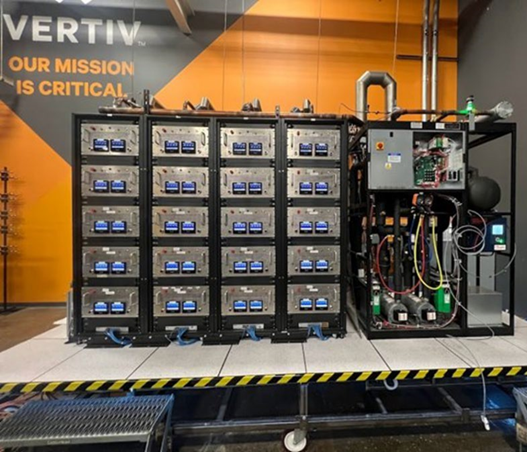
The growing need for technological advancements
Increased power densities of GPUs, CPUs and other components within a server and overall power consumption of IT equipment are driving dynamic discussion in the data center industry on what liquid cooling technologies will be required in the future. New generations of chips are packing other sub-systems into the IT equipment, such as memory and communication, which may require lower case temperatures than their processing counterparts.
Liquid cooling solutions will not only need to meet thermal performance requirements of IT loads but also energy efficiencies of the overall data center. Vertiv, in collaboration with industry partners, is conducting studies on emerging liquid cooling technologies to increase technology and commercial readiness levels in an effort to be ready for mass deployments when the time comes in the industry. These include direct-to-chip two-phase, immersion cooling, and hybrid cooling technologies, each coming with their own benefits and challenges to consider.
Explore these emerging technologies
Enable exceptional scale, velocity, and quality for every project regardless of size or complexity.
| Direct-to-chip | Immersion | |
|---|---|---|
| Adoption | Industry-adopted solution in fast-scaling stage | Limited adoption due to accelerated computing trends and maintenance challenges |
| Coolant | Water or Water/Glycol | Dielectric fluid |
| Efficiency | Depends on secondary water temperature design | High |
| xPU Heat Flux | < 300W/cm^2 | < 100W/cm^2 |
| Direct-to-chip | Immersion | |
|---|---|---|
| Adoption | Increased adoption and aligned with future xPU roadmaps | Very limited adoption due to design complexity and dielectric fluid regulations |
| Coolant | Boiling delectric fluid | Boiling dielectric fluid |
| Efficiency | Very high due to use of higher facility water temperatures | Very high |
| xPU Heat Flux | > 300W/cm^2 | < 300W/cm^2 |
| Direct-to-chip | Immersion | |
|---|---|---|
| Adoption | Industry-adopted solution | Limited adoption |
| Coolant | Industry-adopted solution | Limited adoption |
| Efficiency | Industry-adopted solution | Limited adoption |
| xPU Heat Flux | Industry-adopted solution | Limited adoption |
| Direct-to-chip | Immersion | |
|---|---|---|
| Adoption | Industry-adopted solution | Limited adoption |
| Coolant | Industry-adopted solution | Limited adoption |
| Efficiency | Industry-adopted solution | Limited adoption |
| xPU Heat Flux | Industry-adopted solution | Limited adoption |
| Direct-to-chip | Immersion | |
|---|---|---|
| Adoption | Industry-adopted solution in fast-scaling stage | Limited adoption due to accelerated computing trends and maintenance challenges |
| Coolant | Water or Water/Glycol | Dielectric fluid |
| Efficiency | Depends on secondary water temperature design | High |
| xPU Heat Flux | < 300W/cm^2 | < 100W/cm^2 |
| Direct-to-chip | Immersion | |
|---|---|---|
| Adoption | Increased adoption and aligned with future xPU roadmaps | Very limited adoption due to design complexity and dielectric fluid regulations |
| Coolant | Boiling delectric fluid | Boiling dielectric fluid |
| Efficiency | Very high due to use of higher facility water temperatures | Very high |
| xPU Heat Flux | > 300W/cm^2/td> | < 300W/cm^2 |

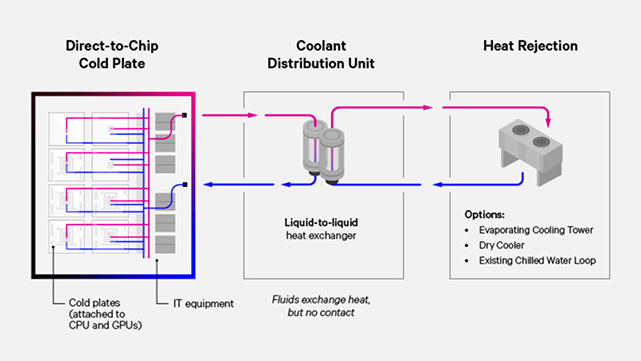
How does single-phase direct-to-chip cooling work?
Cold plates sit atop the heat-generating components (usually chips such as CPUs and GPUs) to draw off heat. Fluid flows through manifolds and in pipes through IT equipment, exchanging heat with cold plates to draw off heat without touching the chips. Air cooling is still required to extract heat from components that do not have a cold plate.
How does two-phase direct-to-chip cooling work?
Heat is generated in the silicon chip and captured at cold plates. That heat is then transferred to the refrigerant, which evaporates into a gaseous state. Via secondary fluid networks (SFNs), the vapor refrigerant moves to coolant distribution units (CDU) within the data center. These CDUs exchange the heat from the refrigerant to the primary (facility) loop for heat reuse or rejection, condensing the vapor refrigerant back into a liquid state. This primary fluid source can be water, water/glycol, or refrigerant based. The now liquid refrigerant is pumped back to the cold plates for another heat capture cycle.
Get the right solution for the challenge
Enable exceptional scale, velocity, and quality for every project regardless of size or complexity.
 |
 |
|
|---|---|---|
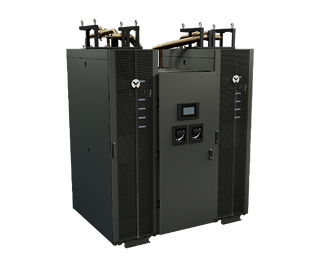
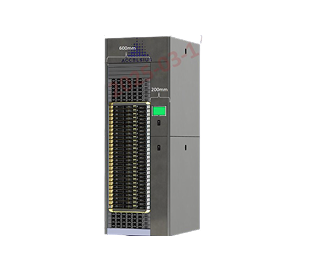
| Cooling solutions | CoolChip CDU XDRL | CoolChip CDU XDRL rack |
| Coolant distribution architecture | Refrigerant to liquid | Refrigerant to liquid |
| Deployment type | Row-based | Row-based |
| Total capacity | Up to 500kW | Up to 200kW |
| Refrigerant type | R515B | R515B |
References







Looking for a cooling solution?
Please fill out the form and we will get back to you as soon as possible