
The Unit of Compute macro force drives the use of standardized, validated building blocks, making AI infrastructure buildouts more efficient and predictable.
The data center industry is being reshaped by powerful macro forces fueled by the rise of AI and accelerated compute. These forces, defined in the Vertiv™ Frontiers report, are influencing every layer of digital infrastructure, spanning technologies, architectures, and industry segments.
One of these forces is the concept of the data center as a ‘unit of compute’ (UoC). The AI-era increasingly requires the data center to be built and operated as a single system. The UoC is no longer just a chip—it’s the entire system. Power, cooling, and compute must be highly integrated into one architecture, from rack to row to site.
The UoC approach addresses the issue that conventional data center construction models are arguably misaligned with the demands of modern AI and HPC workloads. Industry benchmarks show that:
- Stranded capacity in high-density deployments can consume up to 20% of installed power and cooling infrastructure, often from poor component integration.
- Construction labor overruns in AI-driven data center builds are increasingly common, accounting for 20–50% of total project costs.
These inefficiencies aren’t isolated. They’re systemic. Traditional infrastructure, built with siloed components and sequential workflows, struggles to accommodate AI’s unpredictable thermal spikes and tightly coupled power-cooling-compute dynamics. Even minor mismatches in electrical resistance or coolant flow can cascade into stranded capacity, degraded performance, or outright failure.
This is where the UoC concept becomes essential. By shifting to a standardized, systems-level approach, data center leaders can help reduce integration gaps, stranded resources, and restore economic efficiency. UoC enables infrastructure to scale like software: modular, predictable, and workload aligned.
Defining the UoC as strategic framework
The UoC is not a product or even a prefabricated module. It's a strategic approach that shifts decision making from "How many racks can we fit?" to "How many standardized compute units do we need to achieve business objectives?"
A true UoC model reduces the need for custom field engineering and replaces it with pre-engineered, validated building blocks. It aligns the smallest logical building block with AI workload requirements today, and scales to dozens, hundreds, or thousands of units without re-engineering. For executives, this can turn AI infrastructure into a predictable investment with clear costs, timelines, and performance.
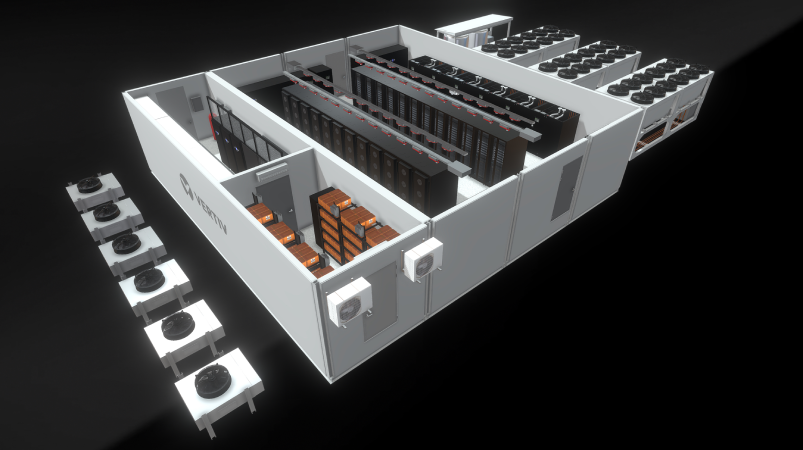
Vertiv 1MW HPC Rear Door Heat Exchanger (RDHx) reference design, illustrating a Unit of Compute model that integrates power, thermal management, and supporting infrastructure into a cohesive high-performance computing deployment. Explore the interactive 3D model at Sketchfab
Vertiv's first-mover advantage
Vertiv has delivered reference designs supporting liquid cooling solutions at rack densities exceeding 100 kW. This capability reflects years of co-development with leading hyperscalers and chip manufacturers, resulting in proven thermal management solutions that can reduce energy consumption by up to 82% compared to traditional air cooling in certain applications.
Operational intelligence as core infrastructure
In the UoC model, operational intelligence is not an add-on: It’s foundational. Select deployments now integrate digital twin modelling with controls to validate performance and support predictive maintenance.
Now what? Three-part plan for adopting UoC
1. Evaluate the strategic case
Assess the potential impact of UoC-driven AI infrastructure on your organization’s competitive position. Consider factors such as projected AI workload growth, time-to-market for new capabilities, and operational efficiency gains. This is about deciding whether a standardized, industrialized approach to compute can deliver measurable business outcomes, and whether it aligns with broader strategic priorities.
2. Align stakeholders and define success criteria
Define the metrics that will determine success, e.g., speed of deployment, infrastructure cost per AI operation, or operational resilience, and use them to guide investment decisions. This alignment sets the stage for a confident, organization-wide commitment to UoC principles when the build phase begins.
3. Benchmark your risk
AI and HPC workloads demand rapid, precise, and efficient deployment. But many data centers still rely on legacy build models that slow time-to-value. Prefabricated, integrated modules can change the equation dramatically.
Next: From strategy to scale
The Unit of Compute reframes AI infrastructure as a strategic decision: standardized building blocks that scale predictably instead of excessive custom integration that compounds risk. The math is straightforward: faster deployment, lower labor costs, less stranded capacity.
Data center as a unit of compute is one of the macro forces reshaping data center infrastructure identified in Vertiv™ Frontiers.