
AI factory economics at scale depend on validated systems instead of individual components. Learn why infrastructure must be simulated and tested as an interdependent whole before deployment.
AI factories are rewriting the economics of compute infrastructure at scale. Billions in capital committed against a single operational question: can electrical capacity be converted into productive compute quickly, reliably, and at a cost structure that justifies the investment?
The answer depends on how the complete physical system behaves as a convergent whole under real-world AI workload conditions. Namely, the power trains, thermal chains, controls, software, and the interfaces between them, working in sync.
Five intensifying forces are driving this shift:
- Density is compressing the margin for error at the rack level.
- Speed is making time to productive capacity the defining competitive metric.
- Scale is turning manageable interactions into dominant engineering challenges.
- Complexity is multiplying the interfaces where design intent diverges from physical reality.
- Dynamic workload profiles are rendering steady-state assumptions obsolete.
The traditional validation approaches of testing individual components against isolated specifications remain necessary. However, they no longer address the question operators are asking on the ground: does the system work when everything runs simultaneously?
The gaps that matter most exist at the interfaces and seams between systems.
This application brief introduces a closed-loop validation methodology that connects virtual simulation, physical systems-level testing, field deployment, and operational learning into a continuous cycle. Each iteration reduces the variance between what was designed and what is delivered.
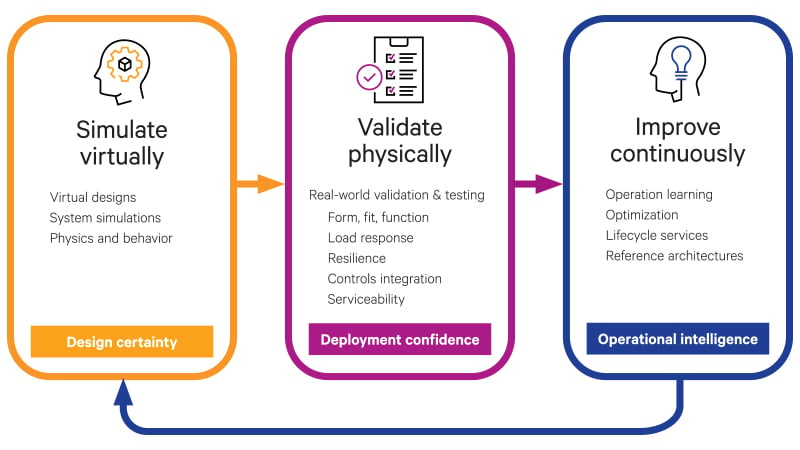
Figure 1. The closed loop enables the continuous reduction of variance between design intent and physical and operational reality. Source: Vertiv.
It examines how decades of distributed critical infrastructure validation capability can be consolidated and focused specifically for AI factory systems: validating combined power, thermal, and control behavior at greater scale, speed, and fidelity. And it frames the economic argument around four metrics that connect infrastructure performance to AI factory outcomes.
The brief provides a capacity validation framework; the questions to ask at each phase of the lifecycle, the indicators that distinguish validated confidence from inherited assumption, and the engineering logic behind treating infrastructure as a system rather than a collection of parts.
The infrastructure either performs as a validated system or performs as an assumption. AI factory economics leave increasingly little room for the latter.