
Traditional air-cooling systems are being pushed to their limits, compelling data center managers to rethink and innovate their cooling strategies with existing infrastructure.
Managing the high thermal density demands posed by AI workloads in data centers necessitates more adaptive and efficient solutions. Considering today’s technologies that can prepare existing infrastructures for future-ready features, liquid-to-refrigerant coolant distribution units (L2R CDUs) deployed in phased modular implementations can maximize the benefits of implementing for growth and attaining optimized thermal management strategies.
Traditional cooling in an AI surge
Conventional air-cooling methods have inherent limitations in the face of expanding AI services and applications. With the latest high-density clusters approaching 130kW per rack and higher, the heat generated can put immense pressure on operators to devise new and innovative thermal management strategies, standardize retrofitting designs, and deploy new equipment purpose-built for AI workloads. These systems are not designed to cope with the variable workloads and heat loads generated. Moreover, the lack of flexibility in cooling solutions often leads to inefficiencies and increased operational costs.

Data center operators no longer need to rely solely on chilled water systems. By integrating DX refrigerant-based heat rejection with direct-to-chip liquid cooling, CDUs offer an alternative that dovetails perfectly with existing DX infrastructure. This air-assisted or hybrid cooling approach ensures that high-density racks can be cooled efficiently, even in AI data centers originally designed for air cooling.
Modular hybrid cooling deployment as a strategic advantage
Data center managers can activate liquid cooling capacity incrementally, aligning with the business’s immediate needs and budget constraints. This phased approach supports the lower total cost of ownership (TCO) and enables significant energy efficiency savings, making it an attractive option for existing and new data centers. Operators can implement a cooling strategy that reaps liquid cooling benefits and prepares their facilities for scalability without the need for extensive, upfront studies.
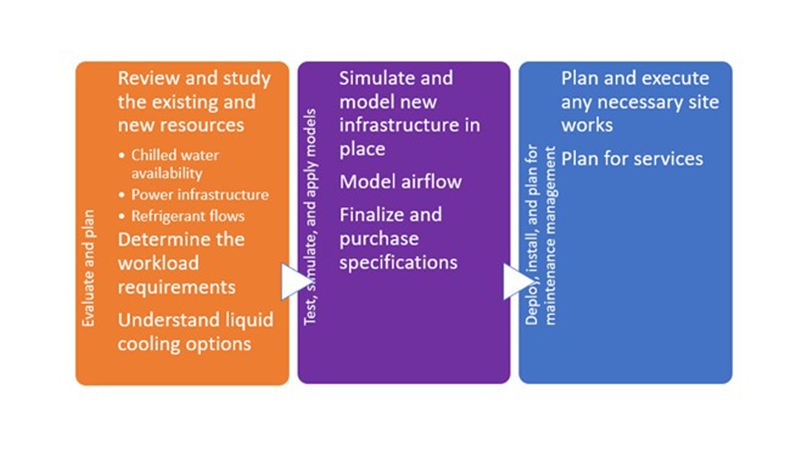
Moreover, these CDUs offer a level of operational flexibility. They allow for the creation of air-assisted liquid cooling clusters tailored to high-performance computing (HPC) and AI workloads while also supporting air cooling for lower-density applications and services. The infrastructure's standardized form factors allow for easy swapping of the new infrastructure. This adaptive capability ensures that data centers can meet evolving demands without undergoing disruptive and costly redesigns.
Leverage existing air-cooling infrastructure to streamline liquid cooling solutions
Deploy AI/HPC with confidence
In finding a flexible, modular, and energy-efficient solution, Vertiv™ Coolphase CDUs can better address the challenges posed by AI/HPC workloads in streamlining the deployment of liquid cooling systems. This mixed approach of air and liquid cooling can meet different workload requirements within the same facility without the downtime associated with infrastructure replacements or upgrades.
Despite the challenges of retrofitting existing data centers for AI/HPC workloads, the benefits driven by L2R CDUs for innovative thermal management can be transformative: addressing energy demands and optimizing for energy efficiency, managing physical space, integrating advanced systems, and achieving cost savings in the immediate and long-term.