
Understand what colocation means, when it makes sense, and how AI workloads are reshaping the power, cooling, and capacity requirements of modern data centers.
AI is changing what data centers must deliver. With GPU-based AI systems drawing more than 250 kW per rack, companies operating legacy data centers cannot build or scale infrastructure fast enough to keep pace. Colocation provides access to the power, cooling, and capacity needed for AI while maintaining control of hardware and data. This guide explains what colocation is, how it works, and what to look for in an AI-ready partner.
This guide explains what colocation is, how it works, and what to look for in an AI-ready partner.
What is colocation?
Colocation, often abbreviated as colo, is a shared data center model in which an organization rents physical space for its servers and IT equipment within a facility owned and operated by a third-party provider. The tenant leases rack space, along with power capacity, cooling, and network connectivity needed to support its deployment. The provider owns the building, power infrastructure, cooling systems, and physical security. The tenant retains full ownership and control of its hardware, software, and data.
The concept emerged as enterprises recognized that building and operating a purpose-built data center was capital-intensive and operationally complex. Colocation offered a way to share the fixed costs of power, cooling, and real estate across multiple tenants, making enterprise-grade infrastructure accessible to organizations that cannot justify a dedicated facility.
Today, the model spans a range of offerings. Retail colocation leases individual racks or partial cabinets to multiple tenants within a shared hall. Wholesale colocation dedicates entire suites or buildings to a single tenant, often at megawatt scale.
Why should businesses turn to colocation for AI?
AI infrastructure requirements are rising faster than many legacy data centers can accommodate. Higher rack densities, increased power demand, and the shift toward liquid cooling require upgrades that are costly, complex, and time-consuming to deploy. Colocation gives customers access to AI-ready power, cooling, and connectivity without building a new facility while maintaining control of their hardware and data.
Traditional racks typically operated at 5-10 kW. AI deployments have pushed densities into the 40-100 kW range (Figure 1) with advanced AI environments reaching 250 kW per rack and beyond. Industry roadmaps indicate rack densities will continue to rise as AI infrastructure scales.
Unlike stable central processing unit loads, graphics processing units exhibit rapidly fluctuating power usage patterns that strain conventional power and cooling designs. For colocation providers, the opportunity lies in closing the gap between legacy facility designs and the power, cooling, reliability, and scalability requirements of AI-ready infrastructure.
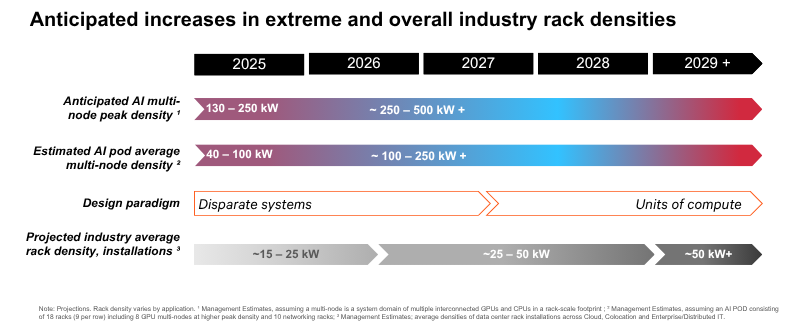
Figure 1. AI workloads are pushing rack densities far beyond traditional data center designs, increasing demand for high-density power and cooling infrastructure.
How does colocation work?
At its core, colocation separates ownership of the facility from ownership of the IT. The provider delivers:
- Physical space: Racks, cabinets, or suites within a hardened facility
- Power: Redundant electrical infrastructure, typically with UPS systems and backup generators
- Cooling: Air handling, chilled water, or liquid cooling systems sized to the contracted rack density
- Connectivity: Network access, often with carrier-neutral options for multiple providers
- Security: Physical access controls, monitoring, and compliance certifications
The tenant deploys its own servers, storage, and networking gear within the leased space. The provider maintains the supporting infrastructure. The tenant manages everything above the rack. (Figure 2)
The power architecture is where AI changes the model. Traditional colocation relied on low-voltage power distribution, which becomes inefficient at the densities AI demands. Providers are adopting medium-voltage distribution and advanced busway solutions to deliver more power with greater flexibility. Today, power typically flows from medium-voltage AC to low-voltage AC, such as 480V or 415V, for facility distribution before being converted again, often to 54 VDC, at the rack level. As AI rack densities approach the megawatt threshold, traditional AC distribution faces physical and practical limits due to conductor losses, high current, and heavy copper requirements. A higher-voltage DC architecture offers a more efficient path by reducing current, reducing copper requirements, and reclaiming space for compute.
Cooling follows a similar arc. AI infrastructure is pushing colocation providers beyond conventional thermal designs, requiring liquid cooling strategies that support higher-density compute while improving efficiency and resilience. Direct-to-chip liquid cooling, rear-door heat exchangers, strategic placement of coolant distribution units, leak detection, and integrated air-and-liquid cooling systems are key considerations for AI-ready colocation environments. The right mix depends on the facility, customer requirements, and careful planning with an experienced infrastructure partner.
What are the benefits of colocation for AI workloads?
Access to AI-ready infrastructure
AI workloads often need more power, cooling, and rack density than existing enterprise facilities can support. Colocation gives businesses access to infrastructure designed for high-density compute without building a new data center
Faster deployment of AI capacity
Building or upgrading a facility for AI can take years. Colocation can shorten the path to usable capacity by providing prepared space, power, cooling, and connectivity that can be matched to the workload.
Scalable power and cooling
AI demand rarely grows in a straight line. Colocation lets customers expand by rack, suite, hall, or campus while providers phase in power and cooling capacity as requirements increase.
Resiliency for dynamic GPU loads
GPU clusters can create fast, unpredictable changes in power and thermal demand. AI-ready colocation facilities use redundant power, cooling, and monitoring systems to help maintain reliability under variable load conditions.
Connectivity for hybrid AI architectures
Many AI environments depend on data movement between dedicated infrastructure, public cloud, edge locations, and users. Carrier-neutral colocation can provide access to multiple network providers and cloud on-ramps to support low-latency and hybrid deployments.
Better infrastructure efficiency
AI capacity should be sized to real workload needs, not guessed years in advance. Colocation can help companies avoid overbuilding, improve utilization, and manage energy use by placing workloads in facilities engineered for high-density infrastructure.
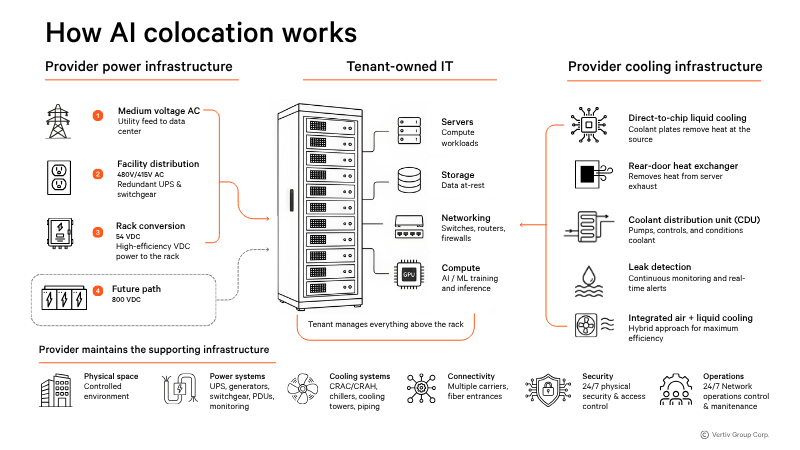
Figure 2. In AI colocation, tenants manage the IT equipment within their racks, while providers supply and maintain the power, cooling, connectivity, security, and facility infrastructure that support AI workloads.
What are the challenges and limitations of colocation for AI?
Colocation is not a universal answer. Several constraints shape the decision.
Power architecture limits
AI density is pushing rack-level power delivery toward its physical limits, with traditional approaches beginning to break down between 350KW and 400KW per rack as connector sizes, busbars, copper volume, and in-rack power conversion compete for space. Shifting to 800 VDC reduces current, conductors, and conversion stages while centralizing power conversion at the room level, allowing operators to simplify rack designs and support modular expansion within AI zones. Facilities that cannot adapt their distribution, conversion, protection, and cooling systems may struggle to support this transition.
Variable load behavior
GPU workloads can create rapid, volatile load steps that affect the power infrastructure supporting AI data centers. These spiky, dynamic loads can shift from idle to overload in milliseconds, while liquid cooling systems must respond to sudden increases in cooling demand. Because AI workloads require much higher power and cooling capacity in the same space, providers must design power distribution, UPS, cooling, and service access as an integrated system rather than separate infrastructure layers.
Control trade-offs
You give up control over the facility infrastructure and physical environment. Compliance demands, data sovereignty, or security policies may make shared infrastructure unsuitable for highly regulated or security sensitive workloads involving government, healthcare, or financial data subject to strict privacy requirements. As Uptime Institute notes, on-premises ownership delivers full visibility and the ability to adjust the risk profile of every workload.
What tested AI power infrastructure looks like
Considering colocation for AI? Ask how the provider handles rapid load swings. EdgeConneX worked with Vertiv to test UPS performance under AI-like power shifts, including transitions between high-compute and idle cycles, utility and generator power, and overload conditions. The takeaway: AI-ready colocation should offer power infrastructure proven against real workload volatility, not just available megawatts.
What are the real-world applications of AI-ready colocation?
Colocation serves a range of deployment scenarios across the infrastructure landscape.
NeoClouds
The largest cloud providers lease wholesale colocation space to expand capacity faster than they can build it. NeoClouds, the emerging class of AI-focused cloud providers, rely heavily on colocation to access the power and cooling infrastructure their GPU clusters demand.
Enterprise AI
Enterprises deploying AI training or inference workloads use colocation when their existing facilities lack the power density or cooling capacity. Applications that demand low latency, enhanced privacy, or strict security often call for on-premises or colocation deployment rather than public cloud.
Scalable power and cooling
AI demand rarely grows in a straight line. Colocation lets customers expand by rack, suite, hall, or campus while providers phase in power and cooling capacity as requirements increase.
Edge computing
Colocation facilities in secondary markets support edge deployments that bring compute closer to users and data sources, reducing latency for real-time applications.
Hybrid infrastructure
Many companies land on a hybrid model. Steady, predictable core workloads run in colocation. Elastic, fast-changing workloads run in public cloud. This per-workload approach reflects how most infrastructure teams actually operate.
Industrial and research
High-performance computing workloads in manufacturing, pharmaceuticals, and academic research use colocation to access specialized power and cooling without building dedicated facilities.
AI-ready capacity without building from scratch
Polar’s AI-ready facility in Norway shows what to look for in a provider: scalable capacity, factory-tested infrastructure, high-density cooling, and efficient operations. The site’s 12 MW initial capacity, scalable to 48 MW, demonstrates how colocation can give customers access to AI-ready infrastructure faster than building a dedicated facility on their own.
What should buyers evaluate in an AI colocation provider?
AI-ready colocation decisions should start with workload requirements, then test whether the provider can deliver the right power density, cooling capability, deployment speed, resiliency, and operational efficiency.
Power systems
At megawatt scale, traditional low-voltage distribution becomes inefficient. Vertiv has aligned with the 800 volt direct current (VDC) power architecture roadmap for the next generation of AI-centric data centers, with our 800 VDC power portfolio scheduled for release in the second half of 2026.
Cooling systems
Conventional air cooling cannot manage the heat concentrated in AI racks. We are seeing the industry move toward hybrid cooling strategies that combine air and liquid cooling. Direct-to-chip liquid cooling removes up to 75% of rack heat load, while rear-door heat exchangers provide flexible, power-dense cooling. The Vertiv™ CoolPhase Flex solution, developed with Compass Data Centers, integrates air and liquid cooling into a single system that can support traditional workloads today and convert to liquid cooling for AI workloads in less than a day. Rear-door heat exchangers are effective for rack densities up to approximately 80KW, depending on the unit configuration, making them a practical complement to direct-to-chip systems in hybrid cooling environments.
Rack density
Vertiv’s co-developed reference architecture for the NVIDIA GB200 NVL72 liquid-cooled rack-scale platform supports up to 132 kW per rack. In comparison, Vertiv’s OCP-aligned rack ecosystem includes concepts supporting loads up to 142 kW. Colocation providers must plan for a wider density range, rather than the low-density racks that shaped earlier facility designs.
Speed-to-power
Speed-to-power is becoming a core constraint as grid capacity and interconnection timelines shape how quickly data centers can scale. Vertiv™ OneCore is a hybrid, pre-integrated solution for 10 MW to 250 MW data centers and beyond, offering end-to-end infrastructure designed for the speed and flexibility demands of AI applications. Buyers should assess how quickly a colocation provider can deliver usable capacity and whether its infrastructure can be matched to workload needs rather than overbuilt for every scenario.
Infrastructure resiliency
AI workloads introduce dynamic, unpredictable load changes that current designs may struggle to handle. Adaptive UPS systems, grid support capabilities, and power distribution engineered for variable loads are becoming baseline expectations.
Operational efficiency
AI infrastructure should be planned around the workload, not just available space or power. Buyers should match each workload’s density, latency, utilization, and resiliency needs to a provider’s power and cooling capabilities. This helps avoid overbuying capacity, control energy costs, and maintain reliability as AI demand scales.
AI-ready colocation depends on density, speed, and infrastructure readiness
Colocation bridges the gap between on-premises ownership and public cloud, offering capital efficiency, speed to capacity, and access to infrastructure that many companies cannot build themselves. AI has changed what infrastructure must deliver. Racks draw 10 times the power they did a decade ago. Cooling has moved from air to liquid. Power distribution is moving from low-voltage alternating current to 800 VDC. The colocation providers that succeed will be the ones that engineer density, deliver capacity at speed, and manage the dynamic, variable loads that AI produces. For buyers, the question is no longer where to place servers. It is whether the facility can support the AI workloads the business needs to run.
Preguntas Frecuentes
¿A qué tipo de inventario aplica el 15 % de descuento?
Aplica únicamente al stock actual de los mayoristas e hiper mayoristas de LATAM.Vertiv™Liebert® PSL, GXT-MT, GXT-RT, GXE
¿Puedo comprar inventario con este descuento?
No. El descuento solo aplica cuando se comprueba una oportunidad real y/o la existencia de un usuario final.
Si ya tengo un negocio con un 10 % de descuento, ¿puedo sumar el 15 % del programa Trade-In?
No. El descuento del programa Trade-In no es acumulable. Aplica únicamente para cambiar o actualizar equipos existentes, ya sea de otras marcas, generaciones anteriores o por aumento de capacidad.
¿Cuál es el período de vigencia de la campaña?
Del 20 de mayo al 20 de agosto de 2026.
¿Qué documentación debo presentar para aplicar al programa Trade-In?
- Fotografías del producto a reemplazar (visibles y con número de serie), por cada unidad.
- Aprobación del formulario correspondiente por parte de Vertiv.
Si deseo adquirir productos por la plataforma e-commerce del mayorista, ¿puede aplicar la campaña Trade-In?
Sí. Siempre que el mayorista pueda evidenciar los documentos requeridos, formulario Vertiv completo y evidencia fotográfica enviada al mayorista para obtener la aprobación del descuento.
¿Existe un límite de unidades para aplicar el descuento?
No. No hay un límite máximo de unidades para participar en la campaña.
¿Existe un límite de unidades para aplicar el descuento?
No. No hay un límite máximo de unidades para participar en la campaña.