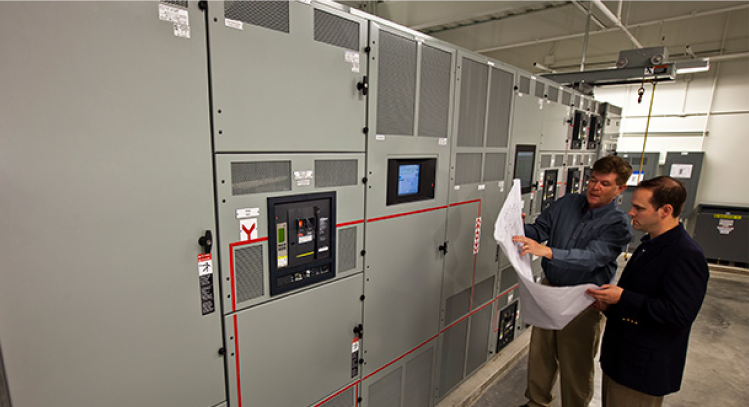
There was a time when telecom sites were relatively simple. The loads were static and linear. Operators knew what the power draw was not just for the site, but for every piece of equipment at the site. They were notable for their consistency above all else.

Those times are gone.
Today, with IT based equipment deployed to both core and access sites, loads fluctuate wildly. New servers consume more power, and an old name plate rating doesn’t necessarily reflect the true power draw. Higher power servers also generate more heat, and the systems used to cool those servers require power. What once was a straightforward power profile today is a constantly moving target that requires smart energy management.
The proliferation of multi-tenant sites further complicates power management, and even that challenge presents layers of complexity. The power draw isn’t just divided among multiple organizations; it often must be sliced to the business unit or functional level within each organization. Accurate measurement and billing require intelligence that was quite difficult to gather 10 years ago.
There are technologies available to help operators navigate this complex reality. Most of these rely on an array of sensors and additional equipment that, frankly, can be expensive yet every bit as confusing as the status quo. There are helpful load management alternatives, however, including solutions integrated in standard telco site DC power equipment.
Over the past several weeks, we’ve highlighted various features of the Vertiv™ NetSure™ Control Unit (NCU), Vertiv’s advanced controller for DC power systems. We’ve covered things like peak shaving and shifting and lithium-ion battery mode that present opportunities for smarter energy management. The Vertiv NCU also offers integrated, intelligent load management that allows operators to get a clear picture of their site loads and simplify management of those loads – all part of a standard DC power system.
Test Asset - Do not use_For widget testing only.pdf
Intelligent load management provides several potential benefits. These include:
-
Energy Savings: The Vertiv NCU can identify the location and power profile of every rack at a given site, identify potential hot spots and recognize load distribution inefficiencies. It can help operators group loads where they belong and map the site’s power distribution and thermal output, ultimately allowing operators to move racks to optimize airflow and thermal management.
-
Availability: The system measures and displays data on each individual current and each circuit breaker’s capacity, helping operators understand how the load is performing and identify potential issues. That data can be processed in a customer’s site monitoring system. Users can pre-set alarm levels on each breaker and rack to provide early warnings of potential overloads. Such events are not uncommon in today’s telco core sites, where new servers with double the capacity of their predecessors are installed using existing connections that aren’t rated for those servers. That can result in anything from a tripped breaker to a fire.
-
Cost Control: With the Vertiv NCU, users can designate which circuit breaker or fuse is connected to which rack, or any other group of loads, with visibility and control of those connections through an easy-to-use drag-and-drop web interface. This enables detailed measurement of customer energy use and accurate billing. Notably, all the current measurement hardware and software used for this feature is built into the DC power system. It eliminates the need for – and costs of – additional equipment.
As is the case with some of the other features we’ve discussed in this series on the Vertiv NCU, intelligent load management is underutilized in many networks. This is residue of simpler times and sites, but today’s networks are more complex and can benefit from proactive intelligent load management.
Are you using intelligent load management in your sites? If so, what kinds of benefits are you seeing?

Vertiv offers critical infrastructure technologies and rapidly-deployable customized solutions to meet specific business requirements and needs.


NEWS RELEASES
Vertiv Reports Strong Fourth Quarter Results and Provides Full Year 2024 Outlook
Vertiv reported fourth quarter 2023 net sales of $1,865 million, an increase of $211 million, or 13%, compared to fourth quarter 2022 and a 12% organic net sales(1) increase, which excludes the impact of foreign currency. The book-to bill ratio was 1.3x in the fourth quarter and organic orders increased 23% from last year’s fourth quarter, as underlying market demand remained strong.
WHITE PAPERS
How to Implement Liquid Cooling at Existing Data Centers
The future of data center thermal management is here – It is liquid cooling. So, how fast will you transition higher-density workloads to hybrid cooling infrastructures?
Blog Posts
Powering and cooling AI and accelerated computing in the data room
AI is here, and it is here to stay. “Every industry will become a technology industry” according to NVIDIA founder and CEO, Jensen Huang. The use cases for AI are virtually limitless, from breakthroughs in medicine to high-accuracy fraud prevention. AI is already transforming our lives just as it is transforming every single industry. It is also beginning to fundamentally transform data center infrastructure.