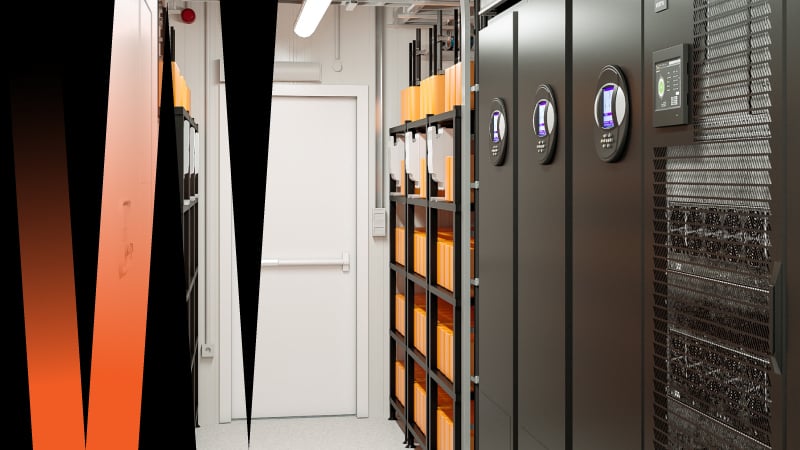
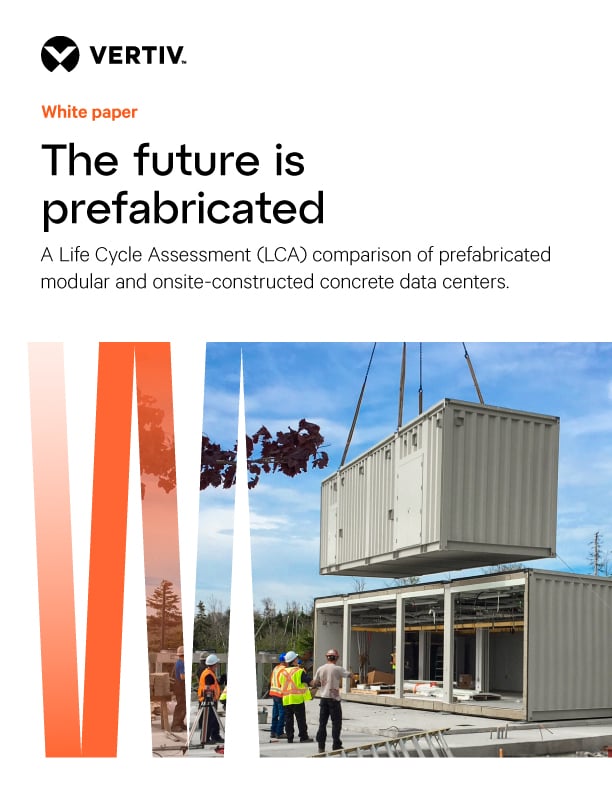
How you build sets carbon locked in from day one.
While the industry focuses on power usage effectiveness (PUE) and operational efficiency, embodied carbon gets locked in before a single server powers on. And unlike energy consumption, you can't optimize it later.
Data center operators now face converging pressures: accelerating capacity demand, tightening emissions reporting requirements, customer expectations for low-carbon infrastructure, and investor scrutiny of Scope 3 emissions. The task is now to deliver capacity at speed and scale while keeping carbon impact in check.
Prefabricated modular data centers (PMDCs) have gained traction for deployment speed, but their carbon advantage has been more assumed than quantified. Until now.
What the assessment measures
A comprehensive Life Cycle Assessment (LCA) conducted according to European Standard EN 15978 compares "a 1.5-megawatt (MW) PMDC with steel-frame construction" against "a conventional concrete-shell facility with matching IT capacity." The LCA report tracks embodied carbon across material production, transport, construction, refurbishment potential, and end-of-life scenarios.
The scope deliberately excludes operational energy to isolate the carbon impact of construction decisions alone. What remains is a comparison of how building methodology drives the portion of a data center’s carbon footprint that's irreversible once construction begins.
Where prefabricated modular data center wins
The carbon advantage stems from five interconnected factors:
Material efficiency.
Steel-framed modules achieve equivalent structural performance with significantly less material mass than concrete, resulting in lower aggregate emissions.
Factory precision.
Research shows that off-site construction can lower waste to 1.8%, compared to the 30% waste generated by conventional methods.
Efficient, low-impact assembly.
Controlled factory conditions can replace energy-intensive onsite work, cut rework, and streamline logistics. Parallel workstreams can shorten deployment time by up to 50%.
Standardization at scale.
Factory-controlled production environments offer greater measurement precision and consistency.
Steel's circular lifecycle.
Steel maintains its structural integrity through repeated recycling cycles, with "over 90% recovery rates.
Why this study matters
Construction decisions made today will define the industry's carbon trajectory for decades. Understanding how building methodology shapes embodied carbon isn't just about compliance. It's about building infrastructure that scales responsibly.
The full whitepaper includes detailed methodology, life cycle stage analysis, and recommendations for emerging approaches including cross-laminated timber and green steel sourcing.
Get the full analysis, technical specifications, and carbon accounting framework.
Get the white paper now.