
Standard commissioning worked when cooling failures meant replacing a fan. In AI factories where compute throughput is revenue, liquid cooling demands two non-negotiable variables: engineered flow and lifecycle balance.
We are witnessing a risky trade-off in the race to deploy generative AI. According to Uptime Institute’s January 2026 Intelligence Update, “Coolant distribution units can complicate commissioning,” the pressure to deliver operational facilities for frontier model training is leading some operators to bypass essential steps like Factory Witness Testing (FWT) for Coolant Distribution Units (CDUs).
"When speed takes priority, and/or CDUs are retrofitted into an existing facility, FWT is more likely to be overlooked. For example, hyperscalers deploying superclusters for generative AI training might proceed without FWT to produce a trained model quickly and will rely on the manufacturer’s assurances of performance and reliability."
‒ Uptime Institute January 2026 Intelligence Update: Coolant distribution units can complicate commissioning*
*A password is required to read the full report. Guest access is available.
The skepticism is warranted: when speed takes priority over verification in a Direct Liquid Cooling (DLC) environment, you aren't just risking a facility-fault. You are risking the compute itself.
An AI data center is no longer just a facility; it is an AI Factory. In this environment, the Secondary Fluid Network (SFN) acts as a circulatory system. When we are dealing with microchannel cold plates featuring 25–50-micron passages, a single particle of construction debris or a pocket of entrained air is not a maintenance nuisance. It is a direct business risk that drives nodes into thermal shutdown.
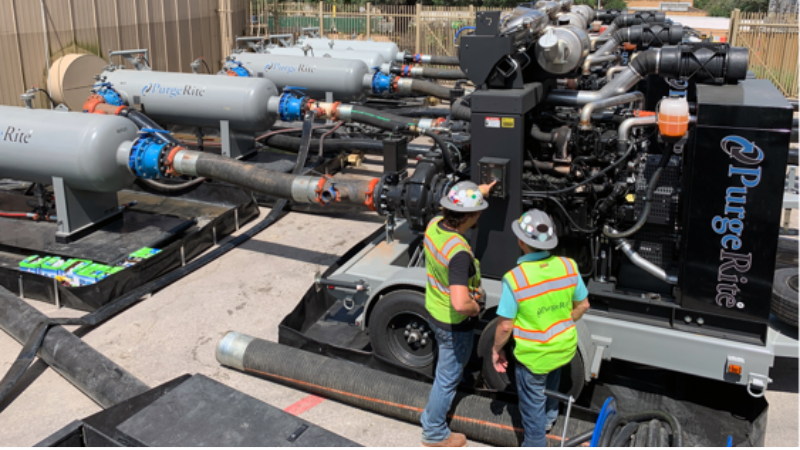
We need to stop treating liquid cooling commissioning as a commoditized "flush and fill" exercise. With the December 2025 acquisition of PurgeRite, a leading provider of specialized fluid management services, Vertiv has established a new standard of care based on two non-negotiable performance variables: flow and balance.
Flow: The [certified] clean start
Flow is not just about moving water. It is about engineered turbulence and the ability to prove correct volume, velocity, and purity from Day 1.
- Engineering before execution: Every flush begins with system analysis, mapping flow, pressure, and head requirements, so performance is designed in, not discovered later.
- Velocity with intent: Flow rates aren’t guessed. They’re calculated to reach debris‑removal velocities where it matters most, including pipe sections standard contractors often overlook.
- Purpose-‑built intelligence: System curves, custom models, and historical performance data define operating points tailored to each environment.
- Designed for predictability: Reduces field adjustments, compresses schedules, and delivers documented performance predictability from the first flush.
Balance: Lifecycle hydraulic stability
The AI Factory is not static. Every tenant move, rack addition, or valve tweak alters the pressure and flow resistance of the loop. Without management, these changes break hydraulic balance, quietly starving other racks of coolant.
- Recurring assurance: Balance is a lifecycle service. We commission and tune balancing valves at startup, but crucially, we re-balance and re-certify every time the environment changes.
- Defensible data: By instrumenting flow and pressure at critical nodes, we provide the operator with defensible proof that thermal SLAs are being met, regardless of "noisy neighbors" on the loop.
The bottom line
The SFN is arguably the most financially exposed system in the modern data center. If your loop is dirty, unbalanced, or air-bound, you don't lose a CRAC unit, you lose compute availability and the revenue that comes with it.
Vertiv treats coolant flow not as plumbing, but as a managed performance variable. With the integration of PurgeRite , we are delivering the industry’s reference process for the AI era.
This is the path toward "adaptive, resilient liquid cooling", a thermal operating system that detects anomalies before a rack derates. But it starts with the discipline to demand flow and balance today.
Adaptive, resilient liquid cooling is one of the technology trends identified as shaping the future of the data center in the Vertiv Frontiers report.