For operators building at AI scale, power availability has become the defining constraint. With grid interconnection timelines stretching past five years, the choice between waiting for utility capacity and generating your own has never carried higher stakes.
There is a decision in front of every operator building large-scale AI infrastructure right now, and it is not primarily about technology. It is about time.
Grid interconnection timelines in the U.S. now routinely stretch two to five years — a window that sits entirely outside the planning horizon of most competitive AI deployments. Rack densities pushing well past 25KW and into the triple digits are arriving faster than utilities can provision the capacity to power them. The result is a growing divergence between the speed at which AI infrastructure demand is materializing and the speed at which grid infrastructure can respond.
For operators facing that divergence today, the choice is no longer theoretical. This article walks through what that decision actually involves — and what our Bring Your Own Power & Cooling (BYOP&C) model is built to deliver.
The five-year queue: What waiting actually costs
The interconnection bottleneck is well documented. According to Lawrence Berkeley National Laboratory, median interconnection study durations for new projects now stretch two to three years, and the timeline from interconnection request to commercial operations frequently exceeds five years. For battery and gas projects, mounting delays compound the challenge further as queues grow.
That timeline carries a direct capital cost that is easy to underestimate. Every month a facility sits in the interconnection queue is a month where infrastructure investment is not generating return. AI infrastructure decisions made today tie to competitive windows that open and close on a cycle measured in quarters, not years. A five-year wait does not simply delay revenue — it can redefine whether a deployment remains competitive by the time it comes online.
Sightline Climate’s latest Data Center Outlook puts a number on the scale of that risk: up to 50% of the 2026 pipeline may not materialize, with around 11 GW of announced capacity showing no visible construction progress despite commitments to come online that year. The gap between announced ambition and delivered capacity reflects, in large part, how thoroughly the grid constraint has disrupted deployment planning.
The hidden capital problem in fragmented infrastructure
Beyond the timeline, there is a less visible cost in how most data center power and cooling infrastructure has been built. On-site generation, done well, targets that cost directly.
Unoptimized power and cooling infrastructure creates stranded capacity buffers: investments in BESS, cooling systems, and electrical distribution that consume capital without contributing to usable compute. When power and thermal systems operate independently, the result is predictable. Electric chillers draw material power loads that erode usable IT capacity. Separated systems can lead to duplicated infrastructure and excess BESS provisioning. AI workloads — spiky and unpredictable by nature — demand systems that can react in lockstep, and siloed infrastructure lacks the coordination for that.
The arithmetic is straightforward. A meaningful share of capital in unoptimized deployments can flow toward buffers and parasitic systems that never translate into compute. That overhead compounds at the scale AI deployments require, creating a structural drag on returns that operational optimization alone is not intended to fully correct after the fact.
What on-site generation actually changes
On-site generation addresses the timeline problem directly. At 3–10MW, modular, factory-integrated BYOP&C configurations compress deployment from years to months — a timeline that aligns with the actual pace of AI infrastructure demand. Grid connections remain an option at this scale, but for operators who cannot absorb multi-year interconnection delays, the calculus shifts decisively.
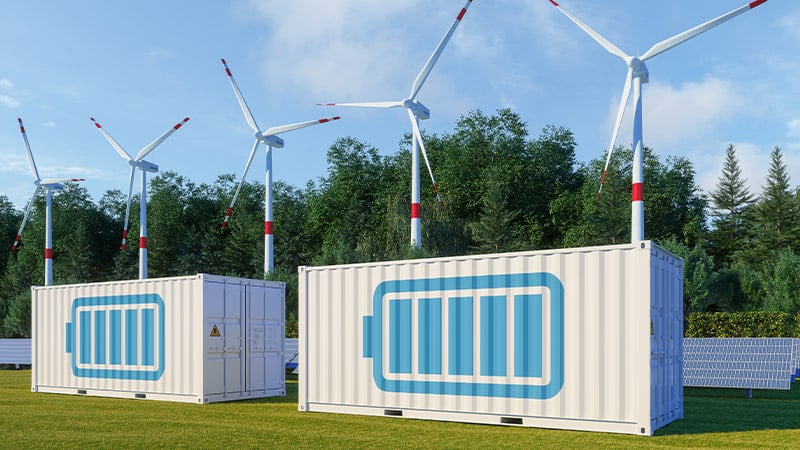
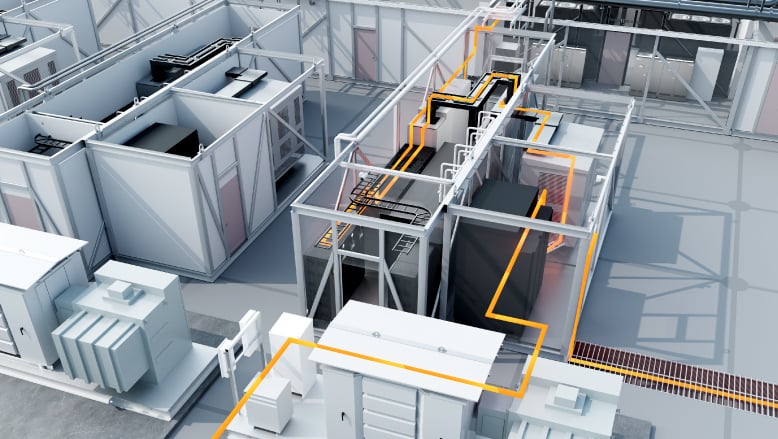
Our BYOP&C model goes further than bypassing the queue. It unifies on-site generation with co-optimized liquid cooling, battery energy storage systems (BESS), and heat-reuse strategies into a converged grid-to-chip architecture. Absorption cooling powered by waste-heat recovery targets reclaiming up to 5–15% of stranded capacity and redirecting it to compute without requiring additional grid allotments. Predictive telemetry anticipates workload spikes, designed to reduce reliance on oversized buffers.
The industry is moving toward validated reference architectures — modular, factory-integrated blocks that shorten design cycles from years to months. These standardize the integration of generation assets, BESS, cooling, and controls into repeatable configurations. The result is a deployment path that is designed to be both faster and more capital-efficient than fragmented grid-dependent designs.
Making the decision: what to evaluate
The choice between grid connection and on-site generation is not binary for most operators. It is a question of where you are in your deployment timeline. Consider what scale you are building toward, and how much capital exposure you can absorb in a multi-year interconnection queue.
For deployments in the 3–10MW range targeting enterprise AI clusters, regional colocation, or dedicated inference infrastructure, BYOP&C is most immediately applicable. For larger-scale deployments — 100MW and above — phased BYOP&C architectures support dynamic load responsiveness, thermal reuse, and scalability across multiple compute generations.
Across both scenarios, the governing question is the same: how much of your capital investment reaches usable compute? A single integration partner covering power generation, cooling, and controls across the full ecosystem is designed to reduce the coordination friction and accountability gaps that fragment multi-vendor deployments. We serve as the orchestrator of the BYOP&C model — synchronizing generation, cooling, BESS, and IT demand so that every watt and every thermal loop contributes directly to usable compute.
The grid constraint is not resolving on a timeline that works for AI deployment. Interconnection queues are lengthening, pipeline delivery risk is rising, and the capital cost of waiting is compounding with each quarter. The decision between grid and on-site generation has moved from a niche consideration to a mainstream infrastructure question.
What BYOP&C offers is not simply an alternative power source. It is an integrated architecture built to align your deployment pace with AI demand. More of your infrastructure capital works toward the output that matters: usable compute at the rack.
The operators making that decision well today are not choosing between grid and on-site in isolation. They are choosing a deployment model, a capital structure, and a long-term infrastructure partner. That choice is worth making carefully, and making now.