Higher-density, variable loads expose gaps in power system design and validation. Closing them depends on how systems are defined, tested, and delivered.
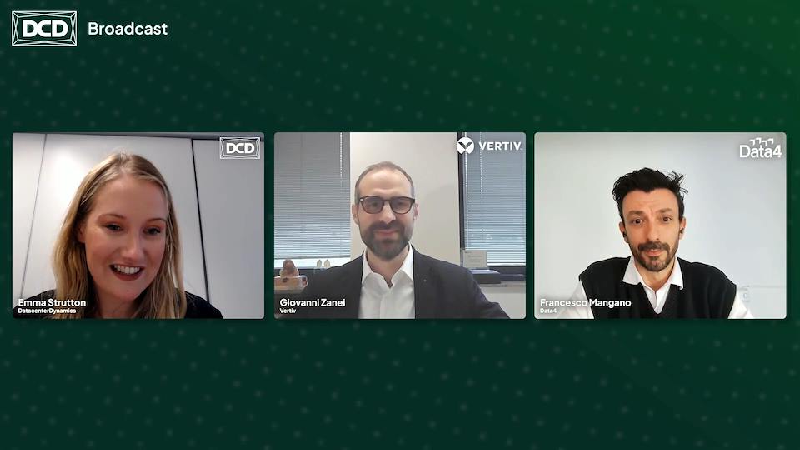
AI workloads are changing how data centers consume, distribute, and stabilize power. In the third episode of Vertiv Power Innovation Day 2026, Francesco Mangano, Head of Engineering at Data 4, and Giovanni Zanei, VP of Large Power Conversion at Vertiv, join Emma Strutton of DatacenterDynamics (DCD). They discuss ecosystem alignment, grid stabilization, the shift toward high-voltage DC (HVDC) power architecture, and why standardizing and replicating at scale is becoming the foundation for AI infrastructure.
Emma Strutton, Head of Channels, DatacenterDynamics (DCD): How important is ecosystem-wide collaboration in delivering AI-ready data centers that scale — and what does a truly aligned roadmap look like across power, cooling, and IT in practice?
Francesco Mangano, Head of Engineering, Data 4:
It's the starting and the end point. With AI at scale, there is a growth of complexity and controls that we cannot treat in single silos. Think of it like a blanket: if you're not positioning your blanket properly, you pull it from one side and you uncover the other. The approach must be holistic.
Ecosystem alignment starts with a clear understanding of the desired destination. From there, organizations can work with partners that take a 360-degree view of the ecosystem to align technical development roadmaps.
Giovanni Zanei, VP of Large Power Conversion, Vertiv:
We need to work as an industry together: customers, consultants, infrastructure builders, and other suppliers. There are new developments every three months, if not faster. AI and larger data centers are driving bigger infrastructure building blocks and greater complexity. The goal of our work is to build more efficient infrastructure, where the IT load remains the priority, and everything else is designed to support it.
Emma: AI training workloads carry fundamentally different load profiles. What challenges do variable, bursting loads create for electrical infrastructure?
Giovanni:
Think about a very large, hundreds-of-megawatt light bulb that suddenly turns on, then turns off very fast. This strains whatever is upstream: the generators, the grid, and the utility's power quality.
Francesco:
It's the difference between a four-hour marathon, which was the old design, and 100 meters at full speed but done continuously, with constant accelerating and stopping. This creates a lot of stress, concerning even transportation and supply operators. The challenge is that the data center can be both a noise producer or one of the filters — one of the solutions as well. What the industry is trying to do is convert what could be a potential issue into a solution for other parts.
Giovanni:
The data center is a big load, and potentially, a big balancer or stabilizer for the grid. Power conversion maintains that the energy to support the load is taken from the right energy source at any given time. With batteries and local energy sources, it's possible to define when the right moment is to support the load. An under-voltage event would traditionally disconnect a data center from the grid, creating significant instability. Done properly, power conversion can instead keep the load flat and run through the fault. This is called "fault ride-through," and it keeps the grid up and running.
Emma: How is densification driving changes in power conversion and distribution strategies?
Giovanni:
Racks are growing from 10 to hundreds of kilowatts; data centers, into the hundreds of megawatts. That scale demands more efficient infrastructure — fewer conversion stages, less copper, and fewer losses in the chain. The design shift is treating cooling and power as an integrated solution, not isolating every piece of equipment separately.
The end load is not only growing in power but also changing the required voltages and currents. The more current used to distribute power, the less efficient it is and the more copper it requires. HVDC architecture can solve both, enabling denser distribution, removing conversion stages, and reducing infrastructure complexity.
Emma: Why is a more integrated, system-level approach now essential for AI data center design?
Francesco:
Every single trade within the data center is interconnected. Reliability and resiliency are the alpha and omega of the design. We are moving pieces of the data center outside the building, from internal construction, where you have multiple people, different approaches, and processes, to a model where a single entity handles it with quality procedures. Adding a layer here is actually increasing quality and simplifying installation afterward.
We take the completed piece and install it. In our own construction, we focus on quality without inspecting the lower layer already completed in the factory under certified procedures.
Giovanni:
A system-level approach means testing the full integrated system, including at the factory level. Standardization is fundamental to quality across suppliers and operators, shifting to reusable components with one layer of customization, be it voltage level or pod size. The foundational layer is standardized. Design once, then replicate.
Francesco:
If you want to move faster and remain at the top level of quality — it's exactly this: standardize and replicate. Like Lego, you build everything with the same pieces. Once you have the same components, you don't need to go through changes in processes. If we keep the basics strong, reliable, and quality-oriented, we will be capable of coping with this super-accelerated market.
Emma: What are your key takeaways for our audience?
Francesco:
We need to focus as we cope with this holistic transition, in terms of mindset and technology approach. We need to think we can keep speed, quality, and environmental standards together. We cannot stay still; we must look ahead and anticipate what is coming.
Giovanni:
We are in a period of significant transition, and the challenges are bringing real opportunities. The industry is building infrastructure that can keep pace with AI while holding quality and speed together. Data centers are large power consumers, but they can also help support the grid.
Watch the full conversation: Aligning power distribution, ecosystems and architecture for high-density environments