
Liquid cooling systems cross traditional boundaries between IT and facilities, creating challenges but also opportunities for more holistic services.
Lost in transmission
At 2:00 AM, a CDU (Coolant Distribution Unit) alarm goes off in a data center rack. The unit, part of the IT’s liquid cooling system, interfaces with the facility’s chilled water loop. The IT team receives the alert through its monitoring tools but lacks access or authority to troubleshoot mechanical components. Facilities has the expertise but isn’t monitoring the CDU in real time. The result: a 45-minute delay as teams coordinate, during which rack temperatures begin to rise.
This is a potential scenario for data centers adopting liquid cooling. Air cooling largely keeps teams in separate swim lanes. IT owns servers and switches. Facilities teams manage chillers and air handlers. Liquid cooling changes this. CDUs, manifolds, and in-rack plumbing don't fit cleanly into either domain. They create operational gaps that affect both performance and reliability.
A survey by Uptime Intelligence, the analyst group within Uptime Institute, found that about 17% of data centers use liquid cooling, and over 61% are considering it. The data points to the growing momentum behind its adoption. As AI and HPC workloads push rack densities beyond 50kW, operators face infrastructure that spans traditional team boundaries.
Where digital meets mechanical
Liquid cooling introduces a new layer between the cooling plant and silicon. CDUs condition and distribute coolant. Manifolds route fluid to specific components. These components affect both compute performance and thermal management, making ownership decisions critical.
The operational complexity multiplies when hyperscale tenants deploy their own liquid-cooled servers while relying on the colocation provider's facility infrastructure. Service level agreements define responsibility, but operational reality often involves multiple teams across different organizations. Who monitors fluid levels? Who responds to pressure alerts? These questions highlight the disconnect between documented roles and real-time response.
Four approaches to shared responsibility
According to the Uptime Institute, the traditional boundary between IT and facilities doesn’t translate cleanly to liquid cooling. Operators typically adopt one of four approaches: (See Figure 1).
Option A: IT-owned stack
IT teams manage everything: from rack manifolds to server cold plates. This simplifies ownership but assumes IT has mechanical expertise for fluid handling and leak management.
Option B: Facilities-owned stack
Facilities teams control all cooling infrastructure, including in-rack components. It leverages mechanical skills but can complicate access and training for IT-managed systems.
Option C: Split at rack boundary
Facilities manages up to the rack CDU or manifold; IT handles internal server plumbing. This split is common in hyperscale-colo agreements where operational roles are clearly defined.
Option D: Facilities connects, IT operates
Facilities teams handle physical connections; IT manages monitoring and basic maintenance. Suited for multi-tenant environments but demands close coordination.
Each model works in specific contexts, but actual deployments often involve custom arrangements.
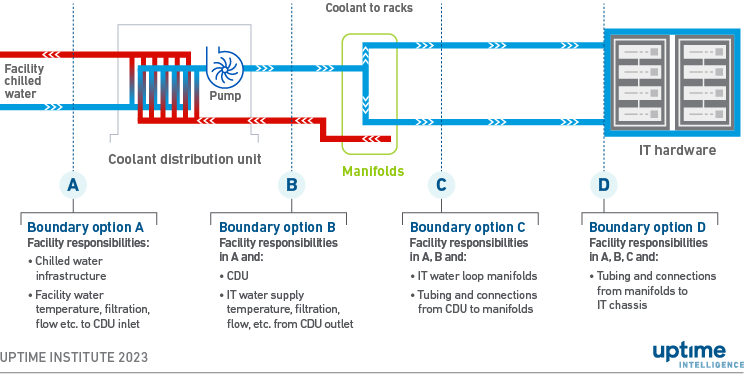
Figure 1. Vertiv™ Facility and IT boundary responsibility options for a DLC system. Source: Uptime Institute, 2023
What collaboration requires
Liquid cooling changes more than just hardware. It changes how teams work. IT and Facilities can’t operate in isolation when systems share fluid loops, controls, and failure points. Coordination isn’t optional. It has to be built into how the infrastructure runs.
Here’s what that looks like in practice:
Shared visibility: CDU and facility alarms should be visible to both IT and Facilities, whether through integrated dashboards or agreed reporting protocols. The goal is not to merge systems but to make sure both sides see the same status data in time to act.
Targeted cross-awareness: IT staff don’t need to become fluid dynamics experts, but they should know what a leak alarm or pump fault means for server availability. Likewise, Facilities teams should understand the implications of server-level alerts so they can connect them back to cooling performance.
Clear escalation rules: Define who handles which alerts, when to call in the other team, and how to grant access to restricted areas during urgent interventions. These rules should include backup contacts, so response isn’t blocked when the primary point of contact is unavailable.
Coordinated vendor support: In multi-vendor environments, assign a coordination role for integration issues across the stack. This doesn’t necessarily mean a single consolidated contact, but it does mean clarifying who manages communication with each supplier and how conflicts are resolved.
Deploy liquid cooling with precision
When components like CDUs fall between teams, response times slow, and performance suffers. Avoiding those breakdowns takes more than hardware. It takes clear roles, shared visibility, and coordinated planning from the start.
Vertiv™ Liquid Cooling Services helps you bridge that divide. From design to day-to-day operation, we align infrastructure and IT to keep systems running without the handoff delays.
Contact a Vertiv specialist and take control of your liquid cooling deployment.