
Build decisions lock in a data center’s carbon footprint before operations ever start. A lifecycle assessment (LCA) report reveals how those choices shape long-term carbon efficiency.
Data center construction decisions made today will define your carbon footprint for decades. As operators optimize operations, embodied carbon—emissions from materials and construction—becomes the limiting factor in meeting future carbon targets. Evolving carbon reporting requirements are turning construction methods into strategic decisions.
Artificial intelligence (AI) workloads accelerate the urgency. Rack densities approaching 140 kilowatts (kW) demand stronger structural systems and faster deployment timelines. At portfolio scale, how facilities are built now determines both how quickly capacity comes online and how much carbon accumulates over time.
Prefabricated modular data centers (PMDCs) are widely used for fast, repeatable deployment, but their carbon impact has been less clearly quantified. To address this gap, a lifecycle assessment (LCA) evaluated a Vertiv™ MegaMod™ steel-shell PMDC and an onsite-built concrete data center of comparable IT capacity. The analysis found lower embodied carbon for the modular approach. Measured differences between construction approaches give operators a practical basis for using build method to improve carbon outcomes.
When construction becomes a carbon decision
Data center developers and owners increasingly disclose greenhouse gas emissions across their value chains as expectations for environmental transparency grow. Embodied carbon from materials and construction falls within Scope 3 emissions (see Figure 1), which places construction choices within formal reporting alongside operational performance. Regulatory frameworks such as the Energy Efficiency Directive (EED), Corporate Sustainability Reporting Directive (CSRD) and California’s Climate Corporate Data Accountability Act (SB 253) surface these impacts early, often before a data center becomes operational.
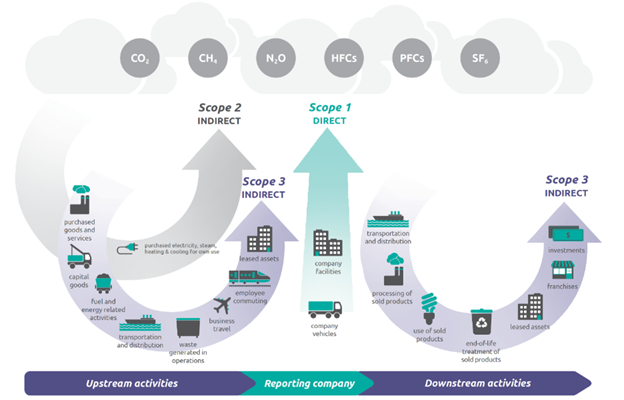
Figure 1. Overview of greenhouse gas (GHG) protocol scopes and emissions across the value chain. Embodied carbon is included within Scope 3 emissions. Source: Greenhouse Gas Protocol
Construction methods have long been selected for speed, durability, or standardization, with carbon outcomes treated as secondary effects. Onsite concrete construction became associated with permanence, while modular approaches emphasized repeatability and speed—but the carbon implications of each approach were rarely quantified.
Early construction decisions set the scope of a facility's environmental footprint. According to Jay Dietrich, Research Director for Sustainability and Energy at Uptime Intelligence:
“An IT operator’s overall sustainability and environmental footprint are dictated by their design and construction choices for owned facilities, as well as the operational characteristics and locations of their colocation and cloud service providers.”
*A password is required to read the full report. Guest access is available.
When construction defines the footprint boundary, carbon evaluation must occur at the point of decision. Measuring how different construction approaches perform allows embodied carbon to be assessed alongside cost, schedule, and scalability, forming the basis for the lifecycle assessment results that follow.
What is a lifecycle assessment (LCA) report?
An LCA measures the environmental impact of a building or product throughout its entire lifecycle, including materials, construction, and disposal. Standardized with ISO 14040/44, LCAs provide a holistic framework for comparing different construction approaches and supporting consistent, evidence-based decision-making in design and material selection.
Where embodied carbon diverges in construction
PMDCs are already used to enable faster, repeatable deployment by up to 50%. To quantify embodied carbon, Vertiv conducted an LCA comparing a 1.5-megawatt (MW) steel-framed Vertiv™ Megamod™ PMDC with a representative onsite-built concrete facility with equivalent IT capacity. The assessment focused on construction-stage emissions, where material and build decisions permanently lock in embodied carbon:
- Product stage (A1–A3): Raw material extraction, manufacturing, and processing,
- Transport to site (A4),
- Construction stage (A5),
- Refurbishment materials (B5), and
- End-of-life (C2–C4): Deconstruction, transport, and disposal.
The assessment focused only on shell construction methods. The teams excluded servers, power and cooling equipment, and mechanical electrical and plumbing infrastructure to maintain comparability between construction approaches.
In the defined LCA comparison, the steel-shelled PMDC achieved up to 3.5× lower embodied carbon per megawatt than the concrete-shell reference design. When scaled linearly for illustration, a 50-MW deployment with the modular approach could avoid ~42,000 metric tons of CO₂e relative to concrete—equivalent to taking roughly 9,000 passenger vehicles off the road for a year.
Material efficiency: Less structural mass required per megawatt (MW)
Onsite concrete construction generated higher embodied emissions because structural loads require greater material mass than steel-shelled PMDCs (see Figure 2). Steel carries higher carbon intensity per kilogram, but lower total material requirements achieve the same structural performance at the system level. As portfolios scale, steel-shelled PMDCs can slow the growth of reported emissions, while concrete construction may increase emissions growth at the same IT capacity.
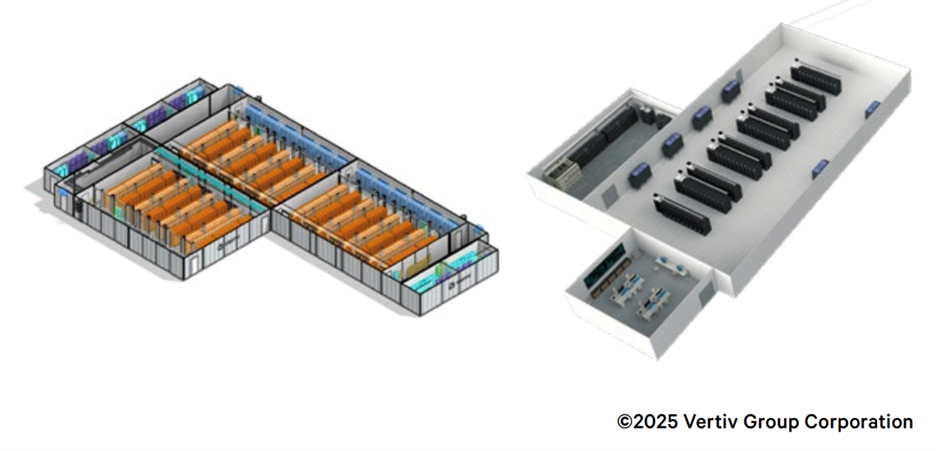
Figure 2. A 1.5 MW Vertiv™ MegaMod™ PMDC (left) and a representative onsite-built concrete data center model (right). Source: Vertiv.
Construction logistics: Shipment count and distance drive transport emissions
The calculation showed transport emissions for PMDCs were about 25% higher, driven by an assumed 1000-kilometer (km) factory-to-site transport distance. This gap should narrow as manufacturing moves closer to deployment regions. Modular facilities ship largely complete, while concrete construction requires more deliveries and longer onsite work, shaping transport-related embodied carbon. Shipment patterns determine whether emissions concentrate in planned movements or spread across sites and become more visible in carbon reporting.
Construction and refurbishment: Lower waste and energy use
Steel-shelled PMDCs use factory-built components and dry assembly, reducing waste and site time, and lowering embodied carbon during construction and refurbishment. Concrete construction relies on wet processes, heavy equipment, and fixed layouts, leading to more waste, energy use, and higher-emission retrofits as infrastructures evolve. Over build and refresh cycles, these differences determine whether carbon exposure and downtime grow—or stay contained across a data center portfolio.
End of life: Steel modules enable reuse, concrete requires downcycling
Steel-shelled PMDCs support disassembly, reuse, and recycling, while concrete facilities require demolition and downcycling. Reuse and higher-value recycling reduce end-of-life embodied carbon compared with demolition. End-of-life choices may limit or add carbon and cost when operators refresh, relocate, or retire facilities.
Designing carbon outcomes at scale
Quantifying embodied carbon allows construction choices to be evaluated during capacity planning, alongside cost, schedule, and scale, rather than after emissions are locked in through construction. Treating embodied carbon as an upfront planning input supports scalable growth, reduces carbon-related rework, and improves the ability to meet disclosure and internal targets as capacity expands.
Before your next construction decision, see the carbon impact
Access the calculation , including construction-stage boundaries and per-megawatt embodied carbon results comparing modular and concrete builds. The whitepaper shows how construction decisions influence carbon outcomes as deployments repeat—informing planning before designs are locked in.