AI is increasing the demands on data center infrastructure at every level. What matters next is not just the individual technologies but how the entire system comes together.
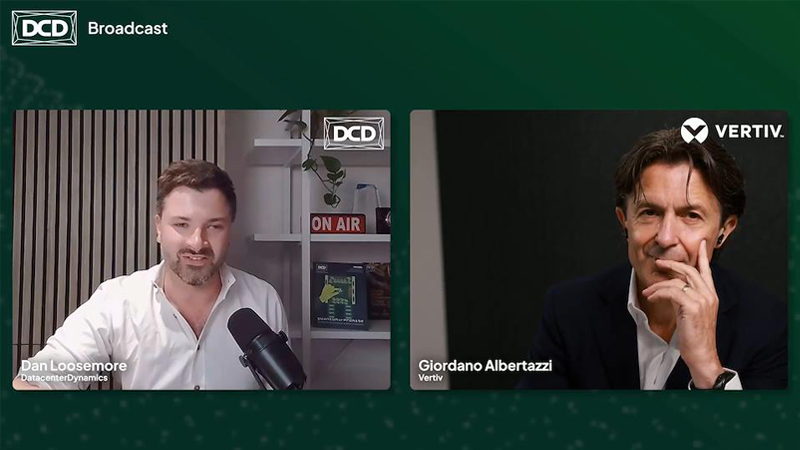
DCD AI Week 2026 opens with Vertiv Chief Executive Officer Giordano Albertazzi in conversation with Dan Loosemore, Chief Executive Officer at DatacenterDynamics (DCD). They cover the five forces reshaping data center design, new efficiency metrics beyond power usage effectiveness (PUE), and the shift from product selection to system-level architecture.
Dan Loosemore, Chief Executive Officer, DCD: A lot has happened in 12 months. How are you seeing the market and the build environment shift?
Giordano Albertazzi, Chief Executive Officer, Vertiv:
Certainly very interesting 12 months, and we are still in early innings. There is a continuous evolution of the IT stack, the silicon, and everything that comes with that. There is more emphasis and acceleration on inference, and very often it's not just inference or training, but both.
The industry ecosystem is becoming more complex and more dynamic. It's not only hyperscale and colocation data centers and developers; it's also neo clouds.
We’re thinking about data centers in modular terms, moving more work into controlled manufacturing environments for faster deployment. The industry is embracing that shift, and we're intentionally helping drive it.
Dan: What are the biggest forces reshaping data center infrastructure for AI, and what does a full system approach mean in practice?
Giordano:
The shift all started and is still about density. A change in IT is changing the physical thermal and power infrastructure. In cooling technology, you see how liquid cooling has emerged on the back of what IT is demanding. On the power side, 800-volt DC is an infrastructure that is more complex, but it makes sense from an efficiency standpoint. The traditional way data centers were built is no longer sufficient for the future.
It is important to be well connected with leading silicon and GPU providers to gain long-term visibility into technology requirements and support infrastructure readiness. What we build as an industry needs to host the silicon and an IT stack one to two years later and remain in service for 15 to 20 years. The ability to have the right technology when the data center is live, and the foresight to support long-term resilience, is very important.
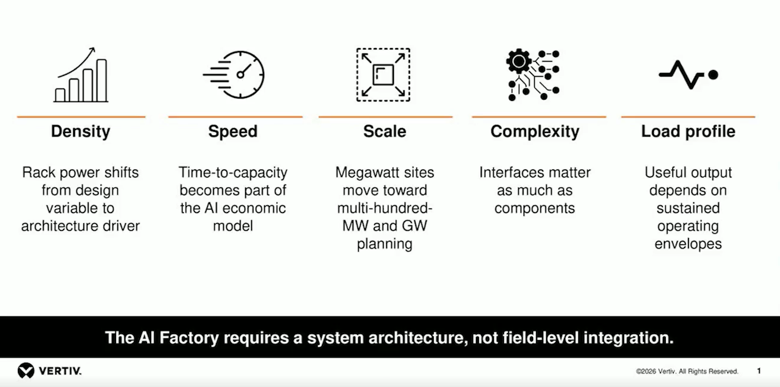
Figure 1. Five intensifying forces that are outpacing traditional data center delivery models. Source: DataCenterDynamics.com.
Scale is the need to change and simplify things at larger sizes. Data centers today have behind-the-meter power generation solutions for grid independence or interaction—all unthinkable approaches a few years ago but now becoming the norm.
Load profiles can be complex and dynamic. Designing a single component on the power train is not enough. The entire power train, just like the thermal chain, needs to be thought of as a system. It's the optimization of that system that drives efficiency, performance, and reliability.
As if this was not sufficient, speed is an enormously important element. What we call time to token is really time to revenue. It can go from prefabrication of some elements to treating the entire data center as a prefabricated system. The vision and ability to deliver an entirely optimized system, the data center viewed as one product — can make a big difference in total cost of ownership and speed of deployment.
All these elements in the data center system and the IT stack must be orchestrated. The need to optimize the way a data center works, what we call tokens per kilowatt per second, needs to be delivered very rapidly. You optimize not just the power train and the thermal chain; you have to look at the data center as a big, orchestrated infrastructure.
Dan: How are you thinking about efficiency metrics in the age of AI — and where does PUE fit?
Giordano:
PUE is still a good metric in many respects, but it’s not sufficient anymore. Power availability has become a constraining factor. You want to maximize the power that reaches the chip and is converted into tokens.
The metrics that we use, tokens per second, per megawatt, is a metric of output. With the AI factory, the bigger the output, the bigger the return. Tokens per watt is really a matter of productivity.
Time to first token goes back to what we talked about earlier: how fast does it take to bring a capital investment to fruition? Shrinking the time from capital commitment to payback is important.
But if you peel this multi-layered onion, you see that it's all about efficiency. How efficiently do I allocate capital? How efficiently am I using every available electron of power? PUE was one level of efficiency. This is a much broader efficiency question.
Dan: Vertiv has shifted from product selection to system-level architecture. Can you walk us through that shift?
Giordano:
The five forces are requiring a much more profound level of system optimization. Over time, we've seen component-by-component data center design improve, but we believe there are diminishing returns to that approach. When you start to think about the entire system, whether it's the whitespace, the power train, the thermal chain, or the entire data center, you move beyond those limitations.
We also look to reduce the number of interfaces because that's where many inefficiencies sit. Taking a holistic approach allows you to achieve efficiencies and speeds that are otherwise difficult to reach.
We still believe you need to be excellent at the product level. You cannot compromise on the technology you deploy. But that's just the starting point. Excellent components do not guarantee excellent infrastructure.
Dan: As compute roadmaps evolve so fast, how should operators think about preserving flexibility and optionality in their infrastructure decisions?
Giordano:
Having a good roadmap of the evolutions you will need to support is an important part of preparing for your next capacity investment or capital deployment.
It is important to partner with someone who has visibility not just into the next chip generation but the next-to-next generation, so the way the whitespace and the data center are designed already factors that in.
There are ways to design the whitespace to accommodate the next and next-to-next generation, so refresh cycles are less disruptive to operations. These are things that can be modeled and factored into data center design through a good digital twin, a strong technology foundation, and an understanding of where IT, AI, and compute are heading.
Dan: Data centers have an opportunity to be good custodians of the communities they serve. What does that look like in practice, and what more should the industry be doing?
Giordano:
The most important thing we can do as an industry is to be very clear and factual. Think about discussions about water consumption, for example. Modern data centers can reduce water consumption depending on the cooling technology deployed. We need to do a better job explaining how the technology works.
We also need to help communities understand that modern data centers can be positive contributors, generating local economic activity and supporting local tax bases.
One example is the closed chilled-water loop. You fill it once and recirculate the cooling medium through the system. Technology continues to evolve, including solutions that can reduce commissioning-related water consumption by nearly 90%.
Dan: It's great to kick off AI Week 2026 with such innovation and to have you back as a thought leader. As we wrap up, what are you hoping to see in the market over the next 12 months?
Giordano:
We see broad-based global growth that we believe is real and strong. We're looking forward to meeting again in 12 months and talking about that global acceleration as a fact. In some parts of the world, it feels like we're now where we were two and a half or three years ago at the start of this cycle. We're excited to see that momentum continue over the next year.
Watch the full broadcast: From planning and design to deployment reality - What operators must solve next