
"We cannot think as we did in the past, that the unit of compute is the chip. The unit of compute is the row. Even more so, the unit of compute is the data center."
Giordano Albertazzi, Vertiv CEO
To open DCD’s AI Week, Vertiv CEO Giordano Albertazzi shared his perspective on the infrastructure demands behind AI’s rapid growth. From rack densities and liquid cooling to power constraints and system-level design, he discussed how the landscape is shifting and why adaptability is essential.
The following highlights from the conversation with Giordano reflect where the industry is heading and what’s required to keep pace.
AI infrastructure has gone from trend to front-page news. What are you seeing at the macro level?
Giordano Albertazzi: A year ago, we saw it coming. We saw the acceleration. Now the exact characteristics of this acceleration are much, much clearer. In the last six, seven, eight months, so many declarations and not just declarations, actual large investments, big sums of money are being poured into an industry that was already accelerating.
Rack densities are rising fast. What are the implications for infrastructure?
GA: We know that the average rack load is increasing, and the peak rack load will be well north of 500 kilowatts per rack. That clearly poses a lot of challenges or opportunities, depending on the way you look at it. You need a different way of designing the rack, the cooling system, and the power distribution.
Everyone’s talking about AI factories. How do you define that term?
GA: AI factory is certainly a very poignant way to define a very specific mandate for a piece of infrastructure or for an entire class of assets. If you're a hyperscaler, you will have your own view. If you are an enterprise, then the AI factory could be a number of GPU clusters. It’s as important to be able to reach out to those enterprise customers and say, ‘This is the way you have to deploy something that is very new to the industry.’
Inference versus training seems to blur in long-term design. What matters more: flexibility or precision?
GA: We see the two things blur. And again, we’re talking about 10-, 15-, 20-year asset life cycles. Do you really know exactly what that asset will be utilized for three, five years from now? So, flexibility is absolutely key.
With so much speed and pressure, how are you balancing standardization with custom needs?
GA: Acceleration and demand mean building at scale and at increasingly fast speed. Data center is a construction business. And construction businesses that accelerate at the scale we are experiencing, how many in the history of humanity? Not many.
We believe data center design should not be done in individual point products, but should start from a very holistic system view. That should translate into an ability to prefabricate—different degrees, total prefabrication.
Let’s talk cooling. There are still a lot of different technologies in play, and it feels like a ‘horses for courses’ situation depending on workload and customer preference. What’s your view on how liquid cooling is evolving?
GA: Liquid is an extraordinarily important part. We see liquid cooling becoming more and more central to the equation. Direct-to-chip is the mainstream solution. It’s what we see the next-generation silicon being designed on. That is there to stay and to scale. Horses for courses, you were saying. Just make sure you have the right conversation and the right partner in the room.
Power is becoming the bottleneck. How do you see the challenge and the solutions?
GA: Power availability is a central discussion item, a problem or opportunity, in the industry. There is a growing speed that clearly is catching off guard a lot of the grid, power generation, etc. You’ll see more and more people talking in terms of being off-grid, or partially hybrid. Bring-your-own-power, gas, small modular reactors. These are all things that are becoming real.
How is the role of the UPS changing? And where does energy storage fit in?
GA: UPS is a power center. It’s managing the various power sources. Innovation there is not going to stop. Think about the same dynamism that we have experienced on the cooling side in the last three years now being replicated on the power side.
What’s the role of system-level design in this new model?
GA: We cannot think as we did in the past that the unit of compute is the chip. The unit of compute is the row, even more so, the unit of compute is the data center. So, system design and the ability for both power and thermal infrastructure to interact and orchestrate to support the needs of the IT loads. That’s an important optimization.
Vertiv has emphasized co-innovation with partners. Why does that matter now more than ever?
GA: No one actor knows the whole story. Never like today, and tomorrow, and the day after tomorrow, the strength of the relationship within the industry—be it power generation players, silicon providers, customers—is very, very important. We sit with our customers not when they are designing the individual data center. We sit with them when they are designing the next generation, and sometimes the next-to-next generation.
Final reflection. What excites you most about this moment in the industry?
GA: I have never seen anything so exciting right now. The industry is becoming so central to the evolution of humankind, like few industries—at least at this speed of growth—have done historically. Energy generates energy. So, it’s a pretty exciting period.
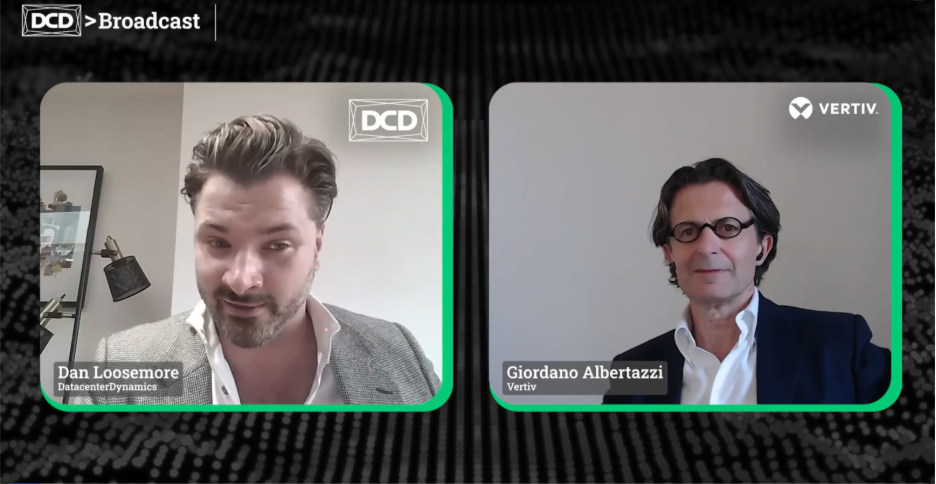
Watch the full conversation: Scaling, efficiency, and resiliency of AI infrastructure - DCD