
An AI data center is a facility engineered specifically to support AI workloads and accelerated computing. Unlike traditional data centers built for general enterprise applications, it integrates high-density power delivery, advanced cooling systems, and compute infrastructure as a unified system.
For IT leaders, facility operators, and business decision-makers, this integrated approach changes how capacity, power availability, cooling, and deployment are planned.
What is an AI data center, and what makes it different?
An AI data center is a purpose-built facility designed to support AI workloads and accelerated computing. It integrates high-density power delivery, advanced cooling systems, and compute infrastructure as a unified system, enabling the training and inference of AI models at scale.
An AI data center differs from a traditional data center in three ways: power density, cooling requirements, and system integration. Traditional data centers typically operated at 2–4 kW per rack. AI data centers routinely exceed 40 kW per rack, with some deployments reaching 130 kW or more. The concept emerged as AI workloads began driving computational demands that legacy infrastructure could not meet. These workloads include deep learning, natural language processing, generative AI, training, and inferencing.
Why AI data centers are becoming critical infrastructure
AI infrastructure is expanding as organizations deploy increasingly powerful GPUs and accelerated computing platforms. This growth stems from the deployment of NVIDIA Blackwell chips, the full utilization of Hopper GPUs, and increased shipments of AMD and custom silicon. Data centers that historically topped out at a few hundred megawatts are now being planned at gigawatt scale.
AI workloads are inherently dynamic, characterized by spiky and bursty patterns that create cascading effects on power distribution and thermal management systems. This volatility means that power and cooling must be tightly integrated with compute to maintain stable operations. Power permitting and availability have become significant constraints, with examples including 3.5 GW of demand projected in Silicon Valley by 2028.
How do AI data centers work?
An AI data center operates on the principle that power, cooling, and compute function as one integrated system. This approach follows the "unit of compute" concept, where power, cooling, networking, and IT come together in modular, pre-engineered systems.
Power Train
Intelligent power management flows from grid to chip. This includes switchgear, power distribution units, uninterruptible power supplies, and energy storage systems designed to handle variable AI loads. As rack densities increase, the industry is exploring higher-voltage DC architectures, including 800 VDC, to support more efficient power delivery with fewer conversion stages. Readers can learn more about these 800 VDC architectures for AI compute in Vertiv's dedicated white paper.
Thermal Chain
Integrated thermal systems move heat from the chip through the facility’s heat-rejection infrastructure, with opportunities for heat reuse where applicable. At higher rack densities, Liquid cooling is increasingly used to manage heat loads that become difficult to address through air cooling alone.
Coolant distribution units, available as in-rack, in-row, and perimeter models, isolate IT equipment from the facility's chilled water loop. They use a separate secondary fluid network. Most deployments combine direct liquid cooling for GPU racks with approximately 20% air cooling.
Key benefits of purpose-built AI data center infrastructure
Performance
AI data centers support the high-bandwidth, low-latency communication required across large GPU clusters. Their infrastructure can also be evaluated through measures such as performance per watt and tokens per joule, helping operators consider compute output alongside energy use.
Efficiency
AI data center infrastructure can be designed to improve how power and cooling resources are used across high-density environments. Liquid cooling, higher-voltage power architectures, and integrated infrastructure designs can help operators address the energy and space demands associated with accelerated computing.
For example, Vertiv’s 7 MW reference architecture for the NVIDIA GB200 NVL72 targets 20% greater energy efficiency and 30% greater space efficiency, while aiming to reduce deployment time and total cost of ownership.
Scalability
Pre-engineered infrastructure designs can help organizations expand AI capacity as compute requirements evolve. Vertiv reference designs provide frameworks that coordinate power and cooling requirements across deployment scales, from individual racks to large AI facilities.
Deployment speed
Pre-engineered and prefabricated infrastructure can help simplify onsite integration and support faster deployment compared with conventional, site-built approaches.
The infrastructure challenges behind AI at scale
AI data centers face significant challenges.
- The deployment timeline gap is stark. GPUs typically take 6–9 months to source, but infrastructure, which consists of power, cooling, and networking, takes 24 to 36 months to deliver. As a result, power, cooling, networking, and supporting infrastructure can become significant constraints on AI deployment timelines.
- Hardware specifications can shift within a 9-month construction window, forcing designs to anticipate rapidly evolving GPU requirements. Even with direct-to-chip liquid cooling handling roughly 110 kW, GPU clusters still push 35–40 kW of residual heat. These patterns challenge legacy room layouts.
- Power availability is a major constraint. Interconnection queues stretch beyond five years. Some operators are evaluating small modular reactors, but commercial adoption is early and highly regulated. Gigawatt-scale builds can require thousands of electricians.
Where AI data centers are being deployed
AI data centers support a range of deployment models. Enterprise AI workloads span four archetypes: edge, small, large, and high-density AI clusters. Each has unique demands for power, cooling, connectivity, and scalability. Scale comes in two forms: giant AI factories producing intelligence at scale, and smaller-scale deployments for inference and edge AI. Colocation providers are transforming facilities to meet AI compute demand, using reference designs to standardize infrastructure across sites.
How AI is changing data center design
AI data centers are changing how organizations approach power systems, cooling systems, rack density, and capacity planning. Managing power and cooling separately can introduce additional complexity, particularly as rack densities and workload variability increase.
Vertiv addresses these challenges with integrated solutions like Vertiv 360AI, which provides reference designs spanning densities from 10 kW to over 140 kW per rack. Vertiv's AI data center infrastructure integrates power, cooling, IT, and services engineered for AI at scale. Designing power and cooling together can support infrastructure optimization, reduce the risk of stranded capacity, and improve the system-level response to changing AI workloads.
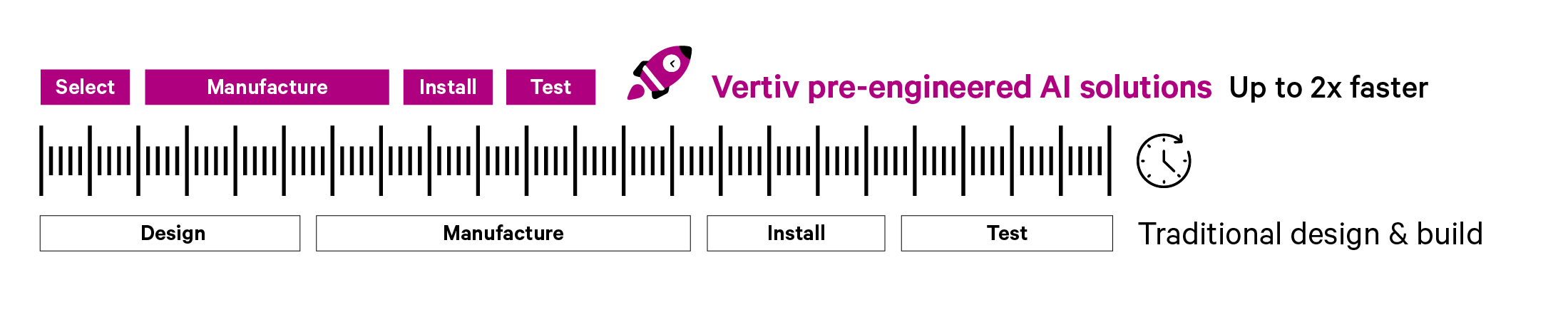
Figure 1. Timeline comparing Vertiv pre-engineered AI solutions with a traditional design-and-build process across design, manufacturing, installation, and testing stages.
What comes next for AI data center infrastructure
Three priorities are emerging in the development of AI-ready data centers: industrialization, digital twins, and greater control over energy sourcing. Industrialization means treating data centers like utilities, with compute delivered as a packaged unit through modular, pre-engineered systems. Digital twins use AI and simulation to design optimized systems in days or hours. This compares to the 6–8 months traditionally needed to produce a bill of materials. Energy sovereignty means developing microgrids and on-site generation to keep pace with power demand, augmenting grid capacity with local resources like natural gas turbines and advanced storage. Designing infrastructure for enterprise AI requires a portfolio approach that prevents stranded capacity and matches each workload to the right deployment model.
Building data center infrastructure for the AI era
An AI data center is a purpose-built facility that coordinates power, cooling, and compute infrastructure to support AI workloads at scale. As AI deployments increase rack densities and introduce more dynamic operating conditions, organizations must reconsider how capacity, power availability, thermal management, and deployment are planned. Liquid cooling, higher-voltage power architectures, and pre-engineered infrastructure are becoming increasingly important options for supporting these environments. As AI continues to evolve, the data centers that support it will need to operate as coordinated, adaptable systems rather than collections of independently planned components.
Figure 2. Vertiv™ OneCore provides a prefabricated infrastructure approach designed to support faster, scalable deployment of AI-ready data centers.
Frequently asked questions
What is the difference between an AI data center and a traditional data center?
Traditional data center environments have commonly operated at lower rack densities, while AI deployments can exceed 40 kW per rack, with some configurations reaching 130 kW or more. AI data centers integrate power, cooling, and compute as a single system, often requiring liquid cooling and higher-voltage power distribution.
What are data center power requirements?
AI data centers require significantly more power than traditional facilities. AI-capable GPU chipsets exceed thermal design powers of 1,000 W and are approaching 2,000 W or more per device. GPUs consume up to 10x more power than traditional IT workloads. Rack densities are scaling toward 600 kW, driving adoption of 800-volt to 1,500-volt DC architectures for more efficient power delivery.
What cooling does an AI data center need?
Traditional air cooling reaches its practical limits at 30–50 kW per rack. Liquid cooling becomes a requirement for racks over 100 kW. Most deployments combine direct-to-chip liquid cooling for GPU racks with approximately 20% air cooling. Coolant distribution units isolate IT equipment from the facility chilled water loop and must operate 24 hours a day, 7 days a week.
How much power does an AI GPU consume?
AI-capable GPU chipsets now exceed thermal design powers of 1,000 W and are quickly approaching 2,000 W or more. NVIDIA Blackwell platforms boast 35 times the power of their predecessors. These power demands drive rack densities to 100 kW per rack and beyond, requiring advanced thermal management and power distribution systems.
What is an AI factory?
An AI factory is a mission-focused facility that produces intelligence at scale, moving beyond traditional IT workloads like email, video, and social media. AI factories represent a shift from data centers that topped out at a few hundred megawatts to facilities planned at gigawatt scale. They require integrated infrastructure where power, cooling, and compute operate as one holistic unit.
How long does it take to build an AI data center?
GPUs typically take 6–9 months to source, but the supporting infrastructure — power, cooling, and networking — takes 24 to 36 months to deliver. The data center itself, not the GPUs, is now the real deployment bottleneck. Pre-engineered, modular building blocks can cut deployment timelines from years to months.
What is the unit of compute concept?
The unit of compute is an approach where power, cooling, networking, and IT come together in modular, prefabricated systems. Data centers function like utilities, with compute delivered as a packaged unit. This industrialization helps reduce deployment timelines and supports integration by moving work from the field to the factory
What rack density does an AI data center need?
Rack densities that were 10–20 kW for decades have surged to 120, 200, even 600 kW and beyond. Densities have moved from up to 35 kW to up to 140 kW, with newer generations pushing toward 240–250 kW per rack. Projections show rack densities reaching or exceeding 1 MW by the end of the decade.