
As facilities grow more complex to support AI workloads, AI-powered predictive maintenance is transforming data center operations from reactive, time-based service schedules to intelligent, data-driven interventions that prevent costly failures before they occur.
For decades, data center managers have aspired to true predictive maintenance for their facilities but have settled for the best available alternatives: time- and condition-based services. Time-based maintenance programs adhered to maintenance contracts stipulating service visits at regular intervals, and condition-based programs use basic analysis of performance data to determine when service may be needed.
With time-based maintenance, technicians inspect equipment during scheduled service visits and react to what they see. They change filters, top off fluids, and – on rare occasions – identify and address potentially serious equipment issues. It’s the equivalent of taking the car in for a three-month oil change.
Condition-based maintenance is slightly more sophisticated, screening performance data against an established criteria to trigger necessary maintenance. For example: A sensor may measure airflow rates and, when those rates slow to a certain point, alert operators who can then install a new filter. Think of this like a low-air-pressure indicator in a car: the dashboard light signals the driver to check the tire for damage. Based on what is found, the driver may repair, replace, or simply add air to the tire. It’s better than adding air every three months, but it’s still reacting to the loss of air pressure.
These approaches have reduced equipment failures, but data centers are increasingly complex. The causes of failures are more varied, and the ensuing outages longer in duration and more costly. Time-based maintenance visits can mean inconvenient disruptions, but if intervals between visits are too long, diminished performance is likely. Condition-based maintenance is reactive, meaning equipment performance is already compromised and is likely to continue to suffer until maintenance is completed.
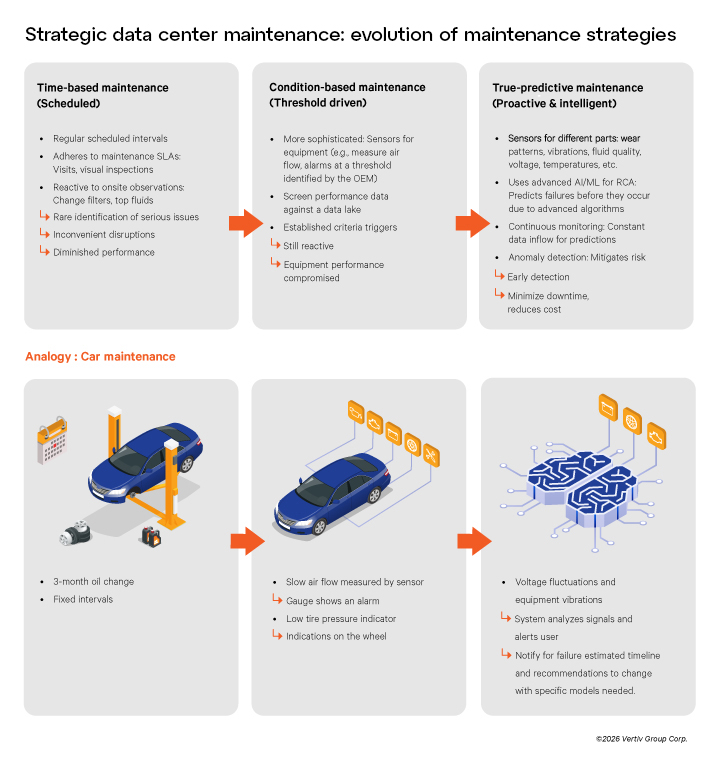
Figure 1. The evolution of data center maintenance of the years: time-based maintenance, condition-based maintenance, and true predictive maintenance. Source: Vertiv.
Understanding predictive maintenance
Today’s data centers are moving for the first time to true predictive maintenance. These service offerings leverage artificial intelligence (AI) platforms to analyze real-time data and identify complex trendlines pointing to precise points in time when systems and equipment will require attention. This is the foundation of predictive maintenance.
With predictive capabilities, organizations can schedule maintenance when it is needed and at the optimal time to minimize disruptions. Technicians executing those service calls arrive fully prepared, armed with comprehensive knowledge of system performance and maintenance needs, and the necessary parts to complete the job. These visits are efficient, minimizing disruption, and eliminating unexpected delays and costs. The reduced time onsite also limits the opportunities for human error – historically one of the leading causes of unplanned downtime.
AI is increasing rack densities and power demands and produces significant fluctuations in load activity. This makes it one of the primary reasons predictive maintenance is needed. At the same time, AI is a necessary component of any predictive maintenance offering. Data centers hosting AI applications are adjusting to staggering increases in rack density, forcing significant changes across their critical infrastructure. This is most apparent in the proliferation of liquid cooling and the increasing complexity of the power chain in these high-density environments. The result is movement toward an approach in which equipment is tightly integrated and functions as a single system, a notable evolution from the loosely connected networks of disparate equipment that typified traditional data centers. These integrated power and cooling systems act and react in concert to efficiently support the fluctuations common to dynamic AI workloads. The benefits of a more system-based infrastructure are immense, but the complexity is orders of magnitude greater.
Bringing order to the vast amount of data these systems produce and applying a predictive lens to the findings requires cloud-based AI platforms that continuously and autonomously acquire knowledge from new data. AI can be used in predictive maintenance to refine its understanding of system performance and predict maintenance needs with increasing accuracy as new data arrives. As these platforms learn more about data center operations, the AI enables advanced machine learning that can identify potential issues hidden from standard time- and condition-based maintenance. The result is a reduction in the number of unplanned failures and break/fix events.
Benefits of predictive maintenance for critical infrastructure
As data centers evolve to a system-based infrastructure, with multiple pieces of equipment fully integrated and functioning in concert, the impact of the failure of any single component is magnified. Predictive maintenance enables early fault detection across power and cooling systems, extending component longevity, enabling managed maintenance, and improving system reliability. In addition, most cloud and colocation providers are required by their customers to adhere to stringent service level agreements (SLAs). For example, typical SLAs specify how long a data center may run with reduced redundancy. Predictive maintenance can help data center operators more efficiently meet those requirements.
Predictive maintenance also enables better capacity planning through real-time analysis of performance trends and varying load conditions, improving energy efficiency, and reducing the total cost of ownership (TCO) across critical infrastructure. It also helps organizations stay in compliance with SLAs and facilitates data-driven capital planning for equipment upgrades and replacements, as well as facility expansion.
Broadly speaking, there are four primary benefits to moving to a predictive maintenance approach for data center critical infrastructure:
- Risk mitigation in high-density environments: Time- and condition-based maintenance programs are designed to facilitate execution of routine maintenance tasks and prevent the most common equipment failures, but there are inherent limitations. When 72 GPU rack servers can cost more than $2.6 million per server, limitations are not acceptable. Predictive maintenance is the best way to prevent hardware damage and mitigate the cascading effects of failure across integrated systems. Those effects – and their business impacts – are accelerated and amplified in interconnected, high-density environments. The expression, “an ounce of prevention is worth a pound of cure,” has never been more apt than in the age of the AI data center.
- Business impact and financial considerations: Predictive maintenance can help prevent those costly unplanned outages and reduce the frequency and duration of planned outages. With a more accurate understanding of maintenance needs and better planning, organizations can also manage inventory to reduce the cost of parts procurement, extend equipment lifecycles to delay replacement costs, and avoid SLA penalties.
- Operational efficiency gains: Traditional maintenance activities are rife with inefficiencies. They follow time-based schedules or respond to condition-based alerts, triggering maintenance without considering data center activity – meaning those interruptions can occur at especially inconvenient times. If technicians discover unexpected issues onsite, they often are unprepared, lacking the tools or parts needed to make the necessary repairs. That can extend the immediate disruption or force additional visits. With intelligent predictive maintenance, technicians can coordinate multiple activities to optimize a single maintenance window and arrive with the required parts. It reduces the mean time to repair (MTTR).
- Mitigation of skilled maintenance personnel shortage: The data center industry is facing a significant skilled labor shortage projected to worsen with the proliferation of AI. Again, while AI is creating this challenge, it is also helping bridge the workforce gap by augmenting the capabilities of skilled engineers. To be clear, AI alone doesn’t replace decades of experience, but it can bridge gaps to minimize the risk of human error, accelerate diagnostics, shorten time on site, and harmonize the service experience from data center to data center across regions and around the world.
Predictive maintenance in practice: Vertiv™ Next Predict
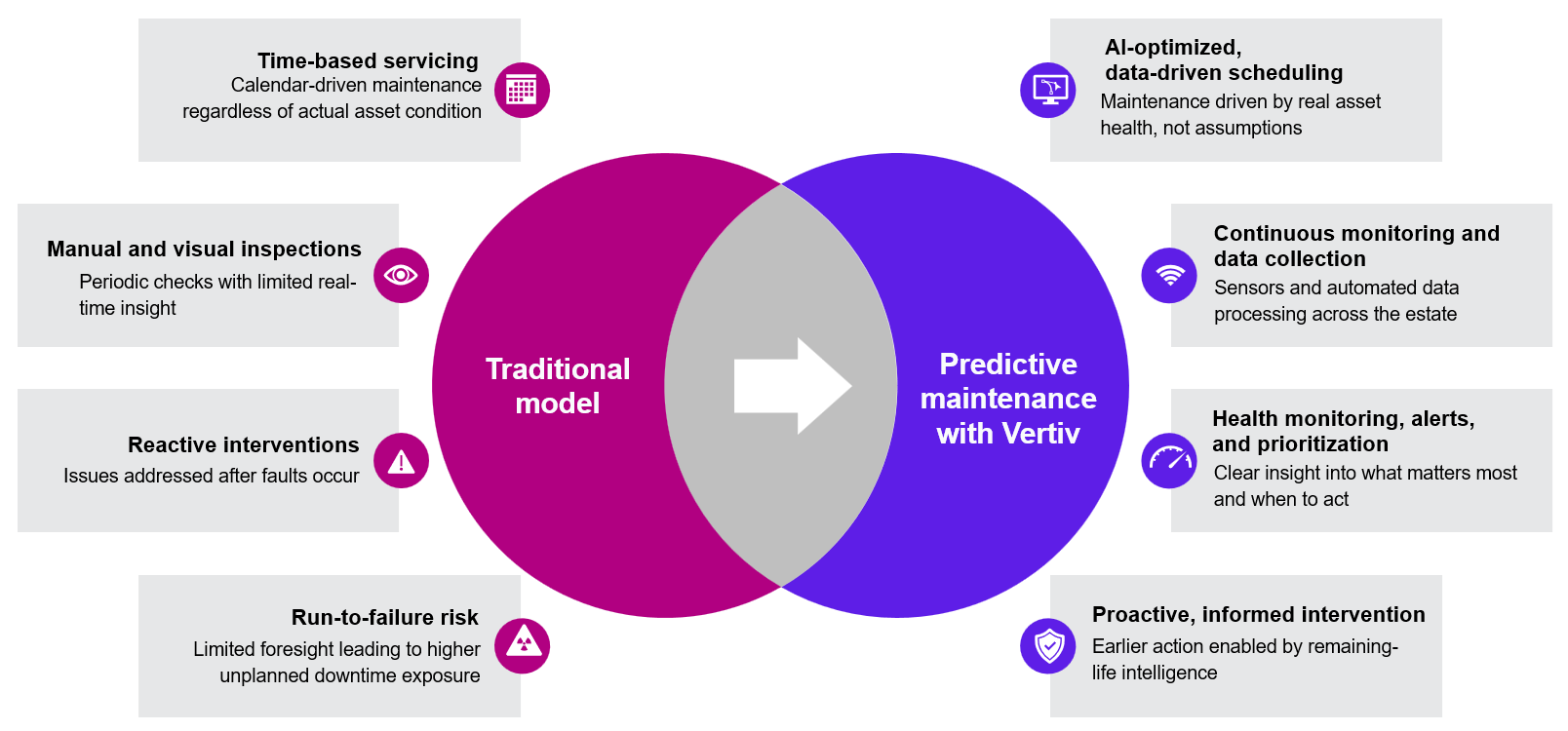
Figure 2. Transitioning from reactive maintenance to true predictive maintenance with Vertiv™ Next Predict. Source: Vertiv.
Predictive maintenance is no longer an aspirational goal for data center operators. Vertiv™ Next Predict is a predictive maintenance offering available today that leverages AI-powered analytics to monitor and manage critical digital infrastructure equipment performance in real time. Vertiv Next Predict provides advanced predictive maintenance capabilities that Vertiv™ Services technicians can use to reduce unplanned downtime, extend equipment lifespans, and deliver measurable value to users.
Vertiv™ Next Predict algorithms and real-time AI-powered rules predict asset downtime before critical component and system failures, triggering alerts that enable field service teams to deliver more value during scheduled maintenance visits and reduce unscheduled visits. The Next Predict dashboard delivers alerts and recommendations when equipment is operating outside normal procedures or the SLA.
Vertiv™ Next Predict monitors critical telemetry, including temperatures, pressures, performance speeds, and other critical equipment performance data. The large volume of telemetry from across the data center is transmitted using a variety of communication protocols, including SNMP, Modbus, and BACnet, among other possible standards. That telemetry comes from sensors on individual pieces of equipment or their components and often passes through a secure gateway before reaching the cloud platform for analysis.
Predictive maintenance models embedded in Vertiv™ Next Predict use proprietary algorithms to contextualize data, detect anomalies, and generate alerts that require monitoring or action. Trained and certified Vertiv™ Services engineers evaluate the findings against predictive algorithms to identify high-priority items and determine the appropriate path for resolution. These experienced, trained oversight teams then equip field technicians with granular information to arrive on-site fully prepared to perform necessary tasks with the utmost efficiency and accuracy.
The results have been validated in the lab and the field, and are updated through continuous, automated, closed-loop learning and retraining of the algorithms informed by feedback from Vertiv Services maintenance engineers. When thresholds are breached across multiple sensors, alarms, or data points within a given interval, a predictive health incident is raised to an oversight team for additional human validation before a service visit is scheduled.
Vertiv Services technicians use the predictive insights to quickly and accurately address pending issues, with responses tailored to the specifics of each case and potentially including emergency triage. These informed, efficient service engagements deliver significant, measurable improvements in multiple areas, including:
- Enhanced operations
- Reduced planned and unplanned downtime
- Optimized maintenance scheduling
- Enhanced resource utilization
- Cost efficiency
- Fewer emergency repairs
- Extended equipment life
- Optimized spare parts inventory
- Service quality
- Faster problem resolution
- More accurate diagnostics
- Improved first-time fix rates
- Customer experience
- Greater transparency
- Increased uptime
- Proactive communication
- Business impact
- Lower operational costs
- Improved asset reliability
- Better maintenance ROI
The bottom line
As data centers scale to support AI and high-performance computing workloads, intelligent, efficient service and maintenance have never been more important. Predictive maintenance is emerging as an essential operational strategy and competitive necessity for organizations seeking to prevent costly equipment failures and unplanned downtime. The transition from time-based, reactive maintenance models to data-driven predictive approaches gives data center operators an advantage in protecting increasingly critical infrastructure while optimizing operational efficiency and extending equipment lifecycles.
The impact of predictive maintenance systems will expand as AI proliferates and data centers become exponentially more complex. Ultimately, predictive maintenance platforms will integrate comprehensively across the data center and act as a force multiplier for broader facility optimization and responsible business efforts.
Predictive maintenance has long been an aspirational goal for data center managers. AI is leveraging the accumulated expertise of trained technicians and decades of data center installation data to make it a reality.
*In compliance with the EU AI Act’s transparency requirements, this article included the use of AI during brainstorming and idea generation. Writers, editors, artists, and technical subject matter experts (SMEs) reviewed, refined, and finalized the published version.