
Heat rejection strategies are expanding as AI introduces new cooling demands and operating temperatures. The right approach depends on climate, rack density, and water availability.
Discover which heat rejection approaches align with your climate, density, and water constraints.
Rising AI densities are turning cooling design into a system-level challenge that affects efficiency, flexibility, and long-term infrastructure decisions. In this DCD Talks interview, James Raddings, Digital Portfolio Lead at DCD, speaks with Maurizio Frizziero, Vice President of Chilled Water Solutions at Vertiv, about how AI is reshaping cooling requirements and the factors that determine which heat rejection approach works best
James Raddings, Digital Portfolio Lead, DCD: Could you tell us why closer collaboration across the data center cooling ecosystem is becoming critical as thermal demands evolve?
Maurizio Frizziero, Vice President of Chilled Water Solutions, Vertiv:
With AI, the evolution of density in data centers has changed the scenario, and it continues to change. It's not anymore about looking at a specific product with an end-user approach to product, offer, installation. It demands optimization of the system.
Densification drives more power demand than before. The more the heat rejection unit is optimized, the more power remains available for the density — which in turn generates more demand for heat rejection. When designing, an end-to-end approach is needed — considering which technology for heat rejection, whether water or wastewater is part of the equation, which refrigerant, conditions, and envelope to implement.
It is a system design where the consultant, end user, advisor, and manufacturer must be part of the same ecosystem, optimizing every angle of the solution.
James: You mentioned the "deploy and maintain" approach, the more traditional way of looking at these things. Why do you feel that mindset is no longer sufficient for modern cooling infrastructure?
Maurizio:
Before AI-driven densification, data centers operated at relatively similar rack densities. Operators selected cooling solutions based largely on climate, redundancy requirements, and site elevation, making it straightforward to match site conditions to a defined solution.
With AI, racks are moving from 10–15 kilowatts (kW) to 100-200 kW — up to 1 MW per data center. The shift adds a third dimension to cooling design: condition, unit, and density together now determine the right combination of liquid cooling, air cooling, heat rejection type, and circuit configuration.
There are two approaches: either apply the same traditional rules according to location regardless of density and optimization or consider density and optimization as a key point, which changes the story completely.
Every user has a different view on how density in their data center will evolve. Some prefer to be on the safe side. Others want more flexibility, and some are ready to be more aggressive today. None of those approaches are wrong. The only way forward is cooperation — finding the right way to optimize with the business view the end user has today.
If optimizing power today is a must, there's a solution. If flexibility is a must, there's a solution. If flexibility to optimize set points and operation five years from now is the priority, there's a solution. Not necessarily the same one. That's why cooperation is mandatory. That's why the heat rejection unit is evolving.
There is no longer a single heat rejection unit that fits any climate condition, location, and density. There are chillers with high water temperature, chillers optimizing pre-cooling versus mechanical cooling, dry coolers, adiabatic solutions, evaporating solutions. It's a matter of finding which one optimizes the result based on condition, regulation, standard, and cost of energy.
The industry is no longer designing for a global world where every location is identical. There are different rules, evolution speeds, and application timelines.
James: Why is the assumption that AI simply requires more cooling an oversimplification?
Maurizio:
AI needs different temperatures. According to the ratio between density and the chip or server being used, the optimal temperature is defined, and the right solution changes.
The additional density can be dissipated more effectively by liquid cooling. But the way liquid cooling is used — and the temperature at which it operates — depends on the density and the type of server.
Combined with location, the solution moves from a pure dry cooler to a pure mechanical cooling chiller. If water temperature is very high and ambient conditions are low, a dry cooler works. If water is abundant, adiabatic dry coolers are an option. But if density is very high and the server needs a low water temperature, a compressor enters the equation. The discussion becomes how to balance free cooling versus mechanical cooling, and whether evaporative or adiabatic cooling is part of the equation based on water availability at site.
A matrix guides the practical solution by location, density, and water availability (see Figure 1). The whitepaper, “Rising chip temperatures and the transformation of data center cooling: A scenario-driven assessment of heat rejection technologies" defines which heat rejection unit can be used according to conditions, server type, and density.
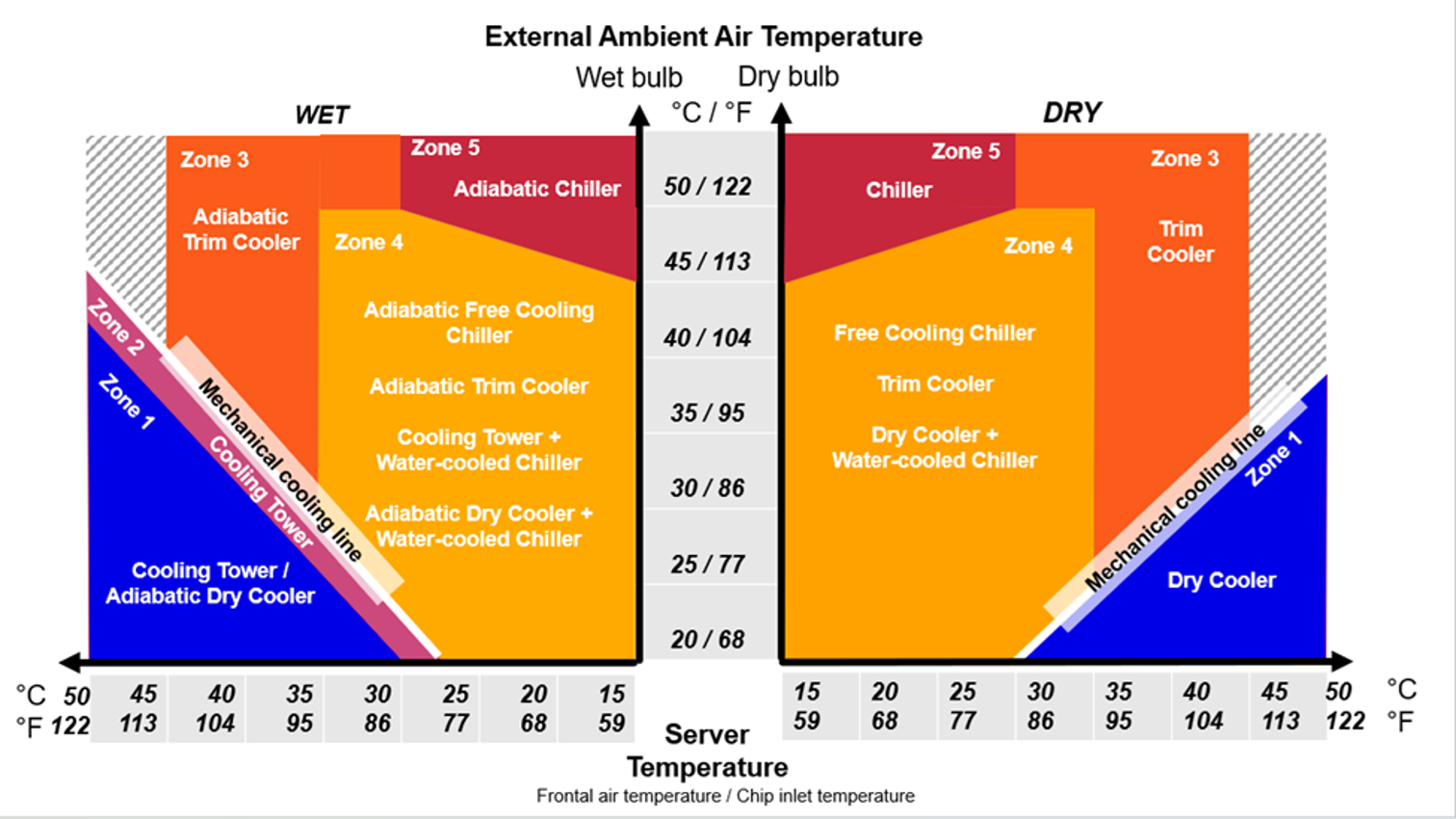
Figure 1. The Chilled Water Heat Rejection Map identifies the possible technologies data center operators can use to manage their cooling needs in the facility based on crucial factors for optimized resource use and availability. Source: Vertiv
As a manufacturer owning the full thermal chain with an end-to-end approach on power and thermal, Vertiv can suggest different solutions and provide a compass to navigate this new chart.
Electronics and servers have a completely different speed than mechanical infrastructure. When a data hall is designed, there are years of design, installation, and application ahead. The dream of any data center owner is not to redesign from scratch every year. But servers can change much more rapidly than mechanical systems. So one key element is keeping optimization flexible. Otherwise, a solution that works today might need a complete redesign in two years with a new server generation.
James: With this increase in workloads and accompanying site complexity, how is that reshaping the way operators approach cooling design?
Maurizio:
There are three major topics:
First — flexibility in unit design. Even when designing a cooling system, technologies need to allow a wider envelope of operating temperature than previous generations. The unit design changes.
Second — integrated system design. The other pillar is how the unit design matches with the rest of the thermal chain — the air handling unit, the coolant distribution units (CDUs). Manufacturers should work to optimize the heat rejection unit with the CDU, with the air portion.
Third — overall system management and control. The different layers — product, system, and control — need to operate as a single pillar based on three different angles. It's not only how a data center is built, but how a unit operates in a flexible way along the data center's operation. The point is how to balance the efficiency of the chiller compared to the CDU when they work together, and how this can be optimized during operation through system-level control.
Previously, this was a nice-to-have. Now an integrated design, a system view, full thermal chain ownership, and overall control are mandatory — they need to be part of the design.
James: So getting those components talking to each other in an aligned system across the thermal chain.
Maurizio:
Exactly. Refrigerants are changing. Some areas define minimum power usage effectiveness (PUE). Some zones consider different approaches for heat rejection, heat recovery, limits on water usage, or typology of water usage for ground source water protection.
Europe has an approach very focused on water use preservation and ground source water protection, as well as new refrigerants. Other areas are moving in that direction at different speeds.
Companies like Vertiv have the responsibility to comply with regulations and standards. Efficiency levels, use of low global warming potential (GWP) refrigerant, responsible use of water go beyond compliance. They generate new environmentally conscious practices.
Some regulations are not based on data centers but on other applications. The original reason for migrating to low GWP refrigerant is primarily automotive and home systems — data centers inherited this because cooling is classified as cooling. The responsibility as a manufacturer and owner of the thermal chain is to deploy units and systems with proper refrigerants that comply with regulation without jeopardizing effectiveness and efficiency.
Moving to low GWP is mandatory, but how the move happens is the key point. Migrating to natural refrigerant is a great evolution if it does not jeopardize efficiency. The approach must be to switch to low GWP while optimizing the unit.
Water usage is another key example. Whether a solution uses wastewater or not depends on location. In some regions, there is more water available than power, and vice versa. The point is to comply with standards with a proper and consistent background on balancing the right solution overall.
James: There's quite a lot that operators need to consider balancing efficiency, compliance, but also long-term resilience. Not just making a system for now, but for tomorrow as well. How should operators approach all that?
Maurizio:
The practical way to anticipate the future is to drive the future. Vertiv is collaborating with server manufacturers to, establishing a common operation with the drivers of evolution.
The cooperation is not only downstream — between Vertiv and the ecosystem implementing data center execution — but also upstream. Operators can partner with Vertiv across the thermal ecosystem, from server design to cooling infrastructure, to optimize both the server and the heat rejection unit.