AI factories are pushing infrastructure teams to think beyond individual technologies. The real advantage may come from understanding how every part of the system works together.
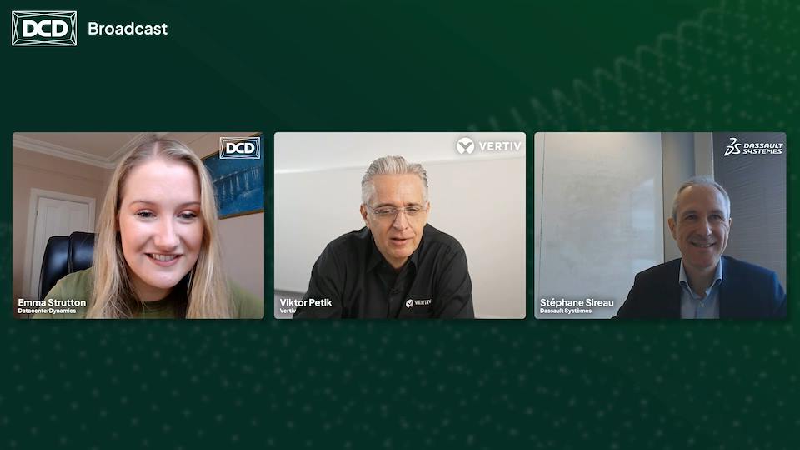
In the third episode of DCD AI Week 2026, Viktor Petik, Senior Vice President of Infrastructure Solutions at Vertiv, and Stéphane Sireau, Vice President of High Tech Industry at Dassault Systèmes, join Emma Strutton of DatacenterDynamics (DCD) to discuss how reference architectures, model-based systems engineering, and digital twins are changing the way AI factories are designed and built.
Emma Strutton, Head of Channels, (DCD): How have high-density AI workloads changed the way we should think about infrastructure design compared to traditional data centers?
Viktor Petik, Senior Vice President, Infrastructure Solutions, Vertiv:
AI is now turning data centers into highly coupled systems. We need to look at power, cooling, network, controls, and compute optimized together. Rack densities, liquid cooling, cable reach, and power delivery influence one another, so just having strong components does not automatically make a system validated. The challenge is understanding the dependencies between them.
Emma: Where do you most commonly see projects encounter problems?
Stéphane Sireau, Vice President, High Tech Industry, Dassault Systèmes:
The risk in the interconnection between power, cooling, network, etc, and having a systems view allows you to see across those disciplines and design and simulate infrastructure as a system. With AI factories, we're talking about effectively one of the most complex systems ever built. You might have seen this level of complexity in aircraft or nuclear power plants. The AI factory is just immense, and that requires a systems view effect.
Emma: What does it take to move from assembling those best-in-class components to delivering that validated high-performance system?
Viktor:
If failures occur, they would occur between the interfaces, not within the system itself. The challenge is to validate how the power, cooling, network, and compute perform together. We provide confidence in the overall system performance, not in the individual product performance. The objective is to validate the complete system against actual operating conditions before we build and deploy.
Emma: Why is traditional sequential engineering becoming less effective for AI infrastructure projects?
Stéphane:
At the end, your AI factory produces tokens, which you use for AI applications. Those tokens are produced by GPUs. Our factory can be seen at a multi-scale from the GPU up to the server, rack, scalable unit, and essential building blocks, such as Vertiv OneCore. You start from the compute up to the overall AI factory system. It all starts with the chip, and that is evolving constantly and very fast. You can't have a traditional sequential engineering approach. You need a continuous co-design approach based on a live model of your AI factory.
Emma: How do reference architectures enable faster, more confident decision-making without limiting flexibility?
Stéphane:
With the scale of AI factory deployment, you do need some guidance, and that's where the reference architecture comes in. Flexibility isn't lost through reference architecture; it's organized. That's the purpose of having a reference architecture that's model-based, which means that it is optimized as a system model, leveraging system engineering principles, to make sure that you don’t have frozen drawings, but a living reference architecture as a living model. That puts the reference architecture as a kit of pre-validated building blocks that you can assemble, plug together, configure, and use to enable an optimal design.
Viktor:
We need to have standardized, validated relationship interfaces, engineering assumptions, and performance models. There's no need to reinvent proven solutions for every project. Reference designs are not rigid and can accelerate decisions while maintaining that flexibility. Well, what we're actually doing is looking to standardize the components and the building blocks. If we standardize our thermal components, power components, power modules, and Smart Run infrastructure, those become the building blocks. And if those building blocks remain standard, with only a small amount of customization, then we can arrange them in different ways.
Emma: What can model-based systems engineering enable beyond visualization?
Viktor:
Model-based system engineering is not just about creating 3D models. It connects requirements, interfaces, system behaviors, simulation results, and engineering decisions. This helps teams understand the downstream impact of design changes and creates traceability across increasingly complex AI infrastructure projects. It also brings multiple disciplines together throughout system development.
Stéphane:
When we look at how it was made possible to design a plane with all its complexity, with all the systems accounted for, and have it fly the first time, it comes down to a systems view enabled by a digital twin. Every nut and bolt influences the whole system, which is why traceability from the component level to the system level is so important. What's exciting now is that we're applying those same principles to AI factories, which are even more complex.
Emma: What issues are most valuable to identify in a virtual environment before construction begins?
Stéphane:
Every asset has its virtual twin. It's a model that can be simulated ad infinitum. With that model, you can simulate before you even break ground. In AI factories, every little issue you can face on the ground can have enormous costs. If a fiber optic cable doesn't connect as it should, it could have a ripple effect on other elements of the system, which could, in turn, cause delays in the infrastructure. You cannot afford to discover this once you're deploying an AI factory.
Viktor:
Small changes can have large downstream effects: a change in power topology may alter thermal behavior; a change in rack layout can invalidate network cable assumptions; a cooling loop modification may affect pump sizing and facility power requirements. We can build this entire data center in a virtual environment and simulate and test different scenarios before deploying the building blocks in production at our factories. Even after production, we still test those modules before they go onsite.
Emma: How can organizations keep design assumptions constant throughout procurement, construction, commissioning, and operations?
Viktor:
You need to maintain this digital continuity throughout the entire project and after we hand over the projects to our customers. It's important that the design assumptions remain visible and accessible not only to engineering but also through procurement, construction, commissioning, and operations. Everyone should work from the same validated information set. It's critical to preserve this design intent, which would reduce the project's risk and the likelihood of unexpected field changes.
Emma: How does maintaining that continuous digital thread enable easier technology upgrades, as we prepare data centers for the future?
Viktor:
A facility can be designed to support multiple compute generations. This digital thread preserves the rationale behind all the design decisions. Teams can evaluate future upgrades using validated models instead of starting from scratch. That will improve planning speed, reduce risks, and increase confidence during any technology transitions. It also makes the infrastructure much more adaptable over its lifecycle.
Emma: What business value do customers gain from combining reference architectures, model-based systems engineering, and digital twins?
Viktor:
We enable faster deployments and dramatically reduce risks. Better decisions can be made earlier in the project lifecycle. We have better predictability during construction and commissioning, and fewer costly surprises in the field. We're also gaining increased confidence that the delivery system will perform as intended and as designed. Reference architectures provide the starting point. Model-based system engineering provides the discipline, and digital twins provide the environment to test decisions before they become physical products in our factories.
Emma: How do you see the industry's journey progressing from standardized digital assets to operational digital twins?
Stéphane:
The industry is moving very fast. Just a few months ago, at Computex, Vertiv was showcasing Smart Run as a fully converged physical infrastructure digital twin — that was absolutely incredible. The journey is on and moving extremely fast, but the foundations are solid: open standards and systems engineering as a discipline. I'm confident that the industry has the right tools and mindset to learn from other industries.
Viktor:
At Vertiv, we start with a system mindset. We treat the AI infrastructure as a complete system, not just a collection of products. System performance matters more than individual component performance. The winners will be those who validate interdependencies before the deployment.
Watch the full discussion: From blueprint to build - Designing smarter with reference architectures and digital twins