A power anomaly triggers a chain reaction that freezes production lines. Stopping the cascade starts with identifying what standard defences miss.
As power quality drops, control systems misread signals, sequences fall out of sync, and processes move into states that standard protection doesn't cover. Even small electrical shifts carry operational impact, setting failure in motion before alerts fire. How far the disturbance spreads depends on whether anything contains it.
Industrial environments often require a different class of power protection than commercial applications. Solutions such as the Vertiv™ PowerUPS 6000 Industrial are designed to help maintain process continuity (see Figure 1). These units support critical control equipment through power disturbances to reduce the risks of electrical events escalating into production interruptions.
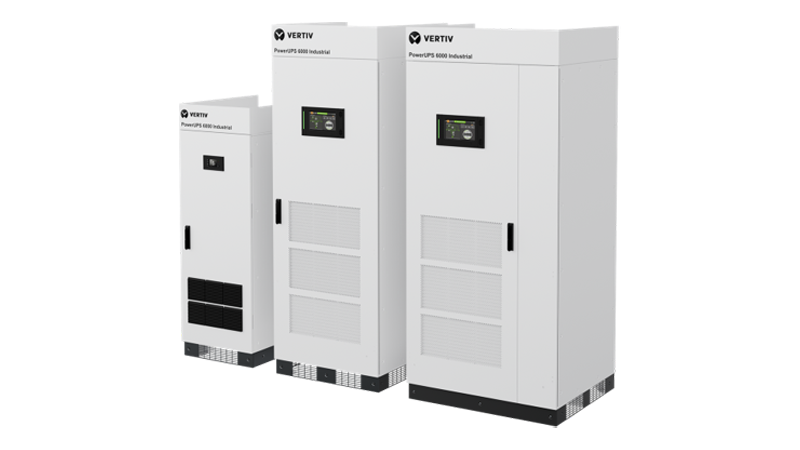
Figure 1. The Vertiv™ PowerUPS 6000 Industrial UPS system redefines versatility for C&I applications like manufacturing, transportation, logistics, cement, and oil and gas with a compact, single- or three-phase design (6–200 kVA). Source: Vertiv.
How a power disturbance becomes a production failure
Industrial systems share buses, feeders, and tightly linked process stages, allowing disturbances to travel across the network. At the control layer, degraded power causes programmable logic controllers (PLCs), drives, and sensors to misread signals and break sequence integrity before operators see an alarm. Automated responses can trigger shutdowns or improper resets, disrupting material flow. Interdependent process stages then stall, reducing throughput and increasing scrap.
Why industrial recovery outlasts the disturbance
In chemicals, food processing, and precision machining, a process interruption converts work in progress into unrecoverable scrap, with material, energy, and processing time lost in full. Production recovery runs well behind power restoration. Teams must clear safety interlocks, rebuild sequences, and resynchronise interdependent systems before operations can resume. Each step extends the outage, and rework, wasted inputs, and delivery penalties can accumulate well beyond the event itself.
How grid variability affects industrial operations across EMEA
In Europe, changing grid operating conditions are increasing the importance of power-quality resilience for industrial facilities. Even brief voltage sags, frequency deviations, or transient events can expose sensitive control systems to conditions outside normal operating ranges and interrupt production processes.
Across the Middle East and Africa, industrial capacity is expanding into grid environments where voltage disturbances and surges are part of routine operation. Consistent production depends on protection designed for the actual grid conditions in each market.
Why dedicated industrial power protection matters
Power disturbances don't need to cause an outage to impact production. Voltage sags, electrical noise, and brief interruptions can disrupt control systems and lead to costly process interruptions. Industrial UPS systems help maintain control integrity by delivering conditioned power during these events. In demanding manufacturing environments, features such as IP42-rated protection support reliable operation in environments exposed to dust and moisture.
Protecting what's at stake
As process sensitivity rises and automation deepens, the impact of a power disturbance compounds at every layer — electrical, control, production, and commercial. The facilities that hold their position under those conditions are the ones that treat power protection as a production specification, not a facility utility.
The Vertiv™ PowerUPS 6000 stabilises power across control and production systems in environments exposed to electrical variability and demanding operating conditions. Combining rugged industrial design with IP-42 rated protection, the UPS helps reduce disruption risk, maintain process continuity, and support reliable operation in facilities challenged by power disturbances, dust, humidity, and other environmental stresses.
Keep power disturbances off the production line
Protect critical loads, maintain control integrity, and help keep operations running through power events.
Contact Vertiv today.
Frequently asked questions
What is an industrial UPS and how is it different from a standard commercial UPS?
An industrial UPS is designed to protect production-critical systems in environments exposed to heat, dust, vibration, and electrical noise. Commercial and data centre UPS systems are typically designed for controlled environments and prioritise IT load continuity, whereas industrial UPS systems focus on maintaining process integrity and operational continuity under demanding conditions.
Why is environmental protection important for industrial UPS systems?
Industrial UPS systems are often deployed in environments exposed to dust, moisture, humidity, and airborne contaminants. Features such as IP42-rated protection help safeguard critical power electronics and support reliable operation in demanding industrial conditions, allowing protection systems to be installed closer to the processes they support.
Why do power disturbances spread beyond the point of failure?
Industrial systems are connected through shared electrical infrastructure — buses, feeders, and tightly integrated process stages, allowing disturbances at one to affect multiple systems. Without properly coordinated protection and isolation, these effects can propagate beyond the original source and disrupt broader operations.
Why do power disturbances cause longer recovery times in industrial facilities than in IT environments?
Industrial recovery often involves more than simply restarting equipment. Safety interlocks must be cleared; sequences restored, and interconnected systems resynchronised before production can resume. Recovery times can exceed the duration of the original disturbance.
How can manufacturers prevent power disturbances from disrupting production?
Industrial environments require power protection solutions designed for electrical variability, environmental stress, and continuous operation. Aligning power with control system requirements and process recovery objectives can help limit disruption, maintain process stability, and reduce recovery time following a disturbance.