
AI compute now moves faster than the industry has been able to prove the infrastructure behind it. The Vertiv™ ATLAS Lab closes that gap by testing power, thermal and controls together, as one system, ahead of the silicon.
Infrastructure now sets the pace of AI
On November 6, 2026, we walked NVIDIA leadership through the Vertiv ATLAS Lab, alongside the engineers behind roughly three years of joint work. What they saw was a performance test of the AI factory as one system, under load.
The reason Vertiv exists is simple. AI compute now moves faster than the industry has been able to prove the infrastructure behind it.
Five forces are accelerating at once, and each one lands on power, thermal, and controls first:
- Density. Every compute generation puts more power and more heat into each rack.
- Speed. Compute platforms now turn over annually, and capacity has to come online at the same cadence.
- Scale. AI factories are planned in hundreds of megawatts and increasingly in gigawatts.
- Complexity. Grid, power, thermal, IT and controls meet at more interfaces, and most deployment risk lives at those “seams”.
- Load profile. AI workloads move power demand in large, synchronized swings that travel from the rack back to the grid.
An AI factory is measured in tokens per second, per watt and per dollar, and in time to first token. Infrastructure sets all four of these.
Most of the industry still validates that infrastructure one product at a time. An AI factory succeeds or fails as a system, so we test it as one
What ATLAS is
Vertiv™ ATLAS stands for Advanced Test Lab for Architecture and Systems. The name is deliberate.
Architecture, because we prove how power, thermal, IT, and controls are arranged and connected. Systems, because the unit of proof is the integrated chain from grid interconnect to chip to heat rejection, rather than any single product.
The name carries a second meaning. In mythology, Atlas was the titan who held up the sky. The infrastructure under AI carries a comparable load, and it has to hold before the compute arrives.
Vertiv ATLAS is a capability, not a room. It is how Vertiv proves an architecture before a customer commits capital to build it.
It operates as a representative pod of a real AI factory. What we prove at pod scale becomes the reference design customers replicate at campus scale, because every system that Vertiv ATLAS proves is a fraction of the AI factory it becomes.
How Vertiv ATLAS tests
Every test in Vertiv ATLAS maps to a stage in the life of an AI factory: design, deploy or operate. The walk-through on November 6, 2026, followed that sequence, with a recorded digital twin, a live load-bank demonstration, and operating modes shown in simulation.
- Design: simulate first. We configure and validate the architecture in a physically accurate virtual twin before anything is built. Software answers design questions, which means that a change costs a costs a model revision rather than a site rework.
- Deploy: prove form and fit. We confirm that power, thermal, and IT integrate physically, and we close the interfaces, or the “seams” between them. Problems found here never reach a construction site.
- Ahead of silicon: emulate the compute. There are no NVIDIA GPUs in Vertiv™ ATLAS, by design. Emulators reproduce the power and heat behavior of compute that have not shipped yet, so we validate infrastructure generations ahead of the silicon. The point is also to push systems past their limits, and you do not do that on production silicon.
- Operate: stress the system. We run power and thermal together through the load swings AI workloads create, including power smoothing, and measure how the whole chain responds. The thermal chain runs from cold plate through coolant distribution to heat rejection. The power chain runs from grid interconnect to the rack.
- Operate: orchestrate with the grid. Controls coordinate grid, power and thermal as one operating system for the facility. We prove that orchestration in three modes: grid connected, hybrid with on-site generation, and fully islanded.
The sequence matters as much as the tests. A design proven in simulation, then in form and fit, then under emulated load, gives a customer a validated baseline, which is more valuable than a set of product data sheets.
Built with NVIDIA
Vertiv ATLAS sits at the center of Vertiv’s engineering collaboration with NVIDIA. Engineering teams from both companies work across grid, power, thermal management, controls, and simulation, with Vertiv ATLAS providing a system-level environment to test and validate their work as an integrated system.
The line we shared for the day was "Accelerating AI, together." It only holds if the infrastructure is proven before the compute lands, which is exactly what Vertiv ATLAS is for.
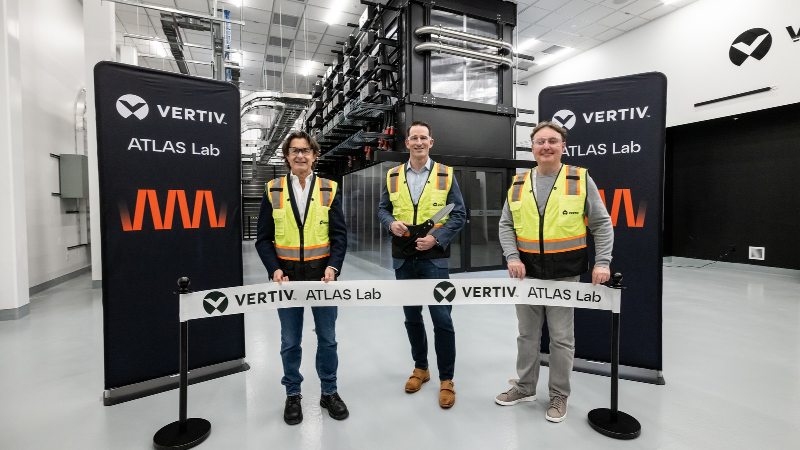 From left: Giordano Albertazzi, CEO of Vertiv; Scott Armul, Chief Product and Technology Officer at Vertiv; and Vladimir Troy, Vice President of AI Infrastructure at NVIDIA, at the Vertiv ATLAS Lab ribbon-cutting in Columbus, Ohio, on November 6, 2026.
What designers and operators gain
The benefit is time and certainty. When an architecture has already been proven as a system, every stage of the AI factory lifecycle moves faster.
- Designers move from engineering every project to configuring from a proven reference.
- Builders close interfaces in a test environment rather than on a construction site.
- Operators start from a validated baseline instead of managing risk at handover.
The economics of speed is already public. At NVIDIA GTC Berlin on October 21, 2026, Vertiv and NVIDIA introduced an approach that cuts configuration and validation from approximately 30 days to three days. Combined with factory-built deployment, it reduces those stages from approximately 120 days to 48 days.
That makes productive AI capacity available about 10 weeks sooner. Under defined assumptions, it generates up to 30% more cumulative token output within the first 12 months with the same installed capacity. Those figures are modeled. Vertiv™ ATLAS is where we prove that the integrated system behind them holds under real load.
Operations is where the next gain sits. Every megawatt a customer contracts should produce tokens, and power held in reserve or derated to absorb workload swings is output left on the table.
Vertiv can test that chain end to end, because Vertiv spans it, covering power, thermal, controls and services from the grid to the chip. So, we optimize the system rather than one link in it. We shorten the time to first token and raise the tokens per megawatt that follow.
Contracted megawatts. Productive compute. Faster.
AI capacity is constrained by power, by time and by integration risk. Vertiv ATLAS takes on all three before a customer breaks ground.
Every AI factory builder should ask one question before committing capital: has this architecture been proven as a system, under load? Vertiv ATLAS answers that question with evidence.
The outcome we hold ourselves to is plain. Every contracted megawatt becomes productive compute, faster.
From simulation to system-level proof
Explore Vertiv’s AI factory readiness application brief to learn how a closed loop of simulation, physical validation and operational learning can help turn every available megawatt into productive compute.