AI growth is driving new power delivery demands. 800 VDC is how the industry responds.
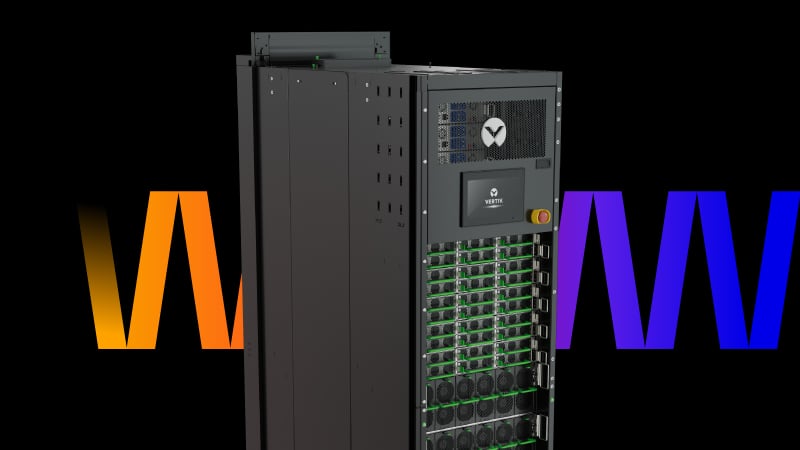
Today's AI clusters already hit 140 kilowatts (kW) per rack, with 240 kW imminent and 600 kW on the horizon. Somewhere between 350 and 400 kW, traditional AC power delivery begins to break down; connectors, busbars, and copper volumes cannot keep pace. Power conversion competes with GPUs for rack space. Vertiv's 800 VDC sidecar architecture moves conversion out of the rack and into the pod. The design returns 8 to 16 rack units to compute while allowing much of the upstream AC infrastructure to stay in place. But voltage alone is not an architecture. The work is designing how conversion, distribution, protection, energy storage, controls, cooling, and service operate together from the grid to the chip.
Why the industry is exploring 800 VDC
| Industry challenge | Power delivery consequence |
|---|---|
| Rising rack densities | More power required in less space |
| Increasing current | Larger conductors and infrastructure |
| Loss of compute space | Power equipment consumes valuable rack capacity |
| AI load variability | Greater demands on electrical infrastructure |
Watch the power shift series: How 800 VDC is reshaping AI power delivery
Join Scott Armul, Vertiv Chief Product and Technology Officer, as he explores the drivers behind 800 VDC and what higher-density AI infrastructure means for future power architectures.
Why AI power delivery is reaching its physical limits
AI has turned power delivery into a compute constraint.
As AI rack designs scale, the challenge is not just securing enough power, but delivering it without constraining compute density.
Higher-voltage DC provides a path forward.
How 800 VDC creates space for higher-density AI
AI compute is taking over the rack. Power conversion has to move.
An 800 VDC sidecar architecture relocates power conversion outside the compute rack, freeing space for AI compute while allowing much of the upstream AC infrastructure to remain in place.
Creating a practical near-term path to higher-density AI starts at the rack.
How AI power architecture extends beyond the rack
Power conversion is moving to keep pace with AI compute density. Traditional AC racks power today's GPUs. Adding an 800 VDC sidecar allows the same AC infrastructure to support higher rack power densities without redesigning the facility.
The longer-term shift is toward centralized DC power tied to medium-voltage (MV) infrastructure.
Vertiv is developing two parallel paths: an MVDC UPS with higher technology readiness today, and solid-state transformer technology that offers improved efficiency and a smaller footprint as it matures.
Vertiv™ AI Hub
Explore the technologies, architectures, and infrastructure decisions enabling AI at scale.
Visit the Vertiv AI Hub