
As AI drives unprecedented increases in data center power density, understanding modern thermal management approaches becomes crucial for maintaining efficient and reliable operations.
Thermal management remains a critical challenge that demands innovative solutions. Where traditional server racks typically consume less than 10 kW, AI computing clusters draw up to 150+ kW per rack today, with research suggesting densities can go even higher in the coming years. This increase in power density creates new challenges for heat collection and removal.
Trends reshaping thermal management
Beyond explaining the fundamental concepts, key trends are reshaping how the technology industry understands and approaches thermal management in data centers:
- Growing diversity of rack densities within facilities
- Increasing pressure on energy and water resources
- Evolving regulations around refrigerants and emissions
- New collaborations between infrastructure and technology providers
These influential trends affect critical design considerations for thermal management solution planning, selection, deployments, and maintenance. From data center size and layout to resilience requirements and resource efficiency goals. Special attention is given to the integration of liquid and air cooling in hybrid environments: an increasingly common scenario as organizations add AI capabilities to existing facilities.
Converged physical infrastructure: Moving from components to system outcomes
“Customers don't need another collection of good boxes. They need a system that fits together cleanly, operates coherently, and performs consistently across Day 0, Day 1, and Day 2.” - Martin Olsen, Vice President of Segment Strategy and Deployment at Vertiv
The modern data center thermal chain
The modern data center thermal chain is the interconnected system responsible for capturing and removing heat generated by IT equipment for compute and processing. The ebook, “The data center thermal chain,” breaks down this complex topic to three key stages:
- Server/rack heat collection: Server and rack heat collection is the first stage of the thermal chain, capturing heat at its source through either air-based systems for low-density environments or liquid cooling for high-density deployments where air lacks sufficient thermal conductivity. Direct-to-chip (DtC) cold plates mounted on CPUs and GPUs remove up to 70–80% of rack-generated heat by transferring it to circulating coolant, while immersion cooling submerges hardware entirely in dielectric fluid to handle the highest power densities. The guide explores different approaches, including rear-door heat exchangers (RDHx), direct-to-chip cooling, and immersion cooling.
- Row/room heat collection: This intermediate stage aggregates heat from individual racks while maintaining proper environmental conditions throughout the facility. Computer room air conditioning (CRAC) units use internal direct-expansion refrigeration to independently cool smaller deployments, while computer air handlers (CRAHs) draw on external chilled water plants to serve larger facilities, with coolant distribution units (CDUs) managing liquid-cooled environments by regulating coolant temperature, pressure, and flow across multiple racks. Thermal walls scale this further by delivering up to 500 kW of cooling capacity in a vertical perimeter configuration that maximizes usable floor space without requiring raised-floor infrastructure.
- Facility/outdoor heat rejection and reuse: Facility-level heat rejection expels accumulated thermal energy from the data center entirely through chillers, condensers, dry coolers, and adiabatic systems enabling heat reuse. Each balances the tradeoff between energy consumption, water use, and cooling capacity based on local climate and resource availability. Economization leverages ambient conditions to reduce or eliminate reliance on mechanical cooling, operating in full free cooling mode when temperatures permit, or in a hybrid partial mode where ambient air handles a portion of the load while compressors handle the remainder.
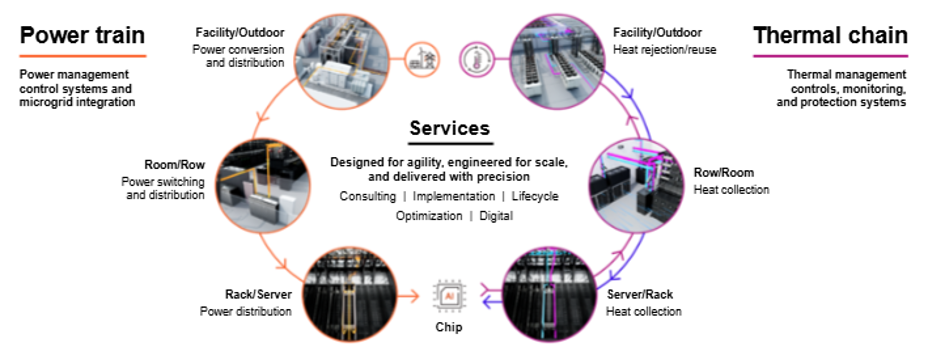
Figure 1. Accelerating compute demand and density at scale requires a new approach to improve power use and thermal chain efficiency. Source: Vertiv.
Redefining heat reuse
Heat reuse reframes data center waste heat as a recoverable energy asset with measurable economic and environmental value. Nearly 100% of the electricity consumed by servers converts to heat, creating a continuous, predictable thermal energy source operating around the clock. Its significance: waste heat from data centers at 25–35°C could provide 221 TWh per year, accounting for an estimated 12% of the EU's heating demand, positioning data centers as the fourth-largest potential heat source.
AI and high-density liquid-cooled systems are particularly conducive to heat capture, as they naturally operate at higher fluid temperatures, thereby improving recovery efficiency. The advancement of gas-powered and absorption chillers further enables this shift by converting low-grade waste heat into a useful energy input for cooling production, decoupling cooling capacity from grid dependency, and closing the thermodynamic loop in ways conventional electric chillers cannot.
Thermal monitoring, control, and services
Thermal monitoring and control is the operational intelligence layer that provides data and actionable insights on whether cooling infrastructure performs to its engineered potential or operates reactively below capacity. At the unit level, advanced controls dynamically adjust fan speeds, setpoints, and operating modes using real-time sensor data and algorithmic logic. Automated, these functions respond to shifting thermal loads as they occur rather than relying on static thresholds.
At the system level, centralized management platforms unify cooling assets under a single interface, enabling coordinated capacity sharing, real-time environmental visibility, and intelligent alarm prioritization across the facility. Predictive analytics and machine learning extend this further by identifying degradation trends and early warning signs of component wear before they lead to downtime, shifting the maintenance model from reactive break-fix to predictive intervention. In high-density environments where thermal margins are narrow and workloads shift continuously, this intelligence layer keeps cooling aligned with actual demand rather than peak design assumptions, reducing energy waste while maintaining the precision that modern compute requires.
Lifecycle services sustain cooling performance across the operational life of the thermal chain, from design validation through long-term reliability. All baseline knowledge and history from the same experienced vendor, along with continuous collaboration with the operator, can contribute to preventive and predictive maintenance. Leveraging sensor data and automated diagnostics collated from remote and onsite monitoring controls establishes baselines, generates health scores, and detects performance drift before it becomes downtime, shifting the operational model from reactive to condition-based actions way ahead of the failure curve. In high-density environments where thermal margins are narrow and the cost of failure is measured in seconds or minutes, monitoring, controls, and services close the gap between design capability and operational reality.
Taking steps forward
Whether data center operators and engineers are facing these challenges for new facilities or retrofitting existing data centers, this guide serves as a valuable resource for understanding modern thermal management fundamentals, approaches, and technologies. It provides the knowledge and insights needed to evaluate the solutions that can support current operations and future growth.
Learn about the changing thermal management strategies and solutions of modern data centers.
*In compliance with the EU AI Act’s transparency requirements, this article included the use of AI during brainstorming, organization, and refinement. Writers, editors, artists, and technical subject matter experts (SMEs) reviewed, refined, and finalized the published version.