

Healthcare organizations are managing increasing digital and clinical demands across environments that weren’t always built for today’s workloads. Understanding where power and cooling constraints appear and how to address them gradually helps operators maintain uptime and create room for growth.
Global healthcare organizations are patient-centered, data-rich, and digitally driven. Many leaders are working in environments with mixed-age infrastructure while expanding services and supporting real-time clinical workflows. A phased approach to modernization can reduce operational risk, add capacity where it is needed, and observe proper maintenance windows and clinical schedules.
Healthcare environments change over time, and the rooms that support digital and clinical systems often reflect years of practical decisions. As workloads grow, issues in power, thermal performance, or room setup start to show up across sites. Noticing these early signs helps teams understand where constraints are likely to develop, and which factors may influence clinical workflows.
Power limitations in mixed-age healthcare infrastructure
Many health systems work across a mix of main campuses and affiliated or leased facilities, and the electrical environments in these spaces often differ significantly. Some locations operate on commercial‑grade power, while others rely on aging distribution equipment that offers limited visibility into load behavior. Recent benchmarking in 2022-2023 across EMEA/APAC indicates similarly high intensity.
According to IDC FutureScape: Worldwide Performance‑Intensive Computing 2026 Predictions, by 2028, 40% of enterprises will adopt an IT architecture that brings accelerated computing, Artificial Intelligence (AI) stacks, and vector databases closer to dedicated storage to improve efficiency and speed AI insights. This move concentrates more performance‑sensitive compute into local environments, increasing expectations for power quality, monitoring, and electrical reliability in the rooms that support these systems.
Thermal constraints in existing spaces
Many healthcare IT spaces were built before widespread digitization and AI. As a result, compute, power distribution, and cooling are often placed in small rooms or repurposed areas. High‑load imaging and analytics workloads can create concentrated heat that exceeds the cooling capacity of legacy telecommunications rooms, Intermediate Distribution Frames (IDFs), and converted administrative spaces.
These dense deployments increase the risk of hot spots, airflow constraints, and inefficient cooling, which can reduce compute performance. Cooling becomes a bottleneck to expanding imaging and AI workloads. Managing thermal risk effectively is critical to maintaining system reliability and compliance.
Rising density needs in healthcare IT rooms
The growth in distributed care models, real‑time imaging, and always‑on clinical systems such as electronic health records and emergency workflows is increasing both compute demand and power requirements across healthcare environments. As digital services expand, more equipment is being concentrated into existing spaces, which raises electrical and thermal expectations in rooms that were often not designed for today’s workloads.
AI deployments intensify this trend. Server racks used to train artificial intelligence (AI) models can reach 50kW or more, which significantly exceeds the capabilities of many legacy healthcare power and cooling configurations. Even introducing a small number of these higher‑load racks can change what a room needs in terms of distribution, monitoring, and airflow.
As these conditions stack up across different rooms and sites, it becomes clearer where day‑to‑day constraints originate and how they influence clinical operations. Once teams can see those patterns, it becomes easier to move toward improvements that can be introduced gradually and fit naturally into existing schedules.
A practical, phased path to modernization
Operators aim to build resilient infrastructure that supports current needs and growth. In practice, that often means introducing advanced power and cooling to support higher density compute. With a clearer view of where constraints appear, teams can sequence improvements to stabilize today’s operations and make room for future workloads.
A potential modernization pathway can include:
- Leveraging assessment frameworks: Use capacity planning, facility condition assessments, and workload mapping to identify and address critical constraints.
- Taking a phased approach to modernization: Prioritize mission-critical and fast-growing workloads first. Modular or scalable architectures can help modernize imaging-adjacent spaces or network closets while limiting disruption.
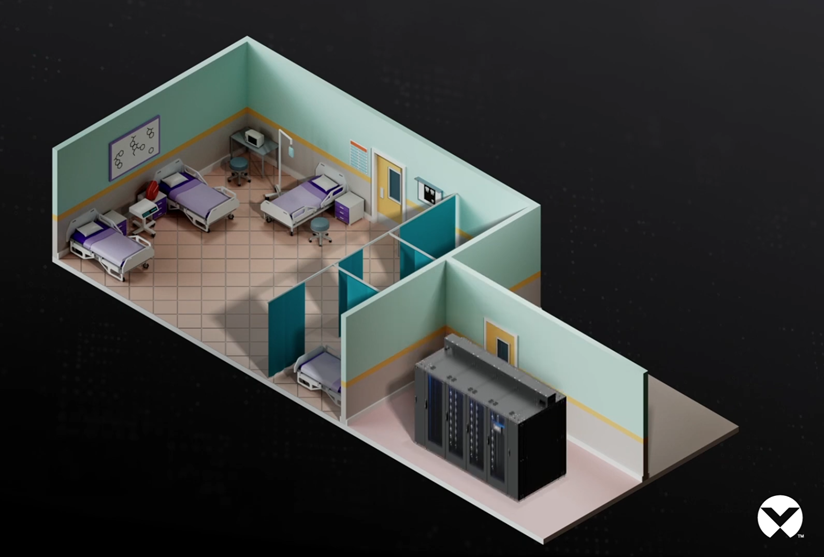
Fig 1. A self-contained Vertiv™ SmartRow™ 2 installed in a small, separate room near care areas. The enclosed row integrates compute, power distribution, cooling, and monitoring in one footprint, showing a space-efficient way to add local capacity in facilities with limited room while keeping IT equipment physically separated from patient spaces.
- Transforming power systems: Updating low and medium-voltage distribution and improving monitoring can provide visibility at the power distribution level and help IT and power teams manage power quality in line with service expectations.
- Deploying advanced cooling: Explore air and liquid cooling strategies that fit the room. The goal is to cool imaging-adjacent and other small spaces while meeting performance and reliability targets.
- Supporting rising rack density: Consider modular, integrated solutions that combine compute with advanced power and cooling in a compact form factor to increase local capacity in space-constrained environments and support data-intensive and AI workloads.
- Balancing on-premises and cloud: Keep latency-sensitive, regulated workloads local, while using cloud platforms for scale and analytics.
Planning for what comes next
Healthcare organizations want to scale digital and AI services to serve growing populations, respond to current and emerging needs, and support clinicians with responsive systems. Modernization helps deliver that vision.
Download the ebook for practical guidance on helping teams evaluate their environments and plan improvements that align with business priorities and budgets. It also outlines ways to reduce risk and deploy efficient infrastructure that support performance and clinical uptime.