Power is becoming one of the defining constraints on AI infrastructure. As operators rethink how they generate, manage, and share power, the role of the data center is starting to change.
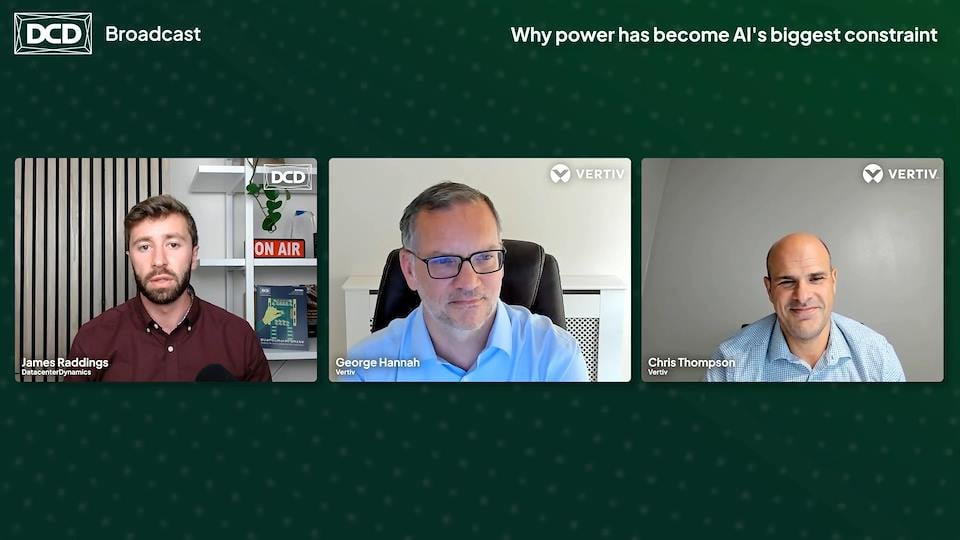
In the second episode of DCD AI Week 2026, Vertiv's Chris Thompson, Vice President of Global Advanced Technology and Microgrid, and George Hannah, Vice President of Thermal Systems and Advanced Development, join James Raddings of DatacenterDynamics (DCD) to discuss what delivering power confidence for high-density data center infrastructure requires.
James Raddings, Digital Portfolio Lead, DCD: AI workloads can fluctuate very steeply and quickly. What are the implications of those rapid fluctuations?
Chris Thompson, Vice President of Global Advanced Technology and Microgrid, Vertiv:
The loads are large, and they fluctuate. We are seeing data centers growing by 10x from where they were before. Grids do not like it when you have large loads bouncing around. With the power systems we designed, we can mitigate those loads.
George Hannah, Vice President of Thermal Systems and Advanced Development, Vertiv:
We have to solve the same problem, albeit on a slightly different timescale. Our thermal chain, which can be very long now that we’re going straight to the cold plate, must react very rapidly to millisecond power changes, that can turn into subsecond thermal changes. Where power is putting uninterruptible power supplies (UPSs) and batter energy storage systems (BESS) in place, we’re looking at thermal energy storage, buffer tanks, faster responding valves, and intelligent controls.
James: What does “bring your own power (BYOP)” actually mean, and does it aim to move away from the grid or work alongside it?
Chris:
There are really several approaches. The first is going to the utility and waiting for power, but the interconnection queue is getting longer. Then we see an interim step where you can get connected more quickly by bringing in energy storage or load curtailment.
Then you might look at onsite power. We’re seeing about 50/50 right now, where 50% are looking at going entirely off the grid, and the other half are continuing to use the grid but augmenting it with onsite power.
George:
From a cooling perspective, once you bring the engine on site, you’ve got an abundance of heat. Technologies that were previously not so interesting, like absorption chillers and organic ranking cycle, become viable.
When you’ve got the high grade of heat from onsite power generation, anywhere from 200°C up to 600° or 650°C, you can start to do things to offset the cooling power absorption you need on site. That can release power back to IT and improve your PUE. At the end of the chain, you still have residual heat that can be given to the local community or process to offset what the grid would otherwise have to provide.
James: Historically, power and thermal have been treated as separate disciplines. Why are they becoming so closely linked in the AI era?
Chris:
As density has grown so much, with the onset of liquid cooling, there’s so much power and heat that those two systems are now more tightly coupled than ever. You need absolute perfect continuity of both, or you go into thermal instability quickly.
George:
If you look at pre-liquid cooling, there was literally an air gap between the heat source and the cooling; air cooling dealt with the rapid temperature changes from the silicon with enough buffering in place to give you that air brake.
But now, we no longer have the air brake. The thermal system is touching the silicon, which is touching the power at the cold plate at the silicon level. When you’re one thermal chain and one power train, you must function as a living, breathing, continuous, coordinated entity.
Chris:
One way I look at the GPU is as a converter between the electrical and thermal domains. Obviously, the output is tokens. All the power goes in and gets turned into heat. And because it's so dense, that's one of the problems. When you think about the size of that chip, the power that's feeding it is below a volt. So if it's getting fed 1,000 amps and at the same time you need to cool it, we're literally running out of space around the chip because everyone wants a periphery where they can feed power to it and get cooling simultaneously.
James: Batteries and UPS systems have historically been there to protect the data center in case something goes wrong with the grid. How has AI evolved the role of those?
Chris:
The time scales we are working across now have really expanded. We used to think of a UPS as something where you had five to 10 minutes of runtime.
Now we’re looking at storage in the rack or adjacent to the rack, which could be an electrolytic capacitor or supercapacitor to handle voltage swings. You could have a storage there, which is often in the form of a BBU that’s one minute, a UPS at 5 to 10 minutes, and now BESS systems and future UPS systems that have 2 to 4 hours of runtime. We are now working across five different time scales. A solution probably needs a combination of those, which we can help optimize but requires a lot of coordination.
George:
Chris highlighted that now the data centers are affecting the grid, and as a consequence, the grid can be unstable in certain locations.
Our products and systems now must cope with over-voltage and under-voltage situations more than they’ve ever had to. Now we have to think about UPS systems being incorporated into our thermal products, battery storage systems, and fault tolerance and voltage tolerance capabilities embedded in the product and qualified.
James: What needs to be done today for the industry to become ready for the wider adoption of onsite generation and more distributed energy?
Chris:
Onsite power is not a get out of jail free card. We have lead times of generation equipment, and some of the major generation vendors, particularly larger turbines, have multi-year lead times. When you go completely off the grid, you need to think about the coincident peak of the system. This is where load orchestration becomes very interesting because you can look at how you coordinate generation, onsite storage systems like BESS and UPS, and onsite thermal systems.
Many of our customers are on this power journey. You may start getting a small amount of power from the grid, add some grid flexibility, and then get a flexible interconnect and get more power. Then you can add onsite power.
Some people are looking at onsite power as a bridge, because your utility will eventually provide something to you in five years. So you use on-site power as a bridge, or as an augmentation.
James: Could data centers actually become part of the solution rather than a burden on the grid?
Chris:
That’s a narrative we’d really like to help intervene on. A data center can actually bring down costs in a region.
By offering flexibility, they can draw power when the grid has available power, letting more revenue be derived from utilities from their existing hardware. They’re getting a higher capacity factor, which allows more revenue from the same fixed costs, and that should put downward pressure on pricing. We see data centers as flexible grid assets.
George:
Politically, the best way to get a result is to incentivize things, and I don’t see much incentive going into encouraging data centers to connect to the grid and, where they have BYOP, to have that power to contribute to the grid.
Storage systems have always been the holy grail of how to solve the problem on the grid, and now we’ve got this device that pulls power off the grid but can provide power back to the grid.
James: If we’re having this same conversation in 5 years, what do you think we’ll be talking about?
Chris:
I think we’re going to see a much larger diversity of generation. I am optimistic about nuclear. With demand being high, I think we’re going to see greater diversity across fuel cells, turbines, and a resurgence of nuclear energy.
George:
We'll see more cooling products that need dual power supplies, whether they're off the grid or running on gas, and more solutions that make use of heat as BYOP becomes more essential. I hope it’s taken positively, with incentives to make data centers as optimized and as giving back to the grid or local community as they can be.
Watch the full discussion: From planning and design to deployment reality - What operators must solve next