Industrial operations depend on more than keeping the lights on. Identifying the most critical loads helps focus protection where power disturbances can cause the most disruption.
Industrial facilities may differ widely, but many rely on a remarkably consistent set of critical loads. Even a brief power disturbance can interrupt process control, affect safety functions, or complicate recovery long before normal operations resume. These systems often determine whether an operation rides through an event or faces extended downtime.
The first two articles in this series examined why industrial applications need a different class of power protection and how power disturbances can cascade into operational losses. This final installment turns to where that protection is applied: the critical loads that support continuity across industries and the role industrial uninterruptible power supply (UPS) systems play in keeping them available.
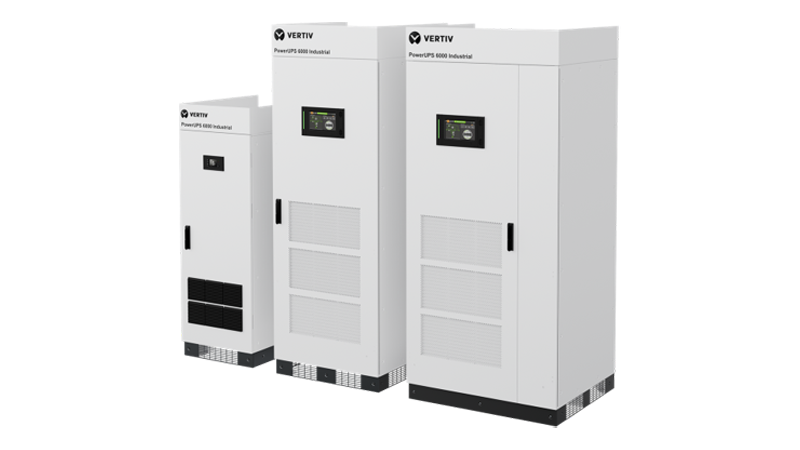
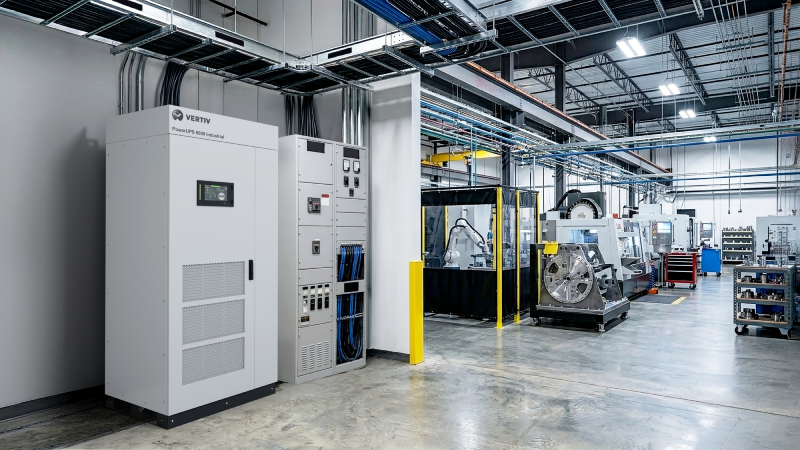
Purpose-built solutions such as the Vertiv™ PowerUPS 6000 Industrial are designed around these requirements, delivering clean, uninterrupted power for critical operations, automation, and process control in demanding industrial environments.
Four categories of loads define industrial continuity
Although industrial applications vary, the loads that require uninterrupted, conditioned power fall into four recurring categories:
- Control and automation systems: Supervisory control and data acquisition (SCADA) platforms, programmable logic controllers (PLCs), drives, and data acquisition systems coordinate the process. These loads are highly sensitive to voltage disturbances and waveform distortion, and a brief interruption can break sequence integrity long before operators see an alarm.
- Safety and protection systems: Fire and gas detection devices, emergency shutdown devices (ESD), and emergency lighting must remain available precisely when the electrical network is at its least stable. These loads carry regulatory weight, and standards such as EN50171 govern central power supply systems (CPSS) for safety applications, including emergency escape lighting.
- Communication and monitoring systems: Passenger information systems, plant communication networks, and remote monitoring links preserve situational awareness during an event. Losing them extends recovery because teams cannot see system state while restoring operations.
- Environmental and auxiliary systems: Heating, ventilation, and air conditioning (HVAC) systems, motors, and pumps maintain the physical conditions that processes and personnel depend on, from underground air movement to refrigeration in food production.
A power protection strategy is only as strong as its coverage of these four categories. That is why industrial UPS evaluation increasingly starts with the load list rather than the capacity rating.
How certifications help specifying engineers evaluate industrial power protection
For specifying engineers, certifications help reduce risk during system selection by providing independent verification that a UPS meets specific performance, safety, and application requirements. They help validate suitability for intended applications before a system is specified or deployed.
EN50121 evaluates electromagnetic compatibility in railway environments, where signalling, control, and communication systems must operate reliably alongside electrically noisy infrastructure. EN50171 applies to central power supply systems used for safety applications, including emergency lighting. Other standards, such as IEC 62040 and SEMI F47, address UPS performance and power quality requirements in industrial and commercial environments.
By carrying these certifications, the Vertiv™ PowerUPS 6000 Industrial allows engineers to evaluate and specify a single platform across multiple industrial applications while supporting project and industry compliance requirements.
What the operating environment demands from an industrial UPS
The critical loads described above often operate in some of the harshest industrial environments. As a result, the UPS supporting them must be designed to withstand the same conditions. Electrical rooms may sit beside kilns, alongside rail infrastructure, in port facilities, or at remote sites where heat, dust, moisture, and corrosion are part of normal operations.
Engineers must evaluate not only what a UPS protects but also whether it can operate reliably in the environment where it is deployed.
The Vertiv PowerUPS 6000 Industrial (see Figure 1) is designed for these realities. An IP42-rated enclosure and conformal coated circuit boards help protect against dust, moisture, and corrosion. The system also operates in ambient temperatures up to 50°C, making it suitable for non-air-conditioned electrical rooms.
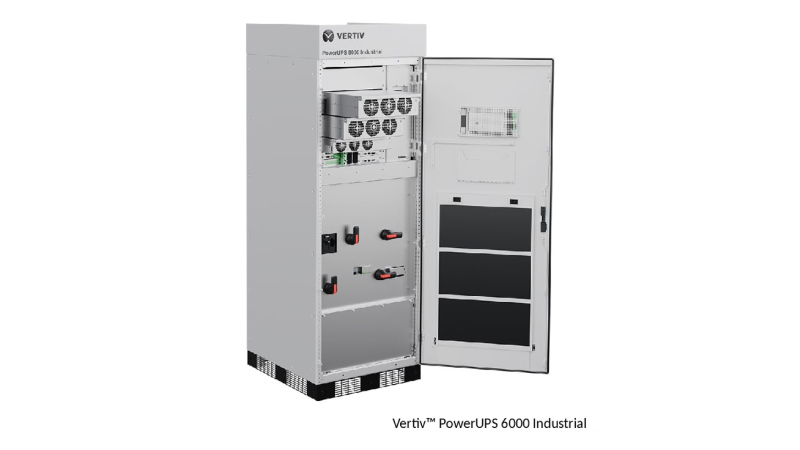
Figure 1. 3D rendering of the Vertiv™ PowerUPS 6000 Industrial, designed for deployment in industrial environments where heat, dust, moisture, and other operating conditions influence UPS selection. Source: Vertiv.
Validated to operate without derating at elevations up to 3000 metres, the system supports high-altitude and other low-pressure environments. A battery cold start function can also restore emergency power after a complete network failure. Compatibility with VRLA, nickel cadmium, and lithium-ion battery cabinets allows engineers to align runtime with recovery needs. A fully front-access design keeps mean time to repair below half an hour in constrained spaces.
What drives China's certified power protection demand
Greater China's urban rail networks and petrochemical facilities represent two demanding power protection use cases across the region. Signalling, railway control, and passenger information systems span extensive metro networks and require both electromagnetically compatible power and reliable time synchronization for coordinated operations. Some industrial UPS platforms, including the Vertiv™ PowerUPS 6000 Industrial, support these requirements through network time protocol (NTP) clock synchronization.
With China among the world's largest petrochemical producers, refining and petrochemical operations run on shared electrical networks. Control rooms, fire and gas detection, and emergency shutdown systems all draw from those networks, making a power disturbance threaten a safety event, not only an operational one. Optional transformers add galvanic isolation for the most sensitive process equipment.
One platform across the load list
Rail networks, mines, cement plants, ports, and petrochemical facilities may look very different, but they all depend on the same principle: the loads that keep operations safe and productive are the loads that cannot fail. That is why industrial UPS selection should consider not only capacity requirements, but also the control, safety, communication and environmental systems that depend on continuous power.
Taken together, the three articles in this series form a complete evaluation framework for industrial power protection. They explain why industrial applications often require a different class of UPS, how power disturbances affect industrial environments, and where power protection must be applied. The result is a more complete evaluation approach, one that considers not only capacity and uptime, but also environmental conditions, compliance requirements, and the critical loads that keep operations running.
The Vertiv™ PowerUPS 6000 Industrial supports this approach on a single certified platform, combining EN50121 and EN50171 certification, IP42 protection, operation in ambient temperatures up to 50°C, high-altitude capability, flexible battery compatibility, and front-access serviceability across a 6-200 kVA range. It allows operators, EPCs, and specifying engineers to protect the full load list with one system designed for the environments where those loads actually live.
Protect the loads that keep operations running
From signalling to SCADA, keep critical systems powered through every event.
Contact Vertiv today.
FAQs:
What loads does an industrial UPS typically protect?
Industrial UPS systems commonly protect SCADA systems, PLCs, communication systems, data acquisition systems, emergency lighting, and ventilation and HVAC systems, along with equipment specific to each industrial process such as kiln controls, signalling systems, or fire and gas detection devices.
What is EN50171 certification and why does it matter?
EN50171 governs central power supply systems (CPSS) used for safety applications, including emergency escape lighting. A UPS certified to EN50171 can be specified to carry life-safety loads, allowing one platform to protect both operational and safety-critical systems
Why is EN50121 important for railway applications?
EN50121 addresses electromagnetic compatibility within the railway environment. Certification confirms the UPS can operate reliably alongside signalling, traction, and communication systems without causing or suffering electromagnetic interference, which is a baseline requirement for rail infrastructure specification.
Can industrial UPS systems operate at high-altitude or remote sites?
Purpose-built industrial UPS systems are validated for demanding site conditions. The Vertiv™ PowerUPS 6000 Industrial has been tested for reliable operation and effective cooling at altitudes up to 3,000 metres without derating, and its battery cold start function can restore emergency power to critical loads after a complete network failure at sites without immediate grid recovery.
How do battery options affect protection for critical loads?
Runtime requirements differ by load. Safety systems may require extended autonomy while control systems need ride-through and orderly shutdown time. Compatibility with VRLA, nickel cadmium, and lithium-ion external battery cabinets allows runtime to be engineered to each application's recovery requirements.