System-level testing and validation addresses density, speed, scale, complexity and dynamic load profiles before next-generation compute reaches the market
Engineering collaboration with NVIDIA advances infrastructure in parallel with accelerated computing and shortens the path to first token
COLUMBUS, Ohio (Nov. 16, 2026) — Vertiv Holdings Co. (NYSE: VRT), a global leader in critical digital infrastructure, is proving the power, thermal management and controls infrastructure behind AI factories at the start of the engineering process, ahead of the silicon it supports, using the Vertiv ATLAS Lab, a system-level testing capability.
ATLAS, short for Advanced Test Lab for Architecture and Systems, exists because five forces are intensifying across AI infrastructure at once: density, speed, scale, complexity and dynamic load profiles. These forces amplify one another, so solving one in isolation can move the constraint elsewhere in the system. Most infrastructure is validated one product at a time, while an AI factory succeeds or fails as a system. The Vertiv ATLAS Lab brings that validation upstream, into engineering, where the five forces can be addressed together before deployment.
ATLAS uses workload emulation, digital modeling and physical system testing to reproduce the power and heat behavior of current and future NVIDIA accelerated computing architectures before production systems are commercially available. The digital modeling uses simulation and digital twin workflows within the NVIDIA DSX AI Factory Platform, including NVIDIA Omniverse libraries, NVIDIA DSX Sim and SimReady assets. These workflows incorporate Vertiv power and cooling assets so infrastructure can be modeled and evaluated before physical deployment. This allows Vertiv engineers to develop and validate power, cooling and controls against requirements informed by NVIDIA DSX AI factory reference designs before customer deployment.
The Lab operates as a representative pod of an AI factory, bringing power, thermal management, controls and IT infrastructure together in one test environment. What Vertiv proves at pod scale establishes a validated reference design that can be applied at campus scale, rather than re-engineering the infrastructure for every deployment.
“Density, speed, scale, complexity and dynamic load profiles are intensifying together, and the critical question is how the architecture performs as a system when they hit at once,” said Scott Armul, Chief Product and Technology Officer at Vertiv. “ATLAS lets us find and solve integration issues before they reach a customer site. We design in simulation, prove it on the floor and test ahead of the silicon, so infrastructure keeps pace with the platform.”
The Vertiv ATLAS Lab is the latest example of Vertiv’s long-standing engineering collaboration with NVIDIA. Vertiv and NVIDIA engineers align current and future accelerated computing requirements with the power, thermal management and controls infrastructure needed to support them. Their work spans digital modeling and simulation, physical integration, power architecture, liquid cooling and controls. ATLAS provides the physical system-level environment to test these elements together, emulating NVIDIA compute behavior and validating infrastructure response to dynamic AI power and thermal loads.
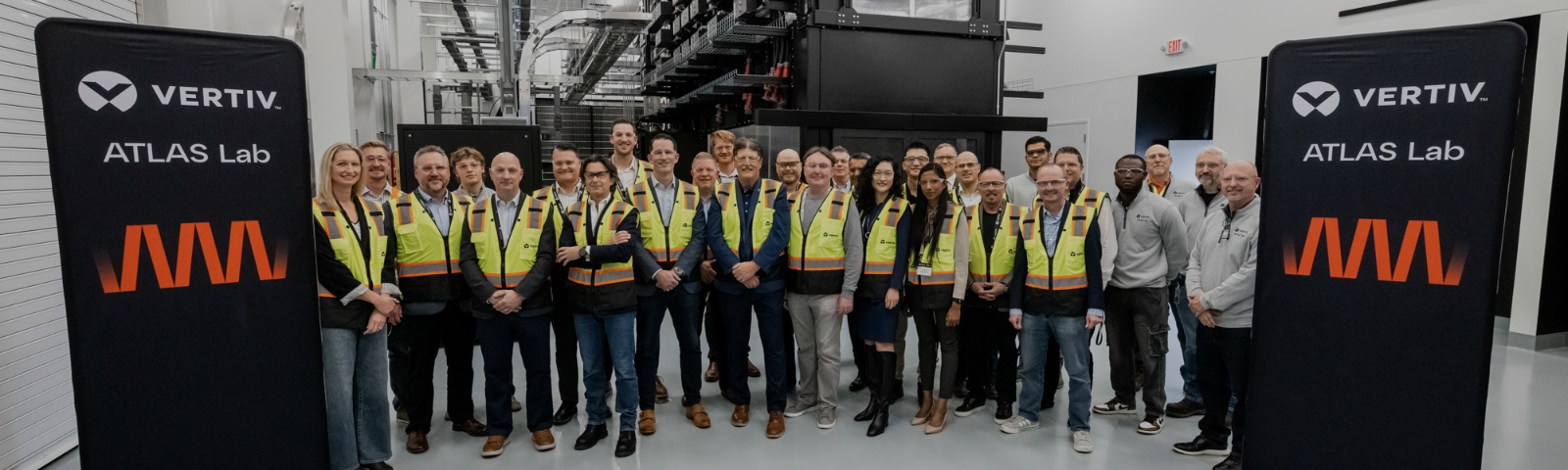
On Nov. 6, Vertiv and NVIDIA engineering leaders came together for an ATLAS ribbon-cutting and technical working sessions focused on the infrastructure requirements of accelerated computing. The sessions moved from NVIDIA AI factory architecture requirements and digital simulation into the ATLAS Lab, where Vertiv and NVIDIA engineers evaluated the interaction among power, liquid cooling, controls and emulated AI workload behavior as an integrated system.
Speaking at the event, Giordano Albertazzi, Chief Executive Officer at Vertiv, said, “AI is changing what data centers need to deliver and how quickly the infrastructure beneath them must evolve. The ATLAS Lab allows us to prove the complete architecture before a customer commits capital to build it. Working with NVIDIA, we can close integration gaps earlier, accelerate the path to deployment and help customers turn more of their available power into productive compute.”
Proving the AI factory upstream
All of this work happens before a customer site exists. Simulation and form-and-fit testing reduces design risk, and emulation ahead of the silicon reduces deployment risk. Stress testing power and thermal systems together against the rapid, synchronized load swings of AI workloads, with coordinated controls, takes risk out of operation. Together, these steps form an end-to-end performance test spanning the infrastructure chain, from grid interconnection to the rack and from liquid cooling at the chip through heat rejection and reuse.
“Accelerated computing is advancing at an extraordinary pace, creating new requirements across power, cooling and controls,” said Vladimir Troy, Vice President, AI Infrastructure at NVIDIA. “By bringing NVIDIA AI factory architecture requirements together with Vertiv’s power and cooling expertise, our teams can identify and resolve infrastructure challenges earlier. System-level validation helps the ecosystem move more quickly from reference architecture to deployment.”
Closing the seams where deployment risk lives
Building an AI factory brings together chip manufacturers, server and rack-scale system manufacturers, power and cooling providers, utilities and operators. Their technologies converge at shared technical interfaces, creating integration challenges that can affect design, deployment and operation.
The Vertiv ATLAS Lab brings those interfaces into a common test environment, where issues can be identified and resolved in engineering, giving customers and ecosystem partners a common technical basis for decisions across chip, rack, facility and grid. The Lab works across the full chain, from grid to chip to heat reuse, so engineers can optimize power, thermal management and controls as one system.
“Next-generation accelerated computing requires power, cooling and controls to be designed and validated together, and the NVIDIA DSX AI Factory platform helps engineering teams evaluate those interactions before deployment,” said Vladimir Troy, Vice President of AI Infrastructure at NVIDIA. “Our collaboration with Vertiv connects NVIDIA simulation technologies with ATLAS physical testing, helping customers resolve integration challenges before compute systems arrive and move from reference architecture to productive operations sooner.”
Turning infrastructure capacity into productive compute
For AI factory designers and operators, system-level validation creates greater speed and certainty from the start. Engineers can resolve architecture and integration issues before equipment arrives on site and begin deployment from a validated technical baseline.
That validated baseline helps customers reach productive compute sooner and put available power to work more effectively. Every megawatt available to an AI factory represents potential compute capacity.
The objective is clear: shorten the time to first token and help turn available megawatts into productive compute faster. That is the principle behind the Vertiv and NVIDIA engineering collaboration: “Accelerating AI, together.”
For more information on Vertiv’s leading portfolio of power and thermal management, infrastructure solutions, IT systems, and services for critical digital applications, visit Vertiv.com.
About Vertiv Holdings Co.
Vertiv Holdings Co. (NYSE: VRT) brings together hardware, software, analytics and ongoing services to enable its customers’ vital applications to run continuously, perform optimally and grow with their business needs. Vertiv solves the most important challenges facing today’s data centers, communication networks and commercial and industrial facilities with a portfolio of power, cooling and IT infrastructure solutions and services that extends from the cloud to the edge of the network. Headquartered in Westerville, Ohio, USA, Vertiv does business in more than 130 countries. For more information, and for the latest news and content from Vertiv, visit Vertiv.com.
Forward-looking statements
This release contains forward-looking statements within the meaning of the Private Securities Litigation Reform Act of 1995, Section 27 of the Securities Act, and Section 21E of the Securities Exchange Act. These statements are only a prediction. Actual events or results may differ materially from those in the forward-looking statements set forth herein. Readers are referred to Vertiv’s filings with the Securities and Exchange Commission, including its most recent Annual Report on Form 10-K and any subsequent Quarterly Reports on Form 10-Q for a discussion of these and other important risk factors concerning Vertiv and its operations. Vertiv is under no obligation to, and expressly disclaims any obligation to, update or alter its forward-looking statements, whether as a result of new information, future events or otherwise.
CONTACT
E Vertiv@RuderFinn.com