
As global healthcare organizations implement distributed care facilities, they are modernizing edge sites to strengthen the operational performance and continuity of clinical infrastructure.
The shift to digital healthcare is driving distributed, connected care. Healthcare is now delivered in hospitals, ambulatory centers, diagnostic facilities, and at home, enabled by a resilient enterprise-to-edge network and remote care hubs.
Clinical workflows are now always-on, which means edge sites often need reliability and performance standards expected in data centers, even when space is limited. These sites support telehealth sessions, remote monitoring, digital imaging reconstruction and caching, lab workflows, and clinician access to electronic health records (EHRs).
Edge sites are increasingly used to run Artificial Intelligence (AI) inference workloads. Examples include real-time imaging analysis and computer-assisted detection. Many inference use cases benefit from low-latency processing close to where data is generated, especially for time-sensitive workflows such as imaging support and clinical alerts. These workloads support digital services while maintaining patient data sovereignty and regulatory compliance.
Transforming distributed infrastructure is a top priority for healthcare organizations
According to a 2025 WJARR study, more than four in five healthcare organizations (82%) have deployed distributed IT infrastructure to enable digital services.
Those with modernized infrastructure saw measurable gains: a 27% reduction in medication errors, a 32% improvement in care coordination metrics, and an average 2.8-day reduction in hospital stays for patients with complex cases. These outcomes depend on edge environments that deliver consistent performance, power quality, and thermal stability.
However, many existing edge sites were not designed for data-intensive and AI workloads. While edge sites support mission-critical loads, they can be operationally fragile. Many rely on legacy power and cooling systems that cannot support high-density digital and AI workloads. They also include IT closets, network closets, and spaces adjacent to medical imaging equipment with small footprints and limited thermal capacity.
Designing an edge transformation program
Healthcare leaders can use the following approach to modernize edge capacity, reducing their dependency on legacy technology:
- Align workloads by business requirements: IT teams plan workload distribution to meet performance, cost, regulatory, and operational objectives. Edge sites are best suited for latency-sensitive, regulated workloads that need real-time performance, while core and cloud environments continue to collect data and run advanced analytics.
- Address power quality issues: Hospital edge sites often operate outside the data center in space‑constrained rooms across campuses and outpatient locations, including leased and non‑clinical areas where electrical conditions can vary. As these sites take on more always‑on clinical workloads, they increasingly need continuous, stable power.
Uptime Institute Global Data Center Survey 2025 report highlights rising power constraints and modernization pressure as power and density requirements increase. A practical starting point is low‑ and medium‑voltage (LV/MV) distribution, which determines how to deliver power to denser racks without overloading circuits or leaving capacity stranded.
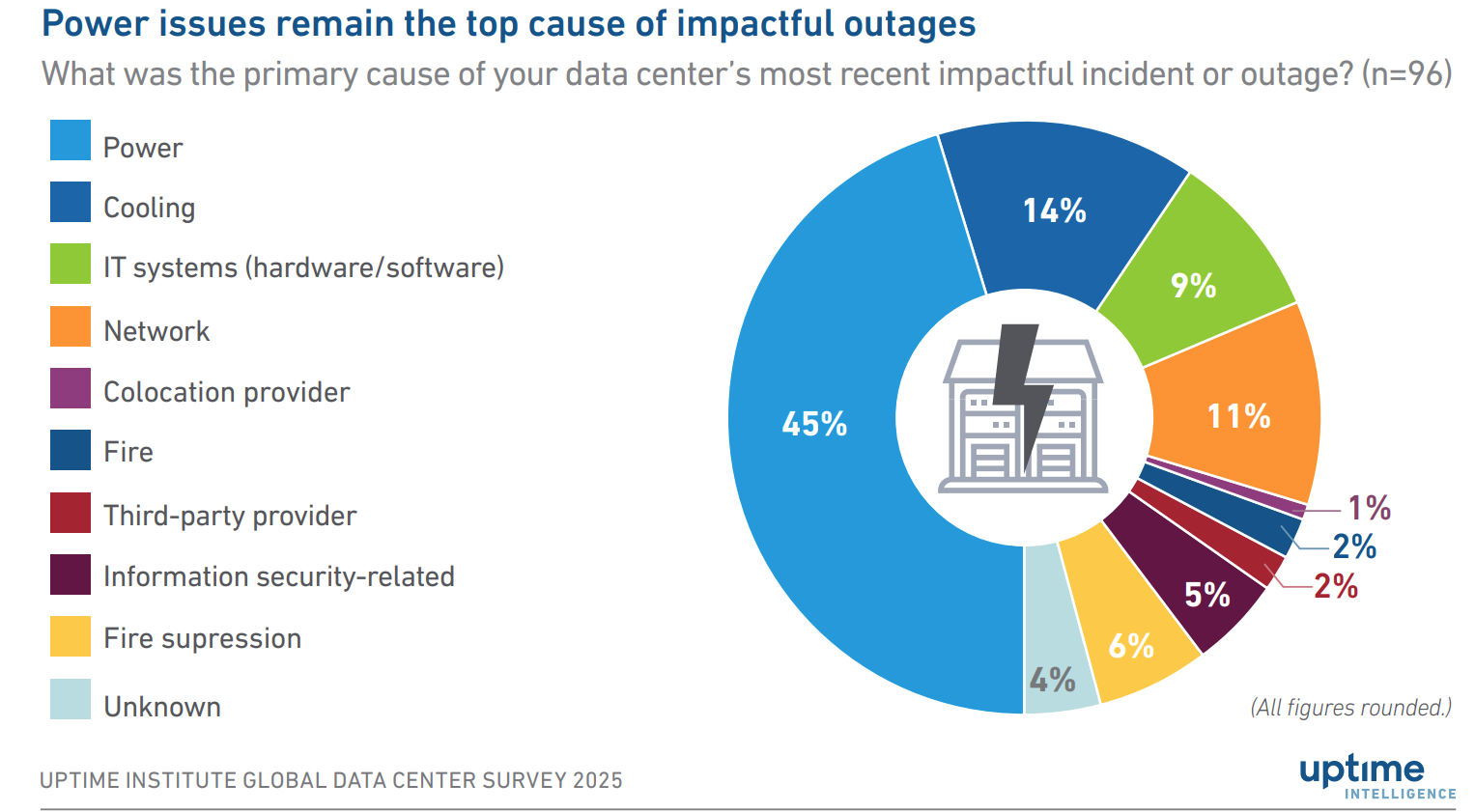
Fig.1: Uptime Institute Global Data Center Survey 2025 shows that power issues account for the largest share of impactful data center outages, followed by cooling, IT systems, and network-related causes.
- Mitigate thermal limitations: High-load imaging and analytics workloads generate significant heat, creating hotspots, airflow issues, and cooling inefficiencies in non-purpose-built rooms, including imaging-adjacent rooms. Hybrid air and liquid cooling systems let leaders align cooling strategies to workload performance and reliability requirements, and modular systems make it practical to add advanced cooling within small spaces.
- Address space limitations: Edge sites such as IT and network closets have limited room for new equipment. Modular solutions with integrated high-density compute, power, and liquid cooling enable healthcare sites to support demanding data, AI, and high-performance computing workloads, without major retrofits or operational disruption.
- Deploy centralized monitoring: Expanding edge environments can decrease visibility and introduce operational risk. Centralized monitoring provides IT and facility teams with holistic visibility, enabling them to identify anomalies and address issues before they affect performance.
Adopting a phased modernization path
A phased approach helps healthcare leaders manage workload demands, budgets, operational risk, and the realities of live clinical environments.
A potential pathway includes the following steps:
- Leverage assessment frameworks: Use capacity-planning tools, facility-condition assessments, and workload mapping to identify constraints in existing edge infrastructure.
- Modernize workloads in phases: Prioritize mission-critical AI-driven diagnostic imaging, real-time analytics, and remote patient monitoring workloads. Modular architectures help standardize deployments across large numbers of sites while maintaining governance.
- Standardize edge architectures: Reference designs support repeatable deployments across clinics and centers, while enabling centralized visibility across distributed sites.
- Balance on-premises and cloud infrastructure: Maintain local infrastructure for latency-sensitive, regulated workloads, while using cloud platforms for scale and analytics.
Developing the healthcare edge as clinical infrastructure
Edge environments now play a direct role in clinical operations, supporting always-on workflows, performance across distributed sites, and compliance. As a result, the edge has become a core part of enterprise healthcare infrastructure planning.
Hospitals that treat edge sites as clinical infrastructure can improve reliability for real-time workflows without relying on major retrofits.
Download the eBook to learn how hospitals strengthen power, cooling, and visibility across edge sites that support imaging, diagnostics, and other real-time clinical applications