
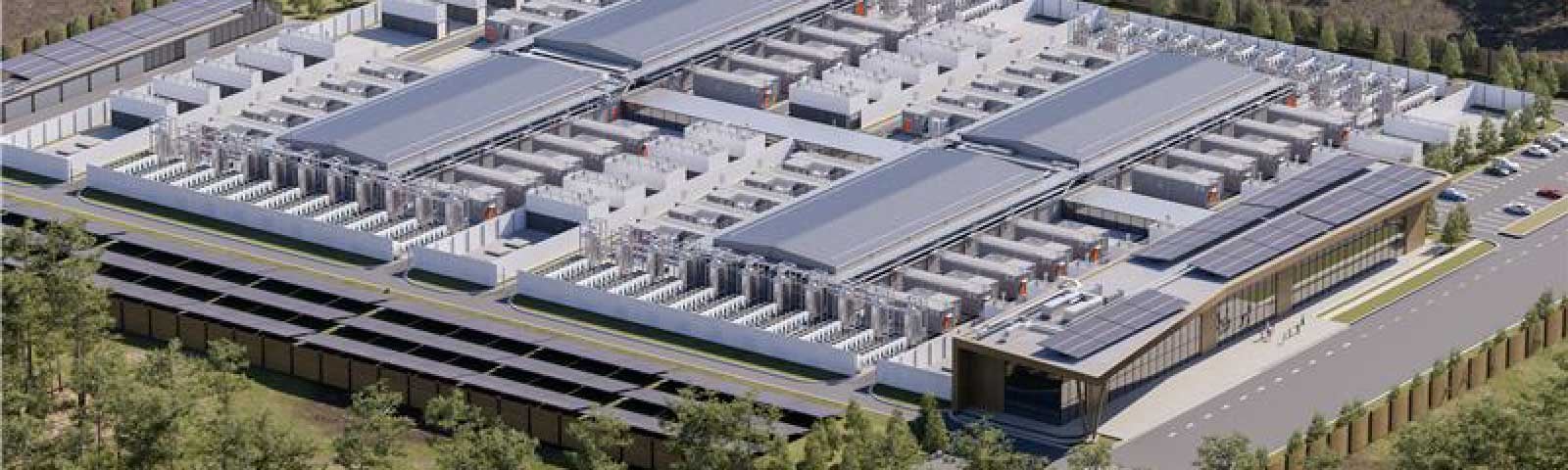
As AI workloads push infrastructure to its limits, assembling best-of-breed components is no longer enough. Converged physical infrastructure integrates power, thermal, controls, services, and digital workflow as one coordinated system—reducing deployment risk, improving usable capacity, and enabling better lifecycle performance across multiple compute generations.
What is “converged physical infrastructure”?
At its core, "converged physical infrastructure" means designing and managing power, thermal, controls, services, and digital workflow as one coordinated system. Instead of viewing the infrastructure as separate components that happen to occupy the same building, this reimagined view represents the difference between assembling components and delivering system outcomes.
Traditional modular data center design involves combining discrete components separately into a single skid. In contrast, converged infrastructure is developed as an integrated system from the ground up: elements like compute, storage, power, cooling, and networking are engineered collaboratively to optimize efficiency and resource management. The result is significantly improved integration compared to assembling separate devices after the fact.
This distinction matters profoundly because AI infrastructure is no longer forgiving. At today's densities and deployment speeds, customers don't need another collection of good boxes. They need a system that fits together cleanly, operates coherently, and performs consistently across Day 0 (design), Day 1 (deployment), and Day 2 (operations).
Consider a practical example: A converged data center might deliberately limit peak central processing unit (CPU) frequency, increase supply voltage, use liquid cooling for only the hottest components, and rearrange rack layout. Together, these deliberate choices reduce total energy consumption, increase reliability, and drive more usable compute per square meter. This is systems thinking in action.
Why converged infrastructure matters
This approach transforms complex AI infrastructure from a collection of separate products into a converged, simulation-ready physical system. The benefits are substantial and measurable. Converged infrastructure helps customers reduce deployment complexity and field integration risk. When systems are designed to work together from the start, the friction that typically appears at integration points—where power meets cooling, where controls meet mechanical systems—is engineered out rather than troubleshot in the field.
The approach improves infrastructure coordination across power, cooling, and controls. Critically, it shifts the value proposition from shipping equipment to delivering system outcomes, from commissioning on day one to governing performance through day two. It optimizes performance from grid connection through chip-level thermal management and even heat-reuse pathways.
Perhaps most importantly, converged infrastructure creates systems that are more adaptable across compute generations. Because the infrastructure is designed around defined interfaces and reusable building blocks rather than a single fixed configuration, it can absorb future generations of hardware that would overwhelm a traditional data center. Rather than limiting hardware flexibility, the approach enhances it by engineering for the physics of high-density computing—heat and power—rather than for a specific server brand.
The five non-negotiables
Delivering converged infrastructure requires five essential capabilities; operational requirements that separate genuine convergence from marketing claims:
- Repeatable building blocks
Repeatable building blocks mean infrastructure is built as configurable product families, not one-off engineered projects. This ties directly to industrialized, factory-ready systems with repeatable bill-of-materials (BOM) and configuration controls, factory testing and validation, and lift-in-place readiness.
This capability compresses schedules, reduces field variability, improves quality, and enables scale. It's also where supply chain discipline becomes visible. Without configurable product families, controlled build triggers, and disciplined supplier ecosystems, repeatability becomes repeated improvisation.
- Defined interfaces
Defined interfaces mean mechanical, electrical, controls, and service boundaries are engineered up front, with standardized connection points and cross-domain coordination. Most infrastructure friction appears at the seams. If interfaces aren't standardized and coordinated early, complexity returns as delay, rework, and risk in the field. This is also a supply chain issue: standardized interfaces enable sourcing, validation, and assembly of repeatable subassemblies within a controlled ecosystem. Without interface discipline, supply chain variability leaks directly into deployment variability.
- System orchestration
System orchestration means power, thermal, and controls are co-designed and operate as one coordinated system, with right-sized capacity and system-level outcomes rather than isolated component optimization.
Customers don't buy isolated component efficiency. They buy usable IT load, resilience, speed to deployment, and total system economics. Those outcomes only emerge when the system is orchestrated as a whole.
Orchestration requires the supply chain to support synchronized delivery of interdependent systems. If power arrives on one timeline, cooling on another, and controls on a third, the orchestration claim collapses. The ability to align sourcing, manufacturing cadence, and delivery sequence across domains is part of the competitive advantage.
- Digital continuity
Digital continuity means the same design intent carries from engineering to deployment to operations through a shared model, reusable parameters, digital change propagation, and preserved version control. Without digital continuity, every handoff loses fidelity. Engineering intent gets diluted, site changes break assumptions, and operations inherit something that no longer matches the original logic.
Digital continuity also allows supply chain discipline to scale. Reusable design rules, controlled configurations, and digital change propagation reduce unnecessary customization and keep suppliers aligned to current design intent. This improves quality assurance traceability and reduces schedule disruption.
- Lifecycle assurance
Lifecycle assurance means performance is tested, measured, and governed beyond day one through telemetry, balance and flow instrumentation, predictive diagnostics, and operational intelligence linked back to design intent. AI infrastructure risks don't end at startup. Drift, imbalance, underutilization, and service complexity appear after deployment. Lifecycle assurance protects performance and enables continuous improvement.
Lifecycle assurance is stronger when the supplier ecosystem is controlled and traceable. Quality assurance traceability, supplier discipline, and stable product platforms make it easier to diagnose, service, upgrade, and optimize the system over time. Supply chain discipline is part of lifecycle confidence, not separate from it.
Why supply chain discipline is a critical factor
Convergence only becomes real when the delivery model supports it at scale. Demand-driven planning, configurable product families, synchronized delivery, and supplier traceability are not back-office details; they are part of the system architecture. Without them, repeatability becomes repeated improvisation.
A natural maturity path, not a pivot
This approach represents a refinement in AI technology’s maturity as a journey and in its progress, not a fundamental shift. The industry has been moving toward convergence for years, and the demand simply makes the path more visible and valuable now. The market is now catching up to the model Vertiv has been building toward.
Standard data center space—selling "ping, power, and pipe"—is increasingly commoditized. Selling converged physical infrastructure moves away from selling floor space to selling computational density. Repeatability, supply chain discipline, orchestration, continuity, and lifecycle assurance require demand-driven production planning, product-family architecture, and traceability of quality assurance across suppliers. The converged framework itself defines a drive from manufactured / converged-ready to foundational convergence and then to advanced convergence, where digital continuity, telemetry, and adaptive optimization begin to compound performance over time.