Not long ago, IT management required being on-site, fixing servers by hand, connecting keyboards and monitors, and troubleshooting in person. That approach no longer works in today’s world, where IT architectures are distributed, security-sensitive, and uptime-critical. Data centers are lean, branch offices are often unmanned, and edge computing systems may be thousands of miles away. At the same time, downtime is more costly and threats are more advanced. Yet many teams still rely on physical access or software-only tools, which may fall short when systems fail. That’s why secure remote access solutions like KVM-over-IP have become essential.
What is KVM-over-IP, and why it still matters
A KVM-over-IP (Keyboard, Video, Mouse over Internet Protocol) switch provides secure, hardware-based remote access to IT systems at the most fundamental level. Unlike software tools, it operates independently of the operating system, network configuration, or system health.
This allows IT teams to:
- Access systems at the BIOS or firmware level
- Troubleshoot powered-on but unresponsive servers
- Perform secure reboots, configuration changes, and recovery remotely
In effect, KVM-over-IP delivers the same control as being physically present without requiring on-site access.
Whether you're managing Windows servers, Linux systems, network switches, or storage arrays, KVM-over-IP provides secure remote access regardless of the device's operating system or current operational state. Even when a system is completely unresponsive at the OS level, you maintain full keyboard and video control as if you were standing in front of the physical hardware.
Why security-first remote access is now a requirement
As IT architectures become more distributed, the attack surface expands. Firmware-level threats, supply chain attacks, and credential-based intrusions increasingly target critical digital infrastructure below the operating system, where many traditional security tools lack visibility. As a result, choosing secure remote access solutions becomes a security decision.
Modern KVM-over-IP platforms must enforce trusted firmware, encrypt all communications, and support compliance in regulated frameworks.
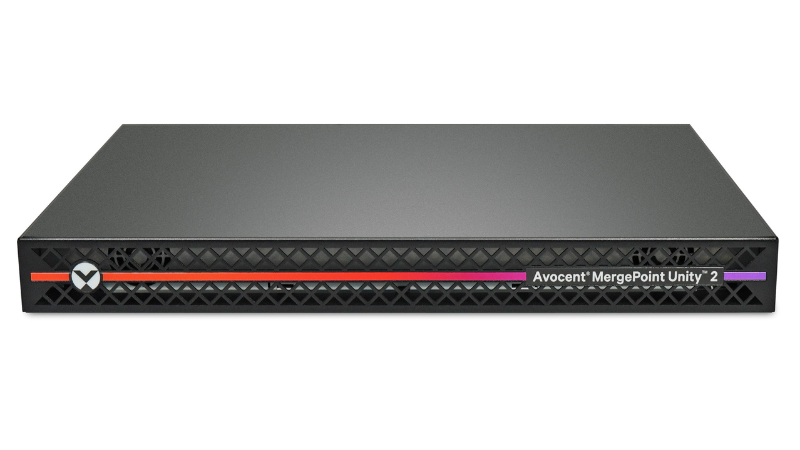
Solutions like Vertiv™ Avocent® MergePoint Unity 2 KVM-over-IP Switches are built with secure boot processes, Vertiv-signed keys, and TLS v1.3 encryption, helping prevent unverified firmware and reducing exposure to low-level attacks. TAA compliance further supports deployment in government, defense, healthcare, and other regulated sectors.
Benefits that reduce downtime and risk
Secure KVM-over-IP proves its value when time, access, and control matter most:
- Remote troubleshooting during outages
When systems are down or unresponsive, hardware-level access enables faster diagnosis and recovery without waiting for on-site support. - Secure firmware updates and recovery
Failed firmware updates often require physical intervention. KVM-over-IP enables secure remote updates and recovery, minimizing outage duration. - Fewer truck rolls and site visits
Full remote control reduces operational costs, delays, and reliance on local personnel. - Support for unmanned and remote location
Branch offices, edge sites, and colocation facilities remain secure and manageable through out-of-band management, even without on-site IT staff.
Advanced security for critical infrastructure protection
In today's landscape, organizations must implement robust security measures to safeguard their infrastructure against sophisticated attacks. Protecting against unverified firmware is paramount, which is why Secure Boot plays a critical role by maintaining only cryptographically signed and verified firmware can execute during the boot process, preventing malicious code from compromising systems at the foundational level.
Equally important is maintaining encrypted communications through KVM sessions, which keeps remote management activities confidential and protected from interception or man-in-the-middle attacks. Together, these security controls create a layered defense strategy that addresses both pre-boot integrity verification and secure operational access, enabling organizations to maintain trust in their systems while meeting compliance requirements for data protection and infrastructure security.
Real-world scenarios with remote access troubleshooting utilizing KVM-over-IP
- Retail chain store network outage: A national retail chain experienced point-of-sale system failures across multiple stores during a critical sales period. Using KVM-over-IP devices installed at each location, IT administrators remotely accessed the servers to diagnose BIOS-level configuration errors and network boot issues. They restored operations within hours without dispatching technicians to dozens of geographically dispersed locations, saving significant travel costs and minimizing revenue loss.
- Manufacturing plant equipment failure: A manufacturing facility's production line control systems froze due to corrupted operating system files. The nearest IT staff were 200 miles away at corporate headquarters. Through encrypted KVM-over-IP sessions, engineers remotely rebooted servers into recovery mode, accessed BIOS settings, and rebuilt the boot configuration—all before the boot process completed. Production resumed within 90 minutes instead of the 6+ hours required for on-site arrival.
- Telecommunications tower infrastructure: A telecom provider managing hundreds of cell tower edge sites experienced simultaneous outages affecting network equipment across rural areas. KVM-over-IP enabled remote access to servers that had lost network connectivity at the OS level. Technicians could troubleshoot pre-boot environments, adjust firmware settings, and restore systems without coordinating expensive helicopter deployments or multi-day road trips to mountainous locations
- Financial services branch recovery: A regional bank branch office servers failed during overnight updates, leaving ATMs and teller systems offline at opening time. The security team used encrypted KVM sessions to remotely diagnose failed firmware updates, roll back changes using Secure Boot verification, and restore services, all while maintaining compliance with financial regulatory requirements for secure remote access.
These examples demonstrate how KVM-over-IP technology dramatically reduces mean time to repair (MTTR), cuts operational expenses, and supports business continuity across distributed digital infrastructure.
Scalable infrastructure solutions for dynamic IT environments
Modern organizations require advanced security, operational efficiency, and scalable infrastructure to protect critical systems while minimizing costs. The Vertiv™ Avocent® MergePoint Unity 2 Switch addresses these needs through Secure Boot firmware verification and encrypted KVM sessions that safeguard against sophisticated threats, while enabling remote troubleshooting that eliminates costly site visits. This solution has been created specifically for retail, manufacturing, telecommunications, and financial services deployments where downtime directly impacts revenue.
With flexible 8-port, 16-port, and 32-port configurations plus universal video interface support (VGA, DVI, HDMI, DisplayPort), organizations can scale infrastructure as business demands evolve while backward compatibility with existing modules protects prior investments and reduces total cost of ownership.
Organizations experiencing growth can start with an 8-port configuration for initial deployments and seamlessly scale to 16-port or 32-port models as server counts increase, or deploy multiple models across distributed locations while maintaining centralized management.
The backward compatibility with modules from previous Vertiv™ Avocent® DSR and Vertiv™ Avocent® MergePoint Unity Switch models further extends the lifespan of existing accessories without the need to ‘rip & replace’ everything, reducing upgrade costs and resulting in lower overall total cost of ownership. This architectural flexibility supports KVM infrastructure in adapting to business demands, accommodating both planned expansion initiatives and unexpected growth spurts, while providing long-term investment protection through scalable configurations that grow along with enterprise needs.
Therefore, in today’s rapidly and continuously evolving IT context, KVM-over-IP plays a key role in enabling smooth datacenter operations. It provides secure, out-of-band access when primary systems fail and integrates naturally with broader IT management tools, monitoring platforms, and service processes. Within the Vertiv™ portfolio, it adds a critical control and visibility layer that complements power, cooling, and IT infrastructure solutions. The result is a more resilient, unified environment designed to keep distributed systems running reliably wherever they are.