With rising power densities and grid conditions becoming less predictable, data centers are rethinking how power is transferred, monitored, and maintained.
This year’s outages in the Iberian Peninsula and at London’s Heathrow Airport exposed a harsh reality: grid fragility is colliding with unprecedented AI power demands. In moments like these, here’s how a data center typically reacts:
Alarms go off as operators track power stability. UPS units kick in to cover the brief dip until generators are running. Static transfer switches (STS) shift loads between power sources within milliseconds to keep critical equipment online.
The numbers are stark: Uptime Institute Intelligence reports that 20% of data centers are experiencing million-dollar outages (≥€900,000). When you’re running AI workloads at 50-100 kW per rack, those few seconds between power loss and backup activation represent exponentially higher financial exposure than traditional deployments.
AI is rewriting power density math. A single AI rack now rivals the power consumption of a legacy server room. This isn’t just about more power, it’s about more critical power. Power transfer now does more than keeping the lights on and plays a direct role in protecting massive computational investments.
Against this backdrop, resiliency is back in focus. Data center owners are reconsidering their power infrastructure and moving towards systems that offer better monitoring and quicker response to potential disruptions.
A closer look at the power transfer point
Power is still the leading cause of major data center outages, representing almost half of reported incidents, according to Uptime Institute’s Global Data Center Survey 2025. (See Figure 1). This highlights how sensitive IT equipment is to even brief power disturbances such as voltage sags, switching events, and total power loss.
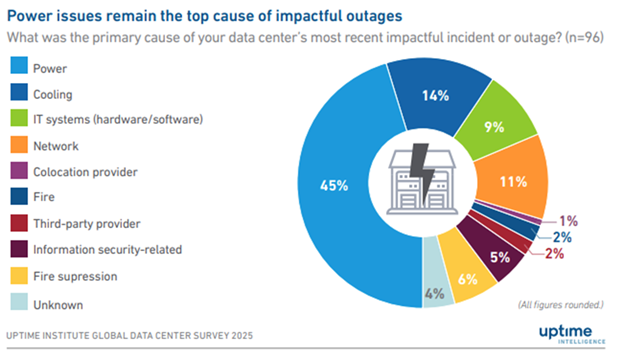
Figure 1. Power remains the top cause of impactful data center outages. Source: Uptime Institute Intelligence, 2025.
Within that landscape, the power transfer point is especially vulnerable. Any failure or delay here can quickly spiral out of control and push infrastructure to its breaking point. The power transfer point governs the split-second transition between utility, backup, and on-site generation, and any lapse here can quickly affect critical loads downstream. Even as a fundamental link in the power train, it’s drawing renewed focus as operators contend with more dynamic, high-density environments.
The STS is critical for keeping operations running smoothly. AI workloads are driving power demands to tens or hundreds of megawatts. This forces operators to completely rethink their approach to on-site capacity planning and managing grid uncertainty. That scrutiny is raising expectations for every part of the power train. Data centers want responses to power events to be faster, smarter, and more coordinated.
Raising the bar on power reliability
The STS has advanced in response to rising colocation and AI workload densities. While the core function hasn’t changed, capacity scaling now leads the way. Models are being designed to support the growing footprint of multi-megawatt UPS systems, aligning with the power architecture of large-scale AI deployments. This reflects broader industry momentum toward more resilient, high-capacity power transfer solutions.
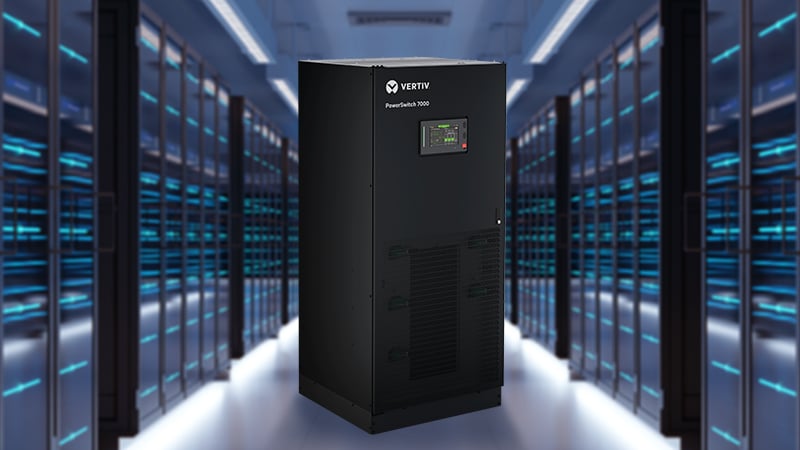
Space constraints make serviceability paramount. With a front-access design, maintenance teams can service components without requiring rear or side clearances. This is critical when every square foot houses revenue-generating equipment. Hot-swappable fans and compartmentalized design enable component replacement without powering down connected loads.
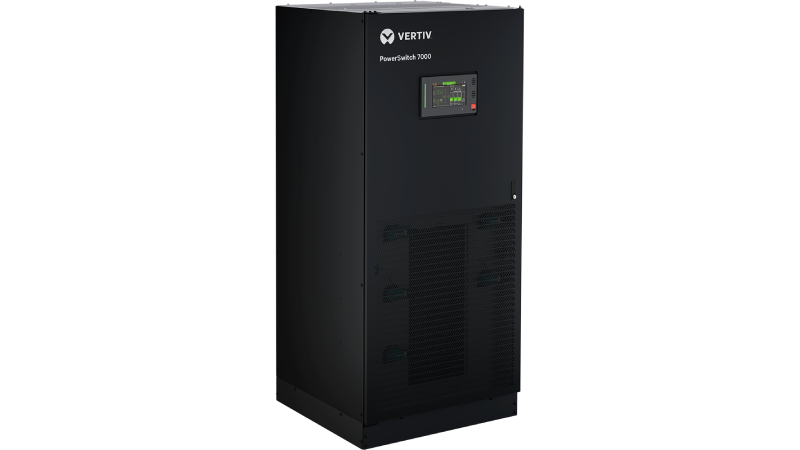
Figure 2. Vertiv™ PowerSwitch 7000 combines space-saving, true front-access design, and advanced monitoring to support reliable power delivery in high-density data centers.
Today’s STS units do more than switch power. Advanced models now capture complete power event sequences, recording conditions before, during, and after each transfer. Traditional STS units switch power; these next generation systems switch power and tell you why. In environments where a single rack failure can halt days of AI training progress, that diagnostic capability transforms from nice-to-have to business-critical.
Better airflow, dual fan systems, and modular components make servicing quicker and safer. Predictive thermal alarms and smarter health monitoring further strengthen reliability and support nonstop operation in tightly packed environments. These improvements reflect what operators now demand: stronger reliability and more granular monitoring, especially in high-density deployments.
Preparing for the next power landscape
Resiliency is a defining element as data centers balance AI-driven growth, new operational requirements, and unpredictable grid conditions. How teams design their core infrastructure affects how quickly they can respond to incidents and keep up with changing needs. As STS units take on new roles in monitoring, diagnostics, and rapid fault response, staying ahead means integrating these capabilities into everyday operations. This includes:
- Using real-time monitoring and accurate fault detection with advanced STS units to provide immediate visibility into power events.
- Closing the loop between event detection and root cause analysis using waveform capture and diagnostics as part of regular checks.
- Choosing modular, space-saving designs that make it easier to upgrade or maintain equipment as densities and power requirements change.
Maximize uptime with intelligent monitoring
With higher rack densities and unpredictable grid conditions, managing power events becomes more complex. Intelligent monitoring and modular STS technology enable teams to respond in real-time, pinpoint root causes, and maintain continuous power delivery.
Evaluate your power transfer readiness:
- Are your current STS units providing diagnostic data beyond basic switching?
- Can your team perform maintenance without load interruption?
- Do you have visibility into power quality events that don't trigger transfers?
Assess how Vertiv™ PowerSwitch 7000's monitoring and serviceability features align with your high-density deployment needs.