Modern data centers generate more telemetry than ever, but turning that data into timely action remains the defining operations challenge.
Data centers have never generated more telemetry, yet visibility into what actually matters has not kept pace. Telemetry is multiplying as artificial intelligence (AI) workloads push racks beyond 140 kilowatts (kW), driving more complex cooling and power architectures and tighter system interdependence. Operators now confront thousands of signals arriving faster than legacy workflows can interpret. Teams must decide in real time which anomalies signal genuine risk, and which can be ignored.
Emerging digital platforms process signals in real time, filtering noise and surfacing alarms that carry operational risk. By compressing detection, diagnosis, and remediation planning into a single workflow, they shorten the gap between insight and action without replacing existing environments. The gain is time — and clarity. Maintenance is shifting toward predictive, automated operations that connect intelligence across the asset lifecycle.
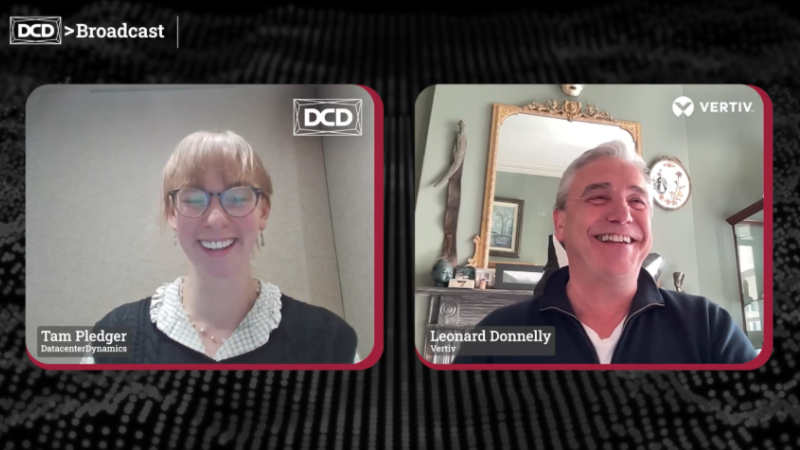
The third episode of Vertiv's Management & Operations Innovation Day 2025, hosted by DatacenterDynamics (DCD), brings together DCD's Tam Pledger and Leonard Donnelly, Vice President of Digital Services and Platform Strategy at Vertiv. They discuss how hyper-automation, intelligent alarm management, and digital services can help operators turn growing visibility into action and prepare for AI-driven infrastructure.
Tam Pledger, Digital Content Manager, DatacenterDynamics (DCD):
You've seen several shifts in how data centers operate. Where are we now, and what challenges are facing?
Leonard Donnelly, Vice President, Digital Services and Platform Strategy, Vertiv:
Equipment architectures in modern data centers are growing more complex across multiple systems. Monitoring platforms, whether vendor-provided or self-built, pull increasing volumes of telemetry and sensor data without distinguishing what matters. Enormous alarm tsunamis occur daily, with thousands of alerts lacking clear interpretation. Maintenance remains largely manual, leaving domain experts to sift through signals and decide what’s important.
“Complex equipment and rising telemetry are changing what it takes to run a data center. The era now emerging is predictive, automated maintenance.”
— Leonard Donnelly, VP of Digital Services and Platform Strategy, Vertiv
(TP): What creates an “alarm tsunami,” and how should operators distinguish critical signals from noise?
(LD):
Many alarms stem from telemetry, yet monitoring systems often generate duplicate alerts without distinguishing passive conditions from critical issues. Signals indicating potential component failure should be treated as critical events, particularly those tied to maintenance and remaining useful life, such as fans or filters clogging. What matters is a real-time understanding of system state to determine what truly requires action.
(TP): Are we approaching a point where data volume outpaces operators’ ability to triage effectively?
(LD):
The trajectory of data growth won’t slow down; it will accelerate. The era we’re entering is predictive, automated maintenance. What we are doing now in Automated Predictive Analytics forms the foundation for significant ongoing technology innovation, moving from efficiency toward optimization. It’s also critical for data center customers can’t afford uniformed human interventions on site—for security reasons amongst others.
The path ahead brings logical efficiency gains first, followed by an optimization era. Even as data rates increase, we’ll intelligently load-balance the entire data center, cooling and power infrastructure, to achieve greater efficiency despite rising data volumes.
(TP): As operations move from efficiency into optimization, which signals predict degradation or failure, and which are just noise across complex OT/IT environments?
(LD):
Modern data centers are diverse ecosystems — moving parts, electrical components, fluids — where understanding operational state in real time is essential. In cooling environments, operators look at error rates; in water-cooled systems, viscosity and filter conditions. Some failures follow physical or operational patterns, but much remains unpredictable, about 50% known and 50% unknown. That’s why an intelligent, real-time understanding of system-wide data is critical.
(TP): Can you give a broader perspective on how Vertiv is helping customers move from reactive to proactive without replacing what already works?
(LD):
The Waylay engine—now part of Vertiv—blends AI and heuristics-based rules logic to powerful outcomes. For example, instead of thousands of alarms to sift through, our platform acts like a brain, processing millions of data points in real time to identify critical anomalies and patterns. We filter that down to a small number of issues for the technician to act on and automatically explains both the problem and the necessary remediation.
Typically, diagnosing and resolving an alarm can take one to four hours; we reduce that to about three minutes. Bringing these capabilities into customer environments, or remotely, minimizes disruption and avoids replacing existing systems.
(TP): It’s important to touch on the human element. How do you incorporate experts and keep them in control?
(LD):
Domain experts build the rules. Engineers can create them visually on a canvas or go deeper with code if they prefer. Those without coding skills can use an agentic studio designed for intuitive rule creation, and external data, such as weather, can be integrated into the logic. This augments how operators and technician's work. It’s like giving car enthusiasts a playground for their expertise and imagination.
(TP): Each customer has different needs. How do you support customers operating across cloud, on-premises, edge, and hybrid environments?
(LD):
We designed the platform for those scenarios from the start. Our architecture is microservice-based and multi-cloud. For on-prem environments, we support thick edge and thin edge deployments, including very low CPU devices. We can also support localized edge collector clouds and hybrid cloud setups. This goes back to having strong engineering foundations, many from telecom backgrounds where rigor and scalability are essential.
(TP): Can you translate that into what a materially better day-to-day experience looks like for operations teams?
(LD):
Recommended operating methods exist for a reason - like using the right oil in a car engine. We build systems to operate in a certain way, but staff churn, training gaps, or human error can change settings over time. Running equipment at incorrect speeds, for example, consumes more power and can degrade assets or shorten their lifespan. We want to stay on top of those deviations constructively.
(TP): Can you leave us with some closing remarks?
(LD):
The three-minute round trip captures the goal: Detect something important, understand it instantly, explain the remediation, and organize the workflow to get the job done. It reduces the time between detection and action.
The trajectory of data payloads isn’t slowing down. Hardware design can only go so far. Now it’s the opportunity for the digital domain—software—to become the new layer of efficiency, making these environments operate more optimally, consuming less power, reducing costs, and creating better-running systems overall. That’s coming too, and the gains will be material.
Watch the full discussion on how the industry is rethinking maintenance for AI-driven data centers
Learn how operators are exploring new ways to cut through alarm noise and act on what matters.
Watch the full conversation: Using data to extend asset lifecycle value