
In this second of a five-part series, IDC analyst Ganesh Vasudevan speaks with Shrirang Deshpande, Vertiv's Country Head for Datacenter Business, Strategic Programs and Global Alliance, about the challenges and opportunities in India.
The need to modernize financial organizations’ infrastructure has never been as compelling as it is today. The massive disruption that occurred in 2020 radically transformed the digital landscape. Customer behaviours changed, the world went digital, and even financial organizations’ traditional operating model has been transformed to incorporate virtual working into their core operations. All this development has brought into focus the sustainability, reliability, and resilience factors essential to support the evolving digital landscape. Some of the key areas that seek the attention of all financial leaders are:
-
Cybersecurity. Attacks are intensifying, and financial services are the key targets.
-
Real-time processing. Straight-through processing and real-time settlement are becoming the norm.
-
24 x 7 service expectation. Customers expect 100% uptime across delivery channels.
-
Regulation. Regulatory mandate for datacenter providers related to high availability, security, and governance.
No other industry is more mission-critical and sensitive to downtime and failure than the financial industry. Regulators have taken cognizance of this and are imposing significant penalties on financial organizations for any disruption of services. These disruptions have brought forth the importance of datacenters, cloud computing, and edge computing deployment for high availability and resilience.
Sustainable Datacenters
Datacenters are the fundamental building blocks of a robust, resilient IT environment. Ironically, for a financial institution, a datacenter is the largest user of power and the primary source of carbon emissions within the organization. Hence, it is paramount that these strategic facilities are not only secure and resilient but also sustainable. Sustainable datacenters change the relationship between ever-expanding compute resources and energy consumption.
According to IDC FutureScape, 2022, 80% of operating high-end datacenters and 60% of mid-tier datacenters in Asia/Pacific (excluding Japan) (APEJ) will implement energy management programs to reduce energy consumption and ensure energy reliability by 2022.
Edge-Optimized Infrastructure
Edge-optimized hardware is increasingly becoming more prevalent in solutions for remote service delivery by financial organizations. The hardware solutions are often optimized to be smaller for freedom of placement and typically include features such as automated provisioning and management along with enhanced security features.
For financial organizations, edge-optimized infrastructures offer highly reliable, serviceable, and manageable hardware across a highly distributed geographical footprint while keeping operating costs to a minimum.
The Reserve Bank of India (RBI) guidelines on Digital Banking Units (DBUs) have brought the focus on retail branch formats and the need to develop lean, digital, and compact branches. DBUs are specialized fixed point business units for delivering digital banking products and services as well as servicing existing financial products and services digitally, in both self-service and assisted mode, to enable customers to have cost-effective/convenient access and enhanced digital experience to/of such products and services in an efficient, paperless, secured, and connected environment with most services being available in self-service mode at any time, all year
Sustainable datacenters and edge-optimized infrastructure have the power to change the way financial organizations operate. To better understand this and the issues financial organizations are facing concerning infrastructure management, I sought views from Shrirang Deshpande, Vertiv's country head of datacenter business, strategic programs, and global alliance, on how Vertiv is helping financial organizations in achieving their infrastructure modernization goals.
Ganesh: Datacenters are the fundamental building blocks of a robust, resilient IT environment of financial institutions. These strategic facilities need to be secure, resilient, stable, and sustainable. How Vertiv can help financial institutions measure success across these objectives?
Shrirang: The advent of digital banking and growth in transactions, while contributing to the expansion of financial institutions, puts a lot of pressure on the IT environment of these institutions and increases their compute/storage densities along with the need for high availability of network systems. As a result, datacenters have become the lifeline to a BFSI’s business continuity. Moreover, with BFSI experiencing accelerating growth, what it simultaneously needs is strong regulatory compliances.
Understanding the situation of BFSIs, at Vertiv we offer solutions which enable business continuity and in turn help enriching user experience. For instance, we have helped customers for green field as well as brown field datacenter support (passive infrastructure) systems and offered white space solution for on premise and colocation environments. The white space solution, which is a host of offerings, includes last mile power and overall environment management, IT and network remote management, asset and access security management of IT asset and a complete suite for datacenter infrastructure management for critical IT set up of customers. large global, public and private banks that depend on Vertiv for white space solution in multi-availability zones.
Whether it’s a technology, business, or a growth challenge for customers, we have solutions, subject matter, and services experts with three decades of experience in Indian environments. As architects of continuity Vertiv brings Hardware, Software, Analytics and Services together which enables uninterrupted operations, optimal performance, and scalability. Further, our Power and Thermal and Datacenter value chain solutions offer best support and hygiene for IT environment to operate at best performance and at the same time bring energy saving for customers.
Finally, we believe that the actual barometer for BFSI success is customer and user experience. We believe in helping our customers to help their customers better. BFSI sector is very receptive and early or first adopter of any technologies and Vertiv has seen tremendous support from customers bringing and deploying new offerings in the passive infrastructure and white space areas.
Ganesh: Edge computing is rapidly becoming one of the most sought-after technologies by financial institutions as they rethink their branch expansion strategy. What are the key propositions of Vertiv to help financial intuitions expand at scale?
Shrirang: Vertiv has a 3S strategy for edge computing for BFSI customers companies — Simplification, Standardization, and Speed. This strategy helps in achieving, energy efficiency, and operational excellence of the ecosystem for BFSI edge computing. We believe simple is best and hence Vertiv’s edge solution has no complexities, offers standardization, consistent quality, and speed that improves time to market for businesses. Overall, it offers greater predictability over the conventional approach. This helps ease the of handling of large rollouts.
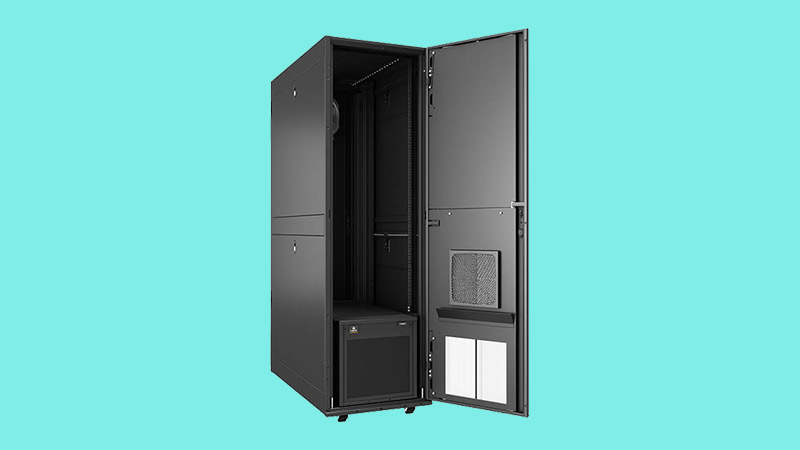
While making urban edge smarter, development of semi-urban and rural economy is the way forward. Vertiv offers a pre-engineered edge solution which is designed to work together for performance optimization. Vertiv’s edge solution proposes saving of space which means greater space for businesses at the edge location or saving of real estate. Along with space, saving of energy is also a unique selling proposition (USP) of the edge solution, which helps customers achieve faster ROI and consistent quality across all edge environments in their multiple branches.
Anything that is monitored can be measured. And if measured, it can be managed well. Edge monitoring and management is conducted on a single pane of glass to help both predictive/reactive monitoring. We also offer analytics that can help to function as a decision support system and improves SLAs and TATs.
With such measures, our customers have saved months/weeks and are able to go live early (in days), which means faster ROI for branches as they can avoid multivendor approach and complex project management when rolling out hundreds of branches. Some of our customers also built the records while rolling-out the edge locations through Vertiv edge solutions.
As a final word, Vertiv’s edge solution is field proven in the last 7 years, easy to deploy, secure and compliant to all relevant standards.