
Data Center Sustainability Challenges and Opportunities
Data centers play an important role in most organization’s environmental, social and governance (ESG) strategies, and a particularly large role in the strategies of data center-dependent businesses. That’s leading enterprise data center teams, colocation operators, managed service providers, telecommunication companies, and hyperscalers to seek out opportunities to reduce their environmental impact and reliance on finite resources.
The Case for Change
Climate change issues are rising to the top of every leader’s agenda. That’s due to both the desire to be good corporate stewards and the growing impact of climate change in the form of more frequent and severe weather events, rising waters, more dangerous wildfires, and water scarcity. In addition, data center owners and operators want to ensure that their businesses can flourish in any regulatory market or environmental condition.
Operators have made significant progress in improving data center energy efficiency over the last 10 years, but capacity growth has offset those savings in terms of total energy consumed. Data centers consumed between 200 and 250 terawatt-hours (TWh) of electricity in 2020, or nearly 1% of global electricity demand, and contributed 0.3% of all global carbon dioxide (CO2) emissions.
The industry’s ability to meet growing demand for capacity could also be limited by resource constraints. Water availability is becoming an issue in many areas and the United Nations has cautioned that global water demand could increase 20% to 30% above current levels by 2050, and that over 2 billion people already live in countries experiencing high water stress. In the United States, a 15-megawatt data center can use up to 360,000 gallons of water a day depending on thermal management practices, and some municipalities are becoming reluctant to meet those demands.
Those factors are creating pressure on data center owners and operators from internal and external sources, including boards, the media, regulators, customers, shareholders, and employees. And the industry is responding.
Hyperscalers are among those leading the way. Apple and Google Cloud have achieved net zero carbon, Amazon intends to do so by 2040, and Microsoft intends to become carbon negative by 2030. In China, technology companies Chindata, Alibaba, Tencent, GDS, and Baidu are also making progress on reducing carbon from data center operations.
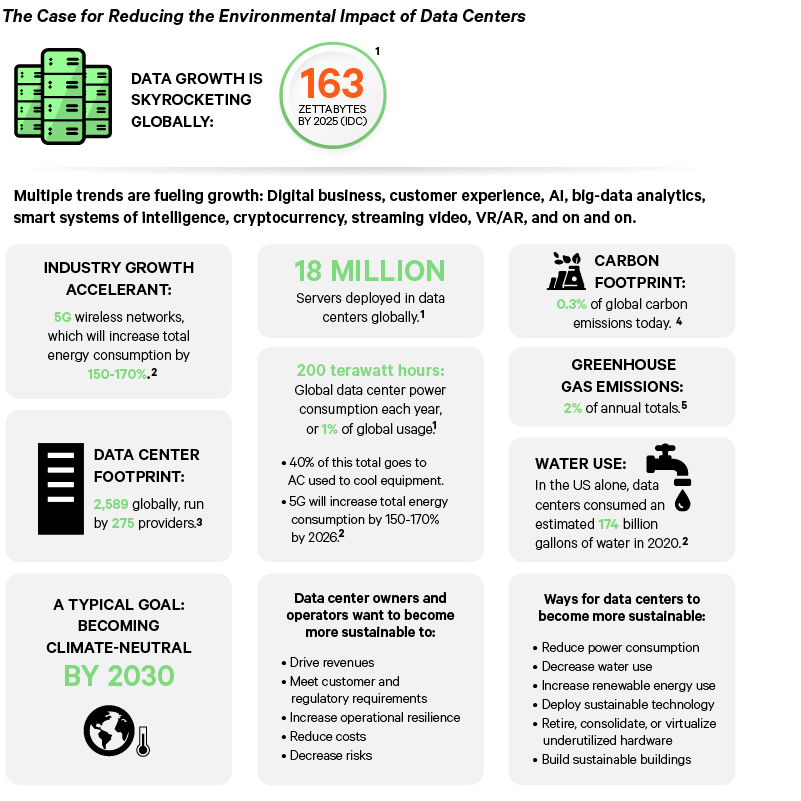
1 Source: Will data center sustainability take priority in 2021? | 2 Source: Data Center Frontier Special Report: The Rise of the Sustainable Data Center | 3 Source: Data Center Locations | 4 Source: The Internet Cloud Has a Dirty Secret | 5 Source: 2021: The Year of the Sustainable Data Centre
Challenges and Opportunities
Not all organizations have the resources to devote to these efforts as the largest operators do, and every organization faces challenges in making the changes required to significantly reduce emissions and water consumption:

Skyrocketing demand: The biggest challenge is reducing resource consumption while growing capacity. Digital Realty estimates that by 2024, Global 2000 Enterprises located across 53 metros will create data at a rate of 1.4 million gigabytes per second. As a result, they will require nearly 20,000 petabytes of additional data storage annually. Supporting that type of growth while reducing emissions and water consumption could require changes to traditional design and operating practices.

Increased technology dependence: As businesses and individuals become more technology dependent, the tolerance for downtime decreases and the cost of downtime increases. Many operators won’t be able to risk reducing the reliability and availability of their operations to achieve reductions in impact. They’ll need to find ways to make improvements that don’t threaten continuity.

Emerging technologies: Not all the technologies that will ultimately enable carbon-free operation have matured to the point where they can effectively support the industry. The goal of operating data centers from locally generated renewable energy, for example, may depend on the ability to generate clean hydrogen on site that can be stored in fuel cells that power the data center when renewable sources aren’t generating enough power. While hydrolyzation technologies are advancing, they do not currently appear to be mature enough for this application.

Time: It will take time for the industry to adopt the changes required to reduce emissions and water consumption and the effects of climate change are already being felt in many areas of the world. Delaying change only adds to the problems operators are trying to solve.
While the challenges are not insignificant, for many operators they are outweighed by the necessity to reduce environmental impact and the benefits they can realize by doing so:
Lower operating costs
Energy consumption is a significant contributor to data center costs. Data centers relying on carbon-based energy sources can reduce emissions by increasing efficiency, lowering total consumption and costs.
Increased risk of obsolescence
Data centers that don’t make the changes required to reduce emissions could become a stranded asset or will carry a financial liability if carbon taxes or pricing are imposed.
Improved competitiveness
Enterprises seeking to support their corporate sustainability goals are turning to cloud and colocation providers that can deliver carbon-free and water-free capacity. A report by 451 Research found that about three-quarters of multi-tenant data center representatives said all or most of their customers want contractually binding commitments for efficiency and sustainability. The more robust operators can make these commitments, the more attractive their services will be to these customers.
Attracting and keeping talent
More than 70% of employees want to work with a purpose-driven company with a demonstrated record of environmental leadership, and nearly half would take a pay cut to do so. Data center owners and operators can use their environmental leadership to attract, retain, and develop the best talent.
Reduced constraints to growth
Reducing dependence on utility grids and local water resources could open new locations for expanding networks and simplify negotiations with municipalities.
Increased business value
Markets are beginning to favor corporations that demonstrate ESG leadership. It is projected that ESG funds could reach $53 trillion by 2025, or a third of all assets under management. Business leaders also recognize the value. A McKinsey survey found that 83% of C-suite leaders and investment professionals say they would be willing to pay a 10% median premium to acquire an ESG leader over an ESG laggard.
Financial flexibility
Environmental performance can be a factor in the ability to obtain favorable financing through “green bonds” or ESG-linked loans where interest rates are tied to environmental performance.
The pressures driving the urgency around sustainability are real and the benefits extend across all aspects of a business. So, how do you establish a sustainability strategy for your organization? That’s covered in the next chapter of this guide.
Resources