
As power tightens and compute surges, data center energy efficiency sets the pace of responsible growth.
World Energy Efficiency Day, observed each March 5, is a reminder that energy is not an unlimited input, and it must be managed carefully. It is a resource to be engineered deliberately from the start. That principle has never been more relevant to the data center industry.
According to the International Energy Agency, global data center electricity use is expected to more than double, from approximately 415 terawatt hours (TWh) in 2024 to about 945 TWh by 2030, roughly equivalent to Japan’s total annual electricity consumption. With rack densities exceeding 140 kilowatts (kW), growth at this scale exposes a widening gap between compute demand and the efficiency of the systems built to support it.
The question this day poses to the industry is straightforward: as AI workloads multiply and power grids strain to keep pace, is efficiency being treated as a design discipline?
Capacity depends not only on how much can be secured, but on how well energy systems are designed and managed. Power supply is one side of the equation; how effectively energy is converted into usable compute inside the data center is the other. The first lever sits in the system architecture itself, particularly in how power and cooling are integrated from the outset.
Designing efficiency into the system
As data centers become more interconnected, separating power and cooling hardwires duplication into the design. Every conversion step—from fuel to electricity, from electricity to cooling—introduces loss and weakens control at the rack, where density and variability now concentrate. Integrating them removes those breaks in the chain and aligns generation, distribution, and heat removal from the start. As Chris Thompson, Vice President for Global Advanced Technology and Microgrid Solutions at Vertiv, says, “When power and cooling are treated as integrated system, efficiency becomes a design decision.”
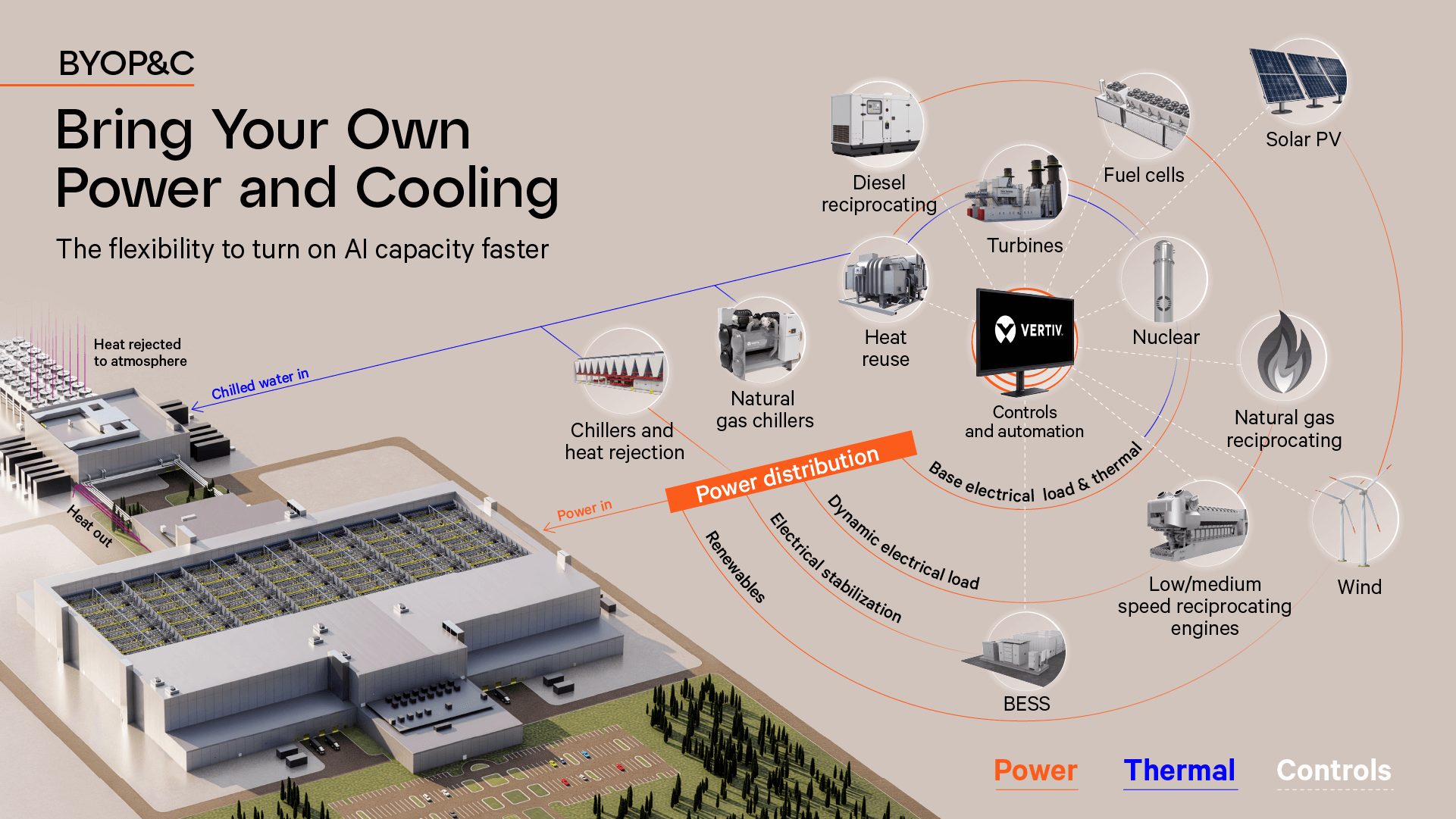
Figure 1. Power generation technology landscape for 3–10+ megawatt (MW) facilities with integrated power and cooling. Integration reduces redundant systems and captures usable heat, improving energy utilization, and tightening PUE. Source: Vertiv.
Bring Your Own Power and Cooling (BYOP&C) applies that principle by engineering generation and cooling together so energy does double duty: first as conditioned power, then as usable thermal capacity. Waste heat can drive absorption cooling, reducing reliance on electric chillers and lowering auxiliary load. Coordinated electrical and thermal flows stabilize inlet temperatures and help improve power usage effectiveness (PUE), a measure of total facility energy relative to IT load, by reducing unnecessary conversions. The practical result: more of the energy brought on site ends up doing useful work.
Making efficiency last
Design sets the efficiency baseline; operations help determine how long it lasts. Over time, systems may drift. Equipment must work harder to deliver the same output, and energy use rises quietly in the background. Replacing existing systems is rarely realistic, so performance has to be protected within the infrastructure already in place.
Preventive maintenance aims to bring systems back to their intended operating ranges before small deviations become standard practice. AI-enabled monitoring (see Video 1) adds continuous visibility into power use, load behavior, temperature trends, and component health. When equipment begins to draw more energy than it should, operators can act early, before incremental losses compound. Together, maintenance and monitoring turn energy efficiency from a design goal into a defined, actively managed part of daily operations.
Video 1. Vertiv™ Next Predict brings AI-enabled monitoring to life — detecting anomalies early, before incremental losses compound.
Inside a telecommunications collaboration achieving 20% energy savings
Vertiv’s expanded collaboration with one of the major telecommunications operators in Spain includes maintenance and monitoring services to support energy efficiency. The agreement builds on a 2018 pilot at a core network site in Madrid that achieved an average 20% reduction in total energy consumption.
Each site begins with a technical assessment that defines a targeted optimization plan with projected savings. As the program expands across Spain, it targets roughly 45 gigawatt-hours (GWh) in annual energy savings.
Engineering energy for scale
Energy efficiency also determines how far existing infrastructure can stretch before new capacity is required. Integrating power and cooling captures structural gains; maintenance and optimization services preserve them under real-world load. Architecture and operations together make efficiency a measurable, controllable outcome, not an assumption. As digital demand accelerates, long-term growth may depend on how deliberately energy is engineered, managed, and put to work.
Learn how to power AI efficiently
Explore the Vertiv™ AI Hub to see how AI is reshaping data centers with reference designs, efficiency strategies, and real‑world solutions you can apply today.