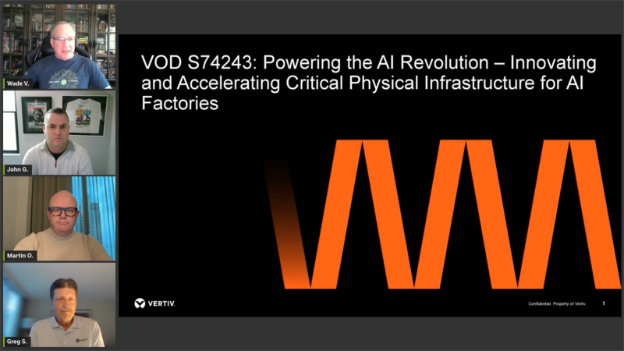
NVIDIA GTC 2025: Bold solutions are required to transform established approaches to data center design to support the next wave of AI factories.
As AI workloads grow in scale, complexity, and intensity, the demand for high-density, scalable, and rapidly deployable power and cooling infrastructure has never been greater. But challenges like power availability, permitting delays, infrastructure densification, and the need for dynamic, AI-specific solutions threaten to slow progress.
Experts from Vertiv, NVIDIA and Prometheus Hyperscale addressed how the next wave of AI factories will require new approaches to data center design during a session at NVIDIA GTC 2025 in San Jose, California.
Greg Stover, Business Development Director, Vertiv : Can you talk about densification and scaling and what we’re seeing at Vertiv?
Martin Olsen, VP of Global Product Strategy, Vertiv:
“Historically, power distribution, cooling, structural support, have all been designed around predictable incremental increases in compute density. Now, with accelerated workloads, that just drives this compute density at an unprecedented pace. It’s almost like densification times scale squared. Racks are jumping from 20-25 kW to 80-130 kW, outpacing traditional siloed MEP systems. You probably want to start looking more at the prefabrication side of it, pulling more of that fieldwork into a factory setting where you drive a lot more repeatability. Modularity, like Vertiv’s AI Hub designs, balances speed, customization, and quality as timelines shrink."
Greg: Talk about some of NVIDIA’s technologies that are driving changes in digital infrastructure.
Wade Vincent, Chief Data Center Distinguished Engineer, NVIDIA:
“The intercommunication between GPUs is important. That dramatic improvement in performance per watt and performance per dollar is only true if you can keep that in the copper interconnect; keeping that all in one rack is driving the critical need. What we used to call a data center really is an AI factory. Together, we want to adopt this infrastructure so that we can go from putting a 10-megawatt site for seven megawatts into the IT to eight, nine and a half, even reuse the waste heat. This IT-facility symbiosis is essential as power and cooling demands escalate.”
Greg: You recently have been involved in designing a project, I believe, at Texas A&M University. What were some of the early obstacles you encountered in that process?
John Gross, CTO, Prometheus Hyperscale:
“We’re in an arms race right now. It’s “how fast can we get this stuff online?” At Texas A&M, turning a former commissary into an H200 cluster data hall, we hit snags: We can’t get the utility power in time. So, we’re now going through a temporary scenario where we have to bring temporary power online until we can get the utility transformer in place. The thing we have to be careful about as an industry is that we don’t use the speed-to-market mentality as a means to end up developing regrettable assets. Speed is critical, but collaboration and planning prevent inflexible designs or stranded capacity."
Greg: What’s the key message or takeaway for data center professionals in 2025?
Wade Vincent, NVIDIA:
“Together we want to adopt this infrastructure so that without changing out the 15-year infrastructure, we can go from putting a 10-megawatt site for seven megawatts into the IT to eight, nine and a half, try to make use of it and even reuse the waste heat. From a modularity perspective, as the IT is evolving, we’re going to find more and more of that becoming symbiotic together going forward.”
John Gross, Prometheus Hyperscale:
“The thing we have to be careful about as an industry is that we don’t use the speed-to-market mentality as a means to end up developing regrettable assets. The responsible deployment strategy can deploy flexible infrastructure as fast as you can.”
Martin Olsen, Vertiv:
“It’s really important to look at these, the power and cooling together as one along the controls and the software around it. It needs to operate as one unit of compute and that’s how we want to think about it. We’ve tried here at Vertiv to provide as much help as possible through our AI Hub, where we have reference designs developed with NVIDIA and our customers together.”
Watch the full Powering the AI Revolution discussion
To dive deeper into the strategies shaping AI factories—from NVIDIA’s densification drivers to Vertiv’s modular solutions and real-world deployment lessons—watch the full Powering the AI Revolution discussion.